2026高考英语新课标II卷|试卷真题深度解读
- 2026-09-24 23:15:00

新课标II卷适用地区 |
海南、辽宁、重庆、黑龙江、吉林、云南、山西、广西、贵州、甘肃、新疆、西藏、内蒙古、四川、陕西、青海、宁夏 |
2026年高考已尘埃落定,英语试卷的育人导向与素养立意愈发鲜明。《学英语》报社迅速组织教研团队对试卷展开系统深入的研析,力求为一线教学提供及时、专业的反馈。
本次研析紧扣2025版新课标“核心素养”理念,从三个维度层层推进:“试卷障碍词汇汇总”系统梳理障碍词与课标词的对应关系,呈现真实语言障碍;“语篇导航”从主题、语篇、核心素养指向三个角度,揭示命题的选材依据与考查指向;“真题解读”则从主旨概要、文化意义、重难点语块、长难句分析及逐题详解入手,深入文本肌理,还原考查重点与思维要求。三者相互呼应,从词汇到篇章再到思维,立体呈现素养考查的全貌。
我们期望这份分析:成为一面镜子,照见命题趋势;成为一座桥梁,连通课标、考题与课堂;成为一份参照,指引师生在素养导向的教改深水区中辨明航向。
《学英语》愿与广大师生并肩,以专业回应变革,以深耕致敬教育。
新课标II卷障碍词汇汇总 | ||||||||||||||||||||||||||||||||||||||||||||||||
|
语篇导航 | ||||||||||||||||||||||||||||||||||||||||
|
真题解读 (听力部分略)

阅读理解
A
原题
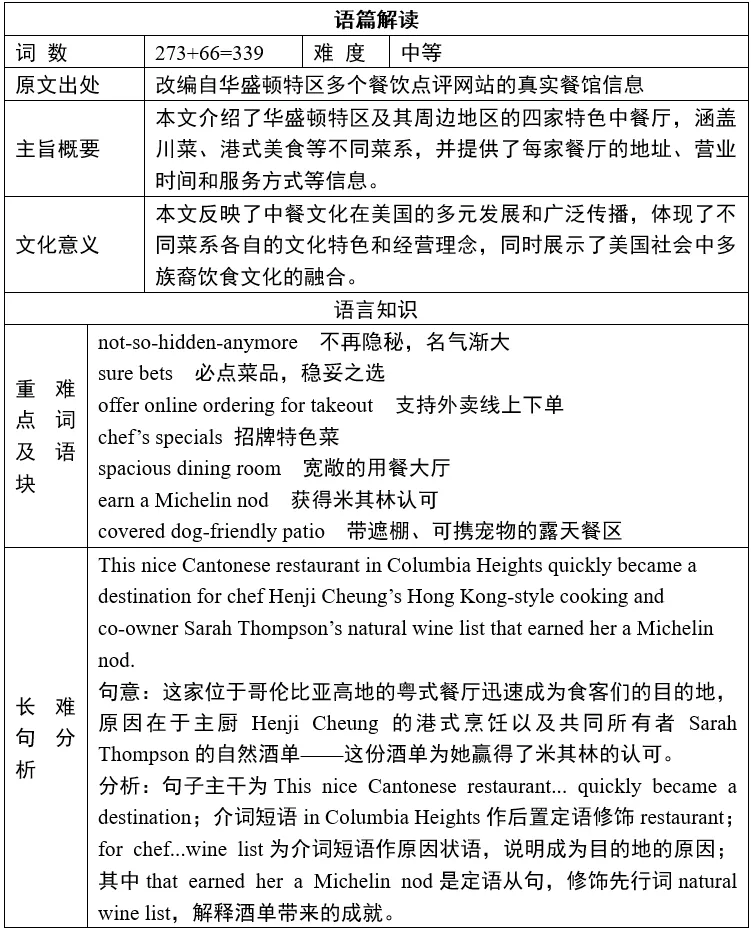
The Best Chinese Restaurants Around D.C.
The D.C. area is home to many outstanding Chinese restaurants, but diners willing to travel outside the city limits will also be rewarded.
Panda Gourmet
This not-so-hidden-anymore fine restaurant for Sichuan cuisine is inside the Days Inn off New York Avenue. Dandan noodles and mapo tofu are sure bets. Panda Gourmet offers online ordering for takeout, and delivery is now an option. Open from 11:00 am to 9:45 pm. Closed on Tuesday.
2700 New York Ave NE, Washington, DC 20002
Shanghai Taste
Shanghai Taste offers arguably the best soup dumplings in the area. It also serves a variety of chef’s specials, beef with rice cakes, and more. The restaurant is open from 11:00 am to 9:00 pm Tuesday through Sunday, offering call-in orders and pickups.
1121 Nelson St, Rockville, MD 20850
Gourmet Inspirations
The spacious dining room is regularly filled with customers enjoying dumplings and a variety of noodle and rice dishes. Customers can also place pickup orders online for lunch or dinner until 8:00 pm six days a week. Closed on Tuesday.
2646 University Blvd W, Silver Spring, MD 20902
Queen’s English
This nice Cantonese restaurant in Columbia Heights quickly became a destination for chef Henji Cheung’s Hong Kong-style cooking and co-owner Sarah Thompson’s natural wine list that earned her a Michelin nod. Reserve a spot indoors, at its chef’s counter, or covered dog-friendly patio (露台), with creative wine tastings in the mix. Dinner hours: Tuesday through Thursday 5:30 pm-9:00 pm (last seating); Friday and Saturday 5:00 pm-9:30 pm (last seating). Closed on Sunday and Monday.
3410 11th St NW, Washington, DC 20010
21. What service is available only at Panda Gourmet?
A. Call-in orders.B. Free packing C. Takeout delivery. D. Online pickup orders.
22. Which restaurant can you go to for beef with rice cakes?
A. Panda Gourmet.B. Shanghai Taste.C. Gourmet Inspirations.D. Queen’s English.
23. What do we know about the Cantonese restaurant in Columbia Heights?
A. It is open only on weekdays.B. It adopts a no-pet policy.C. It takes no reservations.D. It serves only dinner.
答案及详细解析
21. C。细节理解题。考查信息定位与比较筛选能力。
解析:根据Panda Gourmet部分Panda Gourmet offers online ordering for takeout, and delivery is now an option可知,该餐厅提供外卖配送服务;对照其他三家餐厅:Shanghai Taste为call-in orders and pickups,Gourmet Inspirations为pickup orders online,Queen’s English未提及外卖相关服务,可见takeout delivery仅Panda Gourmet提供。
22. B。细节理解题。考查信息定位与关键词匹配能力。
解析:根据Shanghai Taste部分It also serves a variety of chef’s specials, beef with rice cakes, and more可知,beef with rice cakes出现在该餐厅菜单中。
23. D。细节理解题。考查信息定位与细节辨析能力。
解析:根据Queen’s English部分,餐厅明确标注Dinner hours,且只给出了晚餐时间(周二至周六晚),未提供任何午餐或早餐服务,因此serves only dinner符合原文。而其他选项均与文中信息矛盾:餐厅允许携带宠物(dog-friendly)、可以预订(Reserve a spot)、并且周六也营业,故A、B、C均错误。
B
原题
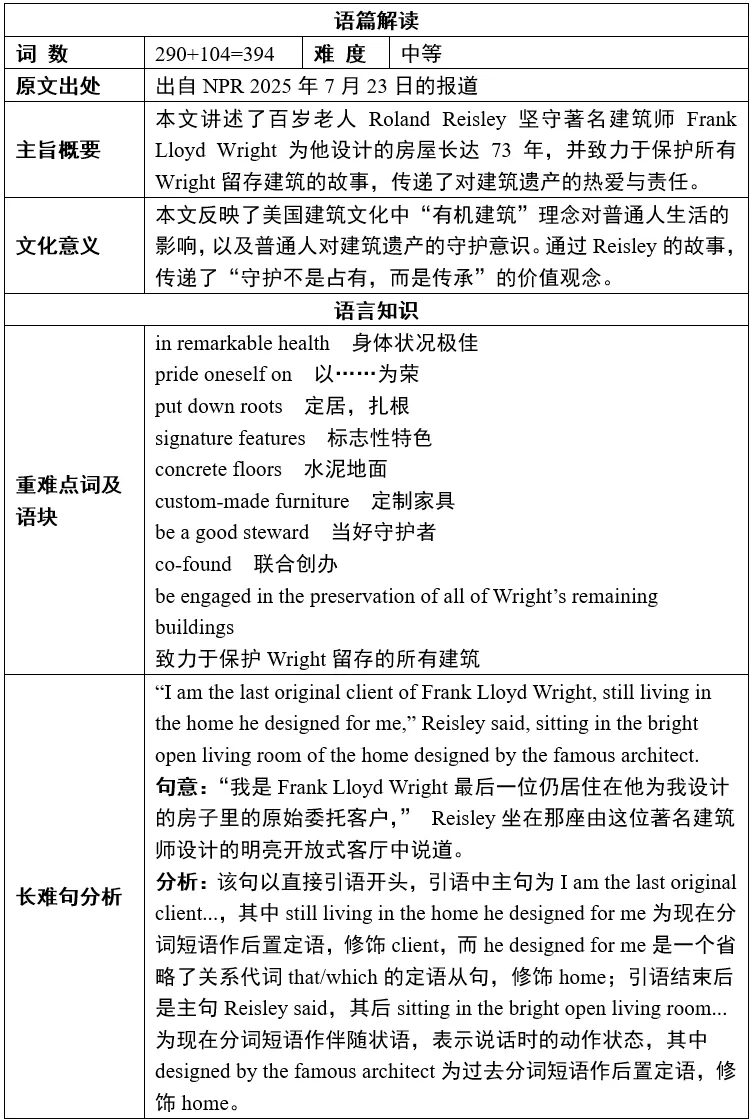
Roland Reisley turned 101 years old in May and is in remarkable health. But that’s not the thing he prides himself on. “I am the last original client of Frank Lloyd Wright, still living in the home he designed for me,” Reisley said, sitting in the bright open living room of the home designed by the famous architect.
The house where Reisley has lived for 73 years is located in the woods of Westchester County, New York, just 30 miles north of Manhattan. It’s one of 47 that make up the peaceful mid-20th-century modern village of Usonia.
Back in 1951, Reisley was just 26, newly married and ready to put down roots. He and his wife began looking for a place in Manhattan. But what they liked, they couldn’t afford on his sound engineer’s salary and what they could, they didn’t like. Then they heard about Usonia. On their first trip out, they were greeted with such enthusiasm from the 10 families who’d already established homes there that they decided to join.
The house has signature Wright features. It is made with local materials, has a flat roof, wood paneling, concrete floors and custom-made furniture. Over the decades, Reisley has opened his doors to visitors. The house is now listed on the National Register of Historic Places. Reisley said he’s tried his best to be a good steward (管家) not just of the Wright creation he lives in, but all others as well. He co-founded the Frank Lloyd Wright Building Conservancy, an organization engaged in the preservation of all of Wright’s remaining buildings. Reisley believes that his devotion to the home and the community are what have kept him in such good health all of these years.
24. How does Reisley feel about having Wright as his house designer?
A. Honored. B. Amused.C. Stressed. D. Inspired.
25. What made Reisley finally decide to settle down in Usonia?
A. Its natural environment.B. Its large-sized houses.C. The convenience of its location. D. The warmth of its residents.
26. What can we learn about Reisley’s house?
A. It is older than its owner. B. It uses local materials C. It has a pointed roof.D. It is put up for sale.
27. What can be inferred about Reisley from the last paragraph?
A. He is very attached to Wright buildings.B. He is devoted to health education.C. He is an expert in home decoration.D. He is passionate about tourism.
答案及详细解析
24. A。推理判断题。考查信息定位与情感态度推断能力。
解析:第一段中,Reisley坐在由Wright设计的家中说道:“我是Frank Lloyd Wright最后一位仍居住在他为我设计的房子里的原始委托客户。”在文章末尾,他进一步表达了对这所房屋及所在社区的深厚情感。综合来看,能够由Wright亲自为自己设计居所,并在此度过漫长岁月,对他而言无疑是一件深感荣幸的事。
25. D。细节理解题。考查信息定位与因果推断能力。
解析:根据第三段On their first trip out, they were greeted with such enthusiasm from the 10 families who’d already established homes there that they decided to join可知,已入驻家庭的热情欢迎使他们最终决定定居Usonia,即居民的热情温暖发挥了关键作用。
26. B。细节理解题。考查信息定位与特征识别能力。
解析:根据第四段It is made with local materials…可知,Reisley的房屋使用当地材料建造。
27. A。推理判断题。考查信息整合与合理推断能力。
解析:最后一段提到Reisley不仅悉心守护自己居住的Wright作品,还联合创办了Wright建筑保护组织,致力于保护所有Wright留存建筑,由此可推断他对Wright建筑有深厚的情感依恋。
C
原题
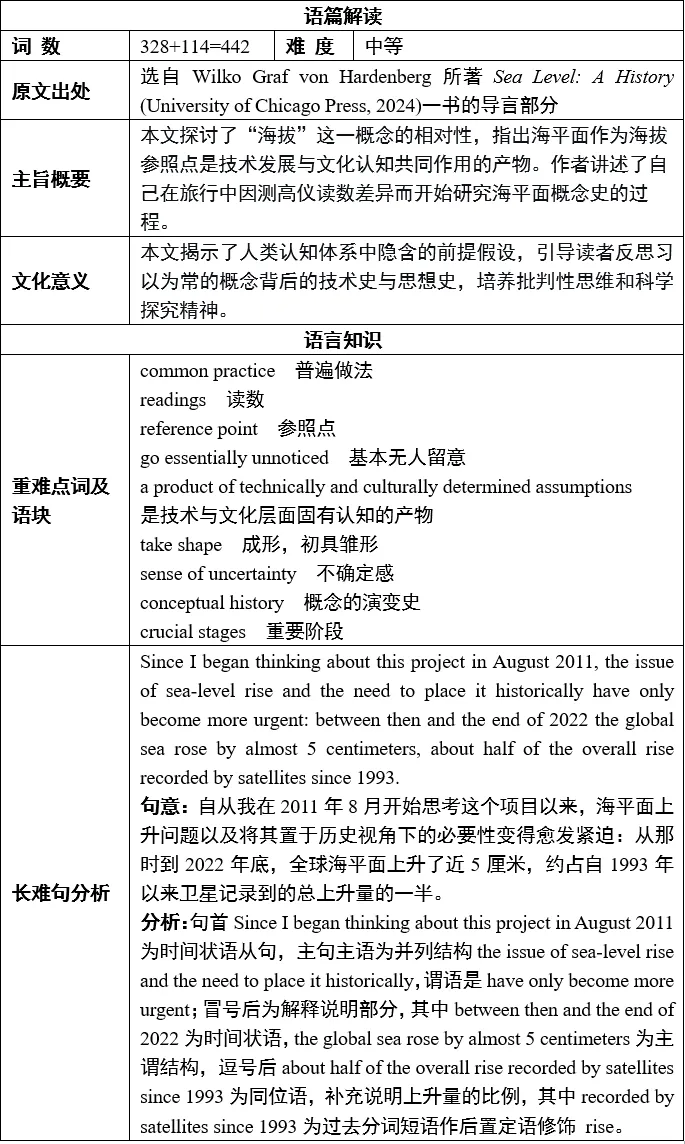
The peak of Mount Qomolangma, 8,849 meters above sea level. Chimborazo, 6,263 m; Mont Blanc, 4,806 m; Pradidali hut, at the foot of the Pala group in the Dolomites, 2,278 m. It is common practice to provide the elevation (高度) of a place. Simple readings are now readily available on our phones and wearables. But elevation is necessarily relative: only the choice of a reference point allows us to express numerically the height of an object or a location.
The idea of sea level as a reference point for elevations has by now been around for so long as to go essentially unnoticed — we mention it without even considering what it means. That the concept has a history is easily ignored. We tend to forget that sea level is a product of technically and culturally determined assumptions. In this book I tell a story of these assumptions.
Appropriately, the book took shape during a summer spent between sea and mountains. A month after visiting the French Riviera and enjoying the sandy beaches of Nice and Menton, I went hiking with friends in the Pala group. Resting on a pass near the Pradidali hut, we began discussing the readings offered by our altimeters (测高仪). Why did they vary ever so slightly from one instrument to the next? This sense of uncertainty led me to think about the meaning of zero. This is how I began my search for the conceptual history of sea level.
In this book I examine three crucial stages in the history of mean sea level. These stages mirror the development of human conceptions of the sea. Since I began thinking about this project in August 2011,the issue of sea-level rise and the need to place it historically have only become more urgent: between then and the end of 2022 the global sea rose by almost 5 centimeters, about half of the overall rise recorded by satellites since 1993.
28. What does the author point out at the beginning of the text?
A. Some mountains are getting higher.B. Data on wearables are misleading.C. The concept of elevation is relative.D. The reference point is hard to locate.
29. What is paragraph 3 mainly about?
A. How the altimeter was invented.B. What initiated the author’s research.C. Why the digital readings varied.D. Where the author spent his holiday.
30. What does the underlined word “it” refer to in the last paragraph?
A. The book.B. The project.C. The issue.D. The development.
31. What can be the title of the book mentioned in the text?
A. The Altimeter: A Must-HaveB. Sea Level: A HistoryC. Meaning of Zero: Nothing or EverythingD. Mountains to Seas: Ups and Downs
答案及详细解析
28. C。细节理解题。考查信息定位、句意理解能力
解析:根据第一段最后一句But elevation is necessarily relative: only the choice of a reference point allows us to express numerically the height of an object or a location可知,作者在文章开头明确指出海拔高度是相对的,必须依赖参考点才能量化表达。
29. B。段落主旨题。考查归纳段落大意的能力。
解析:第三段讲述了作者在夏季旅行中,先去了法国里维埃拉,之后去帕拉群山区徒步。在普拉迪达利小屋附近休息时,他和朋友们发现不同测高仪的读数略有差异,这一不确定性引发了他对“零点”意义的思考,从而开启了他对海平面概念历史的研究。因此本段主要讲的是作者研究的起因,即B项。
30. C。词义猜测题。考查结合上下文理解代词指代的能力。
解析:最后一段中画线词it所在句为the issue of sea-level rise and the need to place it historically。这里的it指代前文提到的the issue of sea-level rise中的issue,即“海平面上升这一议题”。
31. B。推理判断题。考查归纳书名、理解全书主旨的能力。
解析:文章第二段末尾作者说In this book I tell a story of these assumptions,第三段末尾说…I began my search for the conceptual history of sea level,第四段开头说In this book I examine three crucial stages in the history of mean sea level。全书围绕“海平面的历史”展开,因此最合适的书名是《海平面:一部历史》(Sea Level: A History)。
D
原题
The Barcelona subway pulls into the station, the doors slide open and passengers pour out to go about their daily business. Little do they know that as they do so, a burst of energy is sent up to street level to help charge an electric car.
Barcelona has put together a package of clean energy technologies to help public transportation go greener, while also doing its part to tackle climate change and aid Europe’s difficult shift to the privately owned electric vehicle market.
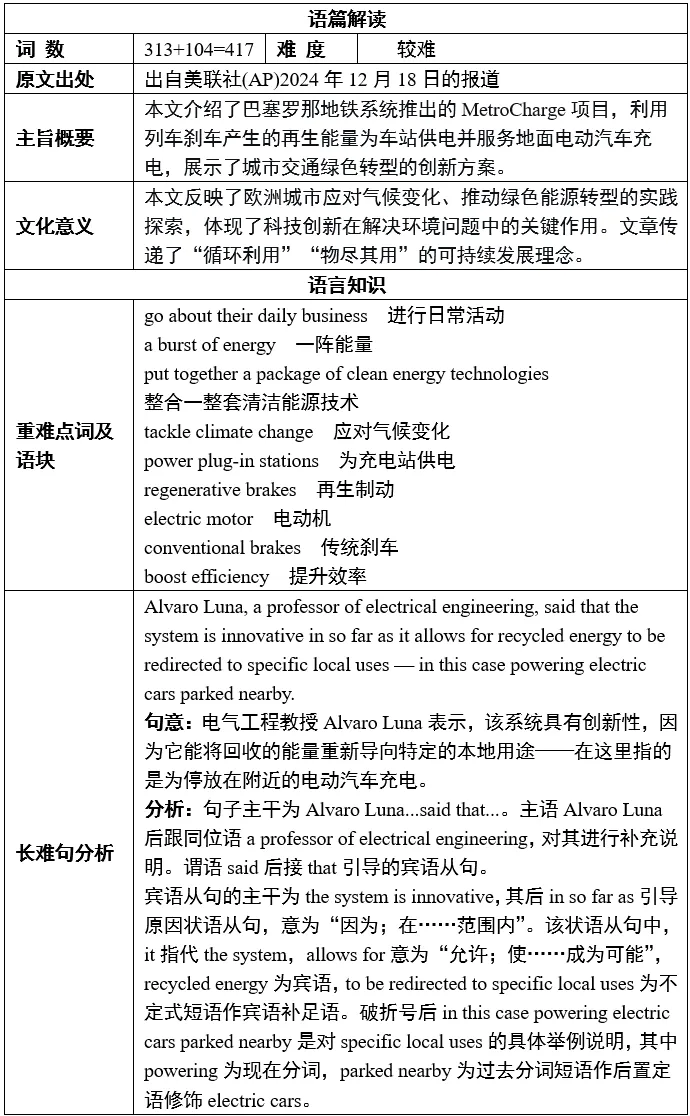
Sixteen stations of Barcelona’s subway system are part of its new MetroCharge project, whereby the energy from the underground trains’ brakes (刹车) is used to power the trains and the stations themselves, while the remainder is sent snaking through cables (电缆) to the surface to power plug-in stations for privately owned vehicles.
Bernardo Espinoza, an engineer who takes the subway every day, owns an electric car. “I am pleasantly surprised, because I am always looking for where to plug it in,” Espinoza said before catching the subway in a working-class area of southern Barcelona. “And if it is from energy from the trains’ brakes, then even better.”
Regenerative brakes have been in trains for decades and are also used in some cars. They consist of an electric motor which collects energy used in the braking action that would be lost as heat by conventional brakes. That energy can be immediately used to accelerate (加速) the vehicle or, in the case of the Barcelona subway system, sent along cables to supply electricity for the station or for electric car chargers.
Alvaro Luna, a professor of electrical engineering, said that the system is innovative in so far as it allows for recycled energy to be redirected to specific local uses — in this case powering electric cars parked nearby. That, he said, boosts efficiency.
32. Why does Barcelona launch the MetroCharge project?
A. To fuel the city’s economy. B. To enhance passengers’ experience.C. To promote green transportation.D. To raise the quality of electric cars.
33. What is Espinoza’s concern?
A. How to cut his travel expenses.B. Where to get a parking space.C. How to avoid rush-hour traffic.D. Where to find a charging point.
34. What aspect of regenerative brakes is discussed in paragraph 5?
A. Their operating conditions.B. Their conventional standard.C. Their potential risks.D. Their working mechanism.
35. What did Luna say about the system?
A. It uses reclaimed energy creatively.B. It improves workers’ efficiency. C. It prioritizes the safety of trains.D. It generates jobs for the locals.
答案及详细解析
32. C。推理判断题。考查信息定位与目的推断能力。
解析:根据第二段Barcelona has put together a package of clean energy technologies to help public transportation go greener, while also doing its part to tackle climate change…可知,该项目的核心目的是推动绿色交通、应对气候变化。
33. D。细节理解题。考查信息定位与理解能力。
解析:根据第四段Espinoza所说I am always looking for where to plug it in可知,他的电动车充电不便,他的担忧与“找到充电点”有关。
34. D。主旨理解题。考查段落信息归纳能力。
解析:第五段解释了再生制动的工作原理:电动机收集刹车过程中原本会被传统刹车以热量形式损耗的能量,这些能量可立即用于加速车辆或被传输到车站或充电桩供电。因此该段讨论的是它们的工作机制。
35. A。细节理解题。考查信息定位与观点理解能力。
解析:根据第六段Luna的评价the system is innovative in so far as it allows for recycled energy to be redirected to specific local uses — in this case powering electric cars parked nearby可知,该系统的创新之处在于将回收能量重新定向到具体的本地用途。

阅读填空
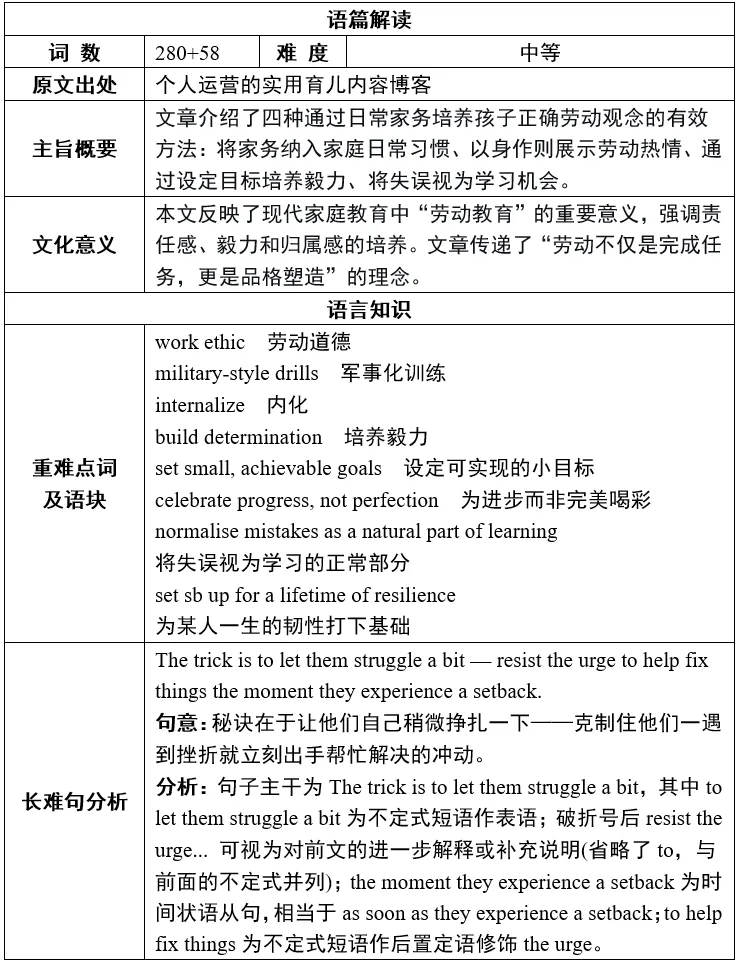
原题
Ways to Teach Kids Work Ethic Early
Ever watched your child try to get out of doing housework by making excuses? If only the effort they put into avoiding responsibility could be redirected into, well, actual responsibility. In fact, building work ethic (道德) in kids doesn’t require military-style drills. Here are four simple and practical ways.
·Make housework part of the family routine.
Involve your child in the daily running of the house: tidying toys, feeding the dog, watering the plants. 36 When the tasks become as routine as brushing teeth, kids internalise that helping with housework is simply part of life.
· 37
You can’t expect your child to tackle their tasks with enthusiasm while you’re complaining about loading the dishwasher. If your child sees you enjoying your work and taking pride in a job well done, they’re far more likely to do the same.
·Build determination through goals.
38 Sometimes you have to help them find their “thing.” Set small, achievable goals together with them and celebrate progress, not perfection. The trick is to let them struggle a bit — resist the urge to help fix things the moment they experience a setback.
·Treat mistakes as opportunities.
Few things strike fear into a child’s heart like the prospect of failing. The best way is to normalise mistakes as a natural part of learning. When kids mess up, don’t jump in with a rescue mission. 39
Teaching kids work ethic is to gently and consistently push them toward responsibility, determination, and pride in their efforts. 40 No worry. Those habits you’re building now are setting your child up for a lifetime of resilience (韧性) and satisfaction.
A. The key is consistency.B. Help kids develop analytical skills.C. Model the work ethic you want to see.D. Instead, encourage them to do differently next time.E. Sometimes, a cleaner living room is the best reward.F. Progress can be slow, and you’ll wonder if it’s all sinking in.G. Not every child is born with the willpower of a marathon runner.
答案及详细解析
36. A。该空位于第一个小标题Make housework part of the family routine之下。前文列举了让孩子参与日常家务(整理玩具、喂狗、浇花等),后文指出当这些任务像刷牙一样成为常规时,孩子会内化“做家务是生活的一部分”的观念。空处应强调让家务成为习惯的关键因素。A选项“关键在于坚持”中的consistency与后文的as routine as形成呼应,起到承上启下的作用。
37. C。该空为第二个小标题,需概括本段主旨。本段内容指出:你不能一边抱怨洗碗一边期待孩子热情地做家务,如果孩子看到你享受工作并引以为傲,他们也会效仿。可见本段强调父母的榜样作用。C选项“示范你希望看到的工作道德”中的Model精准概括了以身作则的含义,与下文描述的父母行为直接影响孩子形成对照。
38. G。该空位于第三个小标题Build determination through goals之下,其后文说“有时候你得帮他们找到他们的‘兴趣所在’”。空处应解释为什么需要帮助——因为并非每个孩子天生就具备毅力。G选项“并非每个孩子天生就拥有马拉松选手般的毅力”中的Not every child is born with与后文的Sometimes you have to help形成因果关系,逻辑顺畅。
39. D。该空位于第四个小标题Treat mistakes as opportunities之下。前文说当孩子搞砸时,不要急着去解救,后文需要给出正确的做法。D选项“相反,鼓励他们下次做得不一样”中的Instead与前面的don’t jump in构成转折对比,具体说明如何对待错误,使建议完整。
40. F。该空位于最后一段。前文说培养孩子的工作道德需要温和且持续地推动,后文说“别担心,你现在建立的这些习惯会让孩子受益终生”。空处应承接前文,承认培养过程可能会有困难或疑虑,再引出安慰。F选项“进步可能很慢,你会怀疑这些是否真的被吸收了”中的Progress can be slow与后文的No worry形成让步转折,而wonder if it’s all sinking in自然引出了对效果的担忧,后文给予宽慰,衔接自然。

完形填空
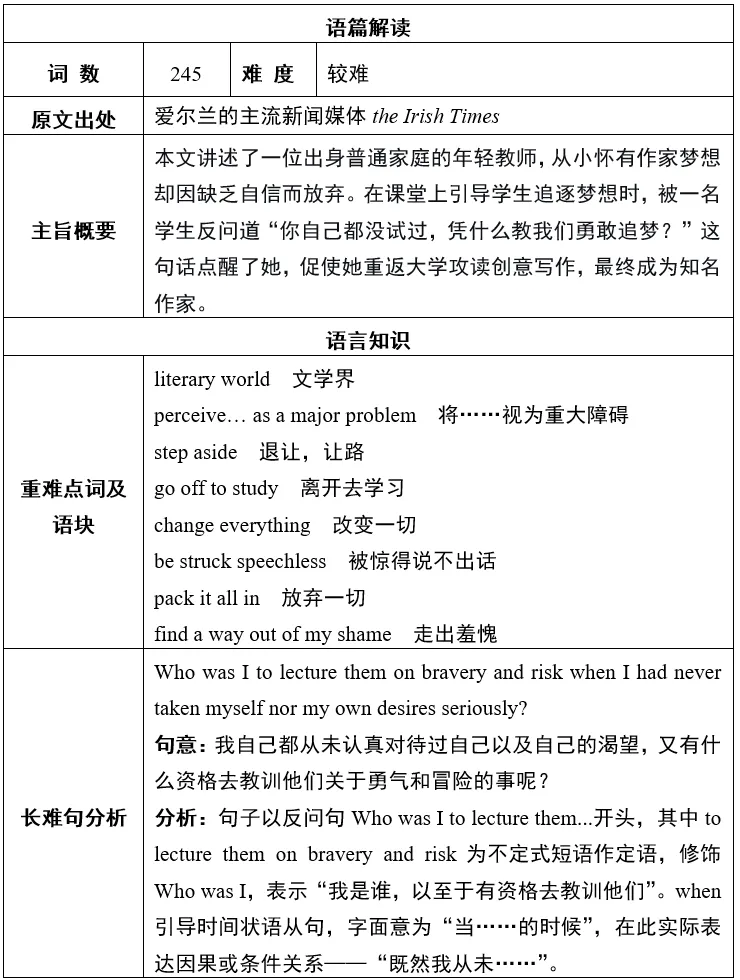
考点分析
考点类别 | 题号 | 数量 |
名词 | 42, 45, 46, 52, 53, 54 | 6 |
动词 | 44, 47, 49, 51, 55 | 5 |
动词短语 | 43 | 1 |
形容词 | 41, 48, 50 | 3 |
原题
I never thought I could be a writer. I didn’t come from a family connected to the 41 world, which I perceived as a major 42 . After my undergraduate degree, convinced that writing wasn’t for me, I 43 to study teaching.
Then came an afternoon that 44 everything. I was teaching poetry, encouraging students to write about their 45 . And then, at the end of the lesson, one child asked me a question: “Have you always wanted to be a 46 , Miss?” I explained that when I was his age, I actually wanted to be a writer, but I didn’t think I quite had what it 47 . The boy replied with a 48 look, “Well, you are telling us to live our dreams when you haven’t even done it yourself. Have you even 49 ?”
I was struck speechless — he was 50 . Who was I to 51 them on bravery and risk when I had never taken myself nor my own 52 seriously?
On the basis of that 53 , I applied to go back to university and study creative writing. There were times when I found myself wondering if I should pack it all in, but the boy’s words kept ringing in my ears. I knew I needed nothing else to succeed but a bit of 54 and hard work. I 55 to find a way out of my shame and into a pattern of work that I loved.
41. A. medicalB. artisticC. scientificD. literary
42. A. subjectB. problemC. eventD. breakthrough
43. A. stepped asideB. got upC. went offD. turned back
44. A. changedB. ruinedC. revealedD. interrupted
45. A. hobbiesB. familiesC. dreamsD. lessons
46. A. writerB. teacherC. reporterD. publisher
47. A. keptB. leftC. heldD. took
48. A. satisfiedB. guiltyC. gratefulD. disapproving
49. A. triedB. noticedC. askedD. waited
50. A. rudeB. rightC. shyD. silent
51. A. examineB. congratulateC. lectureD. consult
52. A. valuesB. imaginationC. inspirationD. desires
53. A. cooperationB. conversationC. administrationD. explanation
54. A. self-beliefB. know-howC. brainstormingD. teamwork
55. A. rememberedB. agreedC. managedD. hesitated
答案及详细解析
41. D。根据空前的I didn’t come from a family connected to the以及后文作者一直想成为作家却认为自己不够格可知,作者认为自己的家庭与“文学”世界无关。literary (文学的)与“作家”直接对应。
42. B。空前的which I perceived as a major指代“家庭与文学世界无联系”这一事实,作者将其视为自己写作道路上的一大“问题”或障碍。problem传达出消极、无奈的自我否定情绪。
43. C。作者在本科毕业后,“确信写作不适合自己”,于是“转而”去学习教学。went off在此处意为“离开(原方向)去做另一件事”,体现职业方向的变化。
44. A。那个下午发生的事彻底“改变”了作者的人生轨迹——从逃避写作到被学生质问并最终重返校园。下文作者申请回大学学习创意写作,说明这是一次积极的转折。
45. C。作者当时在教诗歌,鼓励学生写的内容应与后文学生反问中的live our dreams形成呼应。dreams (梦想)贯穿全文,学生后来质问“你自己都没追逐梦想,凭什么让我们追梦”,证明作者当时让学生写的正是“梦想”。
46. B。因为学生看到老师正在教书,自然而然会好奇老师是否从小就想从事这个职业。而后文作者回答“我小时候其实想当作家”也呼应了孩子的问题,形成了对比与冲突,从而引出了孩子接下来的质问。
47. D。固定习语have what it takes意为“具备成功所需的条件、能力”。作者认为自己不具备成为作家的条件。
48. D。学生在听完作者“我认为自己不够格”的解释后,用反问句尖锐地批评作者言行不一,其表情应是“不赞同的”。disapproving准确传递出质疑、批评的态度。
49. A。学生的核心质问是:你自己连“尝试”都没有尝试过,凭什么让我们追逐梦想? tried呼应前文作者只是“认为”自己不行,却没有付出实际行动。
50. B。作者被质问得哑口无言,内心承认学生说得“对”。
51. C。固定搭配lecture sb. on sth.意为“就某事教训/说教某人”。作者反问自己有何资格对学生“说教”勇敢和冒险。
52. D。作者从未认真对待的是自己内心的“渴望”——成为作家的梦想。desires 直接对应前文的dreams和wanted to be a writer。
53. B。推动作者改变人生的是那次师生之间的“对话”。
54. A。作者领悟到:成功所需的不是天赋或外部资源,而是一点“自信”。self-belief与全文“缺乏自信”的自我否定形成直接对比。
55. C。作者最终“设法”找到了摆脱羞愧、投入热爱工作的途径。managed to do强调克服困难后的成功,与前文作者下定决心、付诸行动的过程一致。

语法填空
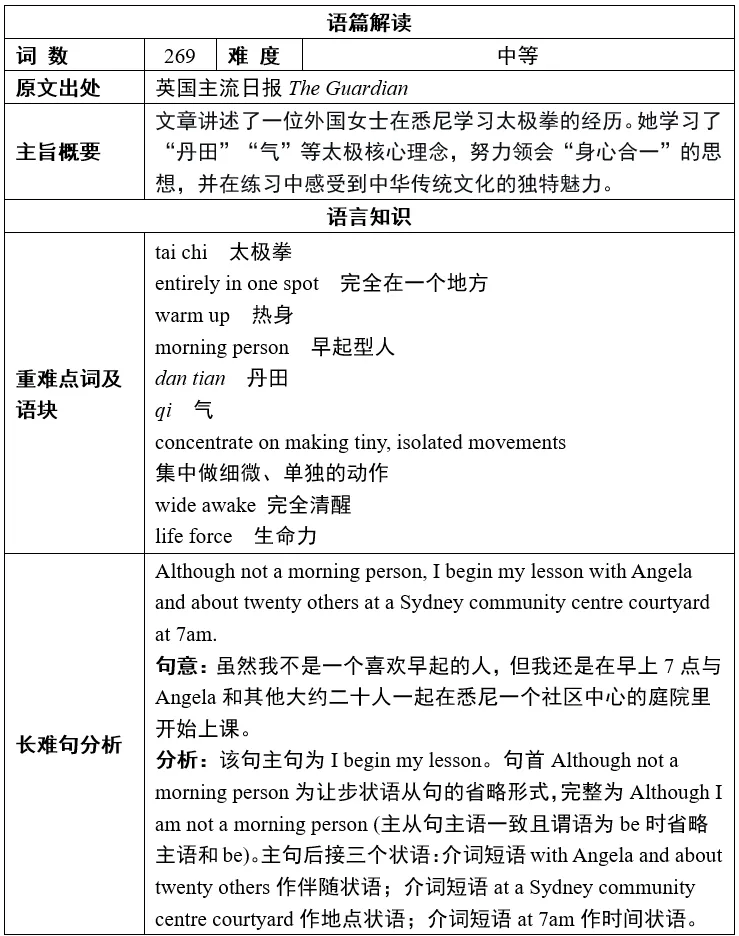
原题
My first time doing tai chi
For the first 15 minutes of my tai chi (太极) class, we remain 56 (entire) in one spot to warm up. Angela, a tai chi 57 (instruct) with twenty-eight years of experience, says that a successful hour of tai chi is an hour with no negative thoughts. “Your mind 58 body go together. That’s all that matters.”
Although not a morning person, I begin my lesson with Angela and about twenty others at a Sydney community centre courtyard at 7am. “Put your 59 (foot) parallel (平行), and use your dan tian to hold up your body,” she says.
In tai chi, the dan tian is your qi core, and qi in Chinese means life force. Now I 60 (suppose) to feel the weight on my legs and sink my dan tian.
We move on to tai chi positions, of 61 there are forty-two in the style that Angela teaches. Today, we will only be doing the first nine. The movements have 62 (describe) names like “holding the bowl” and “grabbing the bird’s tail”.
During most of the class, we follow Angela and concentrate on making tiny, isolated (单独) movements. Then, Angela gets us to try the nine movements on our own. I keep my eyes 63 a woman to my right and try to copy her movements, but unfortunately I soon lose focus.
At the end of the lesson, I feel wide awake, despite it still 64 (be) early at 8 am. It’s time for my dan tian65 (meet) another life force: coffee.
答案及详细解析
56. entirely。 此处考查词形转换。entire需变为副词entirely作状语修饰介词短语in one spot,表示“完全地在一个地方”。句意:头15分钟我们完全在一个地方热身。
57. instructor。此处考查名词。Angela是“太极教练”,instruct的名词形式为instructor。
58. and。此处考查连词。“身心合一”要求mind和body共同协作,二者为并列关系。Your mind and body go together表示思想和身体共同协调运作。故填and。
59. feet。此处考查名词复数。put your ___ (foot) parallel指双脚平行站立,foot需用复数形式feet。
60. am supposed。此处考查动词被动结构。be supposed to do sth意为“应该做某事”。主语为I,故填am supposed。
61. which。此处考查定语从句关系词。of ___ there are forty-two中,先行词为positions,在“of+关系代词”结构中,指物时用which。该从句意为“在Angela教的这套拳法中,共有42个招式”。
62. descriptive。此处考查词形转换。describe需变为形容词descriptive修饰名词names,意为“描述性的名称”。
63. on。此处考查介词搭配。固定短语keep one’s eyes on sb/sth意为“注视着······”。故填on。
64. being。此处考查非谓语动词。despite为介词,后接名词或动名词。it still being early为“despite+名词独立主格”结构,being为动名词形式。故填being。
65. to meet。此处考查非谓语动词。句型It’s time for sth to do…中,不定式作定语修饰sth。dan tian作逻辑主语,to meet作不定式短语,意为“丹田该去会见另一股生命能量了”。故填to meet。

写作
第一节
原题
假定你是李华,外教Kate计划将你们班的英语作文汇编成册。请给Kate写封邮件,内容包括:
(1) 建议配图。
(2) 自荐承担画图工作。
注意:
(1) 写作词数应为80个左右。
(2) 请按如下格式在答题卡的相应位置作答。
Dear Kate,
It’s a great idea to make a collection of our English essays.
Yours,
Li Hua
参考范文:
Dear Kate,
It’s a great idea to make a collection of our English essays.
I think adding illustrations would be a wonderful touch. Pictures related to the topics of the essays can not only make the book more attractive but also help readers better understand the content. What’s more, colorful illustrations would make the collection livelier and more enjoyable to read.
I’d also like to volunteer to do the drawings. I’m good at drawing and have previously taken part in designing posters and school publications. If given the opportunity, I will do my best to create suitable illustrations for the book.
Yours,
Li Hua
第二节
原题
As far as I can remember, I’ve always been a night owl. Even in middle school I would stay up very late. I would feel completely at ease doing my homework in bed, with light music on. I found comfort in keeping myself awake when everyone else had gone to bed, and I loved the silence of the night. My parents urged me to get out of this so-called unhealthy habit, but their repeated requests fell on deaf ears.
Fast forward to my first year of college. I still loved the night and would stay up until unruly hours for no apparent reason: chatting online and watching videos. When I finally started to study, I would race through the assigned work, often well past midnight. My roommates would tell me to go to bed and get up early the following morning to do it instead. Get up early to do my homework? No way! I would never do that.
Then, one day last term, I did exactly that. Bent over my laptop while sitting on the bed in the corner of my room, I suddenly felt a pounding headache, and had to lie down. Unable to keep my eyes open, I decided I had no choice but to finish my homework the next morning. I woke up at 6 am. Hardly had I written half a page when I felt a sharp pain in my chest.
At the school clinic, a doctor, with a serious expression on his face, handed me a medical report.“ You’re 20, but your heart is 40!” he said. A cold wave went through me. I realized that years of living as a late-night person had turned my heart into an overworked engine.
注意:
(1) 续写词数应为150个左右。
(2) 请按如下格式在答题卡的相应位置作答。
Struck by the doctor’s warning, I knew I had to make a change.
Slowly but surely, my efforts to adjust to the new routine paid off.
参考范文:
Paragraph 1
Struck by the doctor’s warning, I knew I had to make a change. The thought of my failing heart at just 20 terrified me. That very night, I broke my old habit. I set an alarm for 6 am and forced myself to turn off my phone by 10 pm. The first few nights were painful — I tossed and turned, restless without my screen. My roommate gently encouraged me, and slowly, I began to fall asleep earlier. In the morning, instead of rushing through homework, I thought more clearly. I took a short walk after waking up, feeling the fresh air fill my lungs. The morning light, once ignored, now felt like a gift.
Paragraph 2
Slowly but surely, my efforts to adjust to the new routine paid off. Within a month, I no longer struggled to fall asleep by ten. My headaches faded, and my chest pains disappeared. When I returned to the clinic, the doctor smiled and said, “Your heart is getting younger.” A wave of relief washed over me. More importantly, I discovered that mornings were quiet and productive — perfect for focused study. My grades improved, and I even had energy to join a morning running club. Looking back, I’m grateful for that warning. It taught me that true freedom is not staying up late, but having the strength to embrace each new day.
- END -
来源:《学英语》报编审中心
编辑:赵蓉
一校:张静 二校:冀晋 三校:田野
初审:王乾宇 复审:卫国君 终审:段泽芳
发布:康列娟