【备赛必读】2020年竞赛摘要填空题专项训练
- 2026-10-31 10:22:27
阅读三专项训练1
Section C (10 marks)
Questions 71 to 75 are based on the following passage.
Jake, aged 16, has a grandmother named Rita, who is 70. They live close by, and they even take a Spanish class together twice a week at a local college. After class they sometimes stop at a café for a snack. On one occasion Rita tells Jake, “I think it’s great how fast you pick up new grammar. It takes me a lot longer.” Jake replies, “Yeah, but you don’t seem to make as many silly mistakes on the quizzes as I do. How do you do that?”
At that moment, Rita and Jake stumble across an interesting set of differences between older and younger minds. Popular psychology says that as people age their brains “slow down”. The implication, of course, is that elder men and women are not as mentally agile as middle-aged adults or even teenagers. However, although certain brain functions such as perception and reaction time do indeed take longer, that slowing down does not necessarily undermine mental sharpness. Indeed, evidence shows that older people are just as mentally fit as younger people because their brains compensate for some kinds of declines in creative ways that young minds do not exploit.
Just as people’s bodies age at different rates, so do their minds. As adults advance in age, the perception of sights, sounds and smells takes a bit longer, and laying down new information into memory becomes more difficult. The ability to retrieve memories also quickly slides and it is sometimes harder to concentrate and maintain attention.
On the other hand, the ageing brain can create significant benefits by tapping into its extensive hoard of accumulated knowledge and experience. The biggest trick that older brains employ is to use both hemispheres simultaneously to handle tasks for which younger brains rely predominantly on one side. Electronic images taken by cognitive scientists at the University of Michigan, for example, have demonstrated that even when doing basic recognition or memorization exercises, seniors exploit the left and right sides of the brain more extensively than men and women who are decades younger. Drawing on both sides of the brain gives them a tactical edge, even if the speed of each hemisphere’s process is slower.
In another experiment, Michael Falkenstein of the University of Dortmund in Germany found that when elders were presented with new computer exercises they pauses longer before reacting and took longer to complete the tasks, yet they made 50% fewer errors, probably because of their more deliberate pace.
One analogy for these results might be the question of who can type a paragraph “better”: a 16-year-old who glides along at 60 words per minute but has to double back to correct a number of mistakes or a 70-year-old who strikes keys at only 40 words per minute but spends less time fixing errors? In the end, if “better” is defined as completing a clean paragraph, both people many end up taking the same amount of time.
Questions 71 to 75
Complete the summary below with information from the passage, using no more than three words for each blank.
Keys:
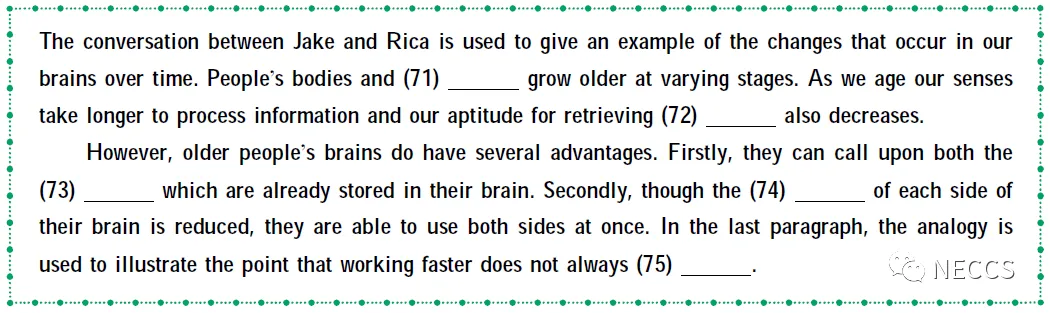
71. minds
72. memories
73. knowledge and experience
74. speed
75. save time
阅读三专项训练2
Section C (10 marks)
Questions 71 to 75 are based on the following passage.
As the presidential candidates shift toward the general election, voters will hear divergent plans to address the problem of “too big to fail” financial institutions. The real threat to Wall Street, however, doesn’t come from politicians, but from startups that are disrupting financial services at an unprecedented pace. In 2015 investment in financial technology (Fin Tech) startups that aim to transform the industry rose to nearly $14 billion, according to American Banker. As they gain customers, the megabanks will lose ground. “Too big to fail” also often means too clumsy to innovate. Already these institutions are finding themselves playing defense. Innovative blockchain technology - the magic behind Bitcoin- could drive further decentralization and disruption. But it isn’t just banking. New startups are reimagining how we learn, eat, stay healthy and get around. This is only a start, as the Third Wave of the Internet gains strength.
The First Wave was about building the Internet. Companies such as AOL created the underlying infrastructure and brought America and the rest of the world online. This phase peaked around 2000, setting the stage for the Second Wave, which has been about building apps and services on top of the Internet. Now the Third Wave has begun. Over the next decade and beyond, the Internet will rapidly become ubiquitous, integrated into our everyday lives, often in invisible ways. This will challenge industries such as health care, education, financial services, energy and transportation - which collectively represent more than half the U.S. economy.
Take education. While the presidential candidates discuss the merits of abolishing or expanding the federal Education Department, entrepreneurs are revolutionizing how instructors teach and students learn. Venture capitalists see what’s coming. Funding for EdTech startups hit $1.85 billion in 2015, according to EdSurge, up from $360 million in 2010. Former teachers are leading companies that are unleashing- finally - personalized and adaptive learning. While the pundits debate education policy, the innovators are in the trenches improving classrooms all across the country. Or look at health care. As the candidates pitch plans to abolish or build on the Affordable Care Act, the real action to improve America’s medical system is coming from entrepreneurs. They are inventing better ways to keep us healthy, and smarter ways to treat us when we get sick. The revolution in health care is being led by the innovators who are working tirelessly to improve outcomes, enhance convenience and lower costs. And again, investors sense this: In 2015 health care companies raised a record $16.1 billion in venture capital, The Wall Street Journal reported, and increase from 2014 of 34%. And work itself is changing. Politicians promise to boost job creation, but their debates seem out of step with reality. As more industries become “Uberized,” and increasing share of employees will work multiple gigs. A full-time job with a single employer could become passé. Thus, how we manage benefits, sick leave and vacation will need to be modernized. That is likely the only path to lifting up the increasingly frustrated middle class.
Second Wave startups have been centered around software: Build an app, do what you can to drive viral adoption, and then find a way to make money, usually by selling ads, but sometimes by selling the entire company. In the Third Wave this approach won’t work as well.
Third Wave innovators will need to learn the lessons of the First Wave: the importance of partnerships, policy and perseverance. They won’t be able to go it alone; they’ll need to go together. They’ll need to engage with governments, as regulators and often as customers. And they’ll need to recognize that revolutions often happen in evolutionary ways. Success will require many alliances, as well as constructive dialogue with regulators. The Third Wave of the Internet is also converging with trends toward regional entrepreneurship and impact investing. The State Science and Technology Institute reports that more than three-quarters of venture capital investment in 2015 went to three states: California, Massachusetts and New York. But now we’re seeing the “Rise of the Rest”: Cities across America are differentiating themselves by supporting startups. The next transformative enterprise in food systems could come from the Midwest instead of Silicon Valley. Impact investing - which focuses on purpose as well as profit - is growing, too. Investors, customers and employees increasingly want to believe in the companies that they buy from or work for.
Politicians and corporate executives should be mindful that the tectonic plates of our economy are starting to shift. They should engage entrepreneurs and seek win-win partnerships, instead of simply watching them with skepticism, or, worse, trying to hobble them with regulations. As in the First Wave, coopetition- blending competition and cooperation - will likely define the coming era. The world is changing for all of us, and a new playbook is required.
Questions 71 to 75
Complete the summary below with information from the passage, using no more than three words for each blank.
Keys:
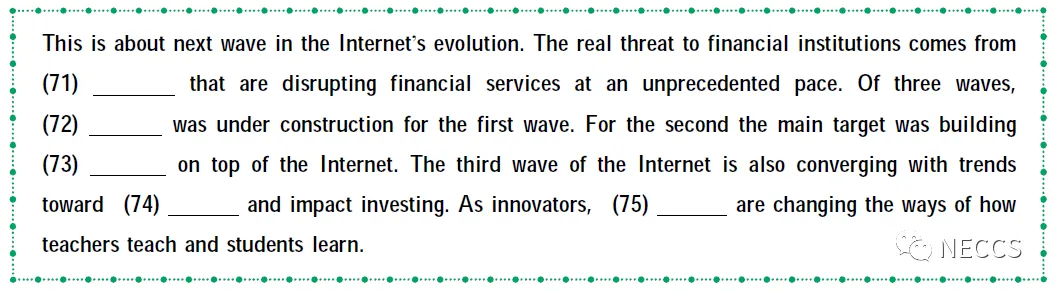
71. startups
72. the underlying infrastructure
73. apps and services
74. regional entrepreneurship
75. the entrepreneurs
阅读三专项训练3
Section C (10 marks)
Questions 71-75 are based on the following passage.
In recent decades, the economic changes created by globalization and the new, flexible requirements of job markets are thought to benefit women. The situation also stimulates a big growth in the participation of women in the political and social fields.
This country was the first in the world to allow women to vote, way back in 1893. Not only that, it now has the highest percentage of women who start businesses in the world. The progressive country in question is a small country in the Pacific Ocean―New Zealand.
The status of women in New Zealand is impressive. In fact, women once held all top four positions in government: Governor-General, Prime Minister, Attorney General, and Chief Justice. Women also hold 29% of the seats in parliament, higher than in any other country but Sweden. Women have as much power as men do in business; 70% of New Zealand’s businesses employ women in senior management positions. Women are also moving forward in law: currently, more women are studying law than men. In just a few years, women may soon outnumber men in the law profession.
Education has certainly played an important role in increasing women’s status in New Zealand. It is often said that education is the basis for economic independence, employment, and quality of life. Over recent decades, much progress has been made in narrowing the gender gap in education participation. The percentage of females graduating from high school doubled during the last ten years and continues to rise. Several of New Zealand’s universities now have a higher percentage of female students, the average statistic being 55% female to 45% male.
Another important contribution to the development of women’s status in New Zealand has been the vigorous activism of various women’s movements. The Women’s Electoral Lobby, a feminist group devoted to women’s participation in politics, has had a particularly deep effect. Only ten years after the group’s formation in 1975, more women had been elected and appointed to government positions than ever before.
The achievements of New Zealand’s women are inspiring, as are the attitudes of New Zealand’s parliament and the general public in supporting the closure of the gender gap. Other countries in the world may be slow in reforming, but New Zealand serves as a shining example of what women can achieve.
Questions 71-75
Complete the summary with words from the passage, changing the form where necessary, with no more than three words for each blank.
Keys:
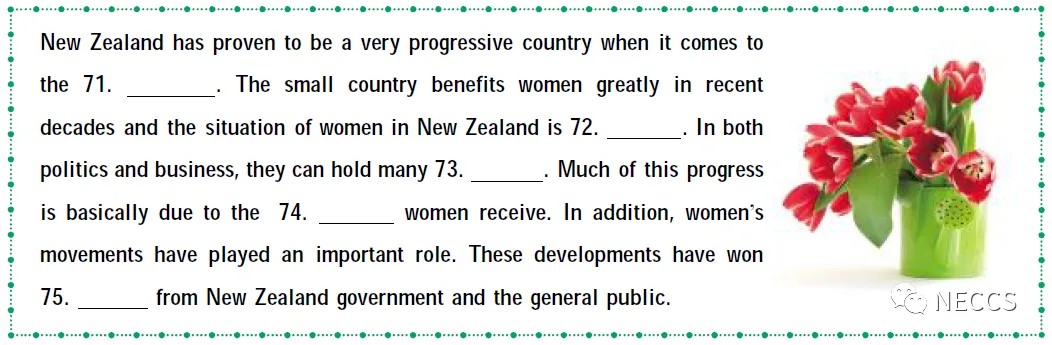
71. status of women
72. impressive
73. top positions
74. education
75. support
阅读三专项训练4
Section C (10 marks)
Questions 71—75 are based on the following passage.
Hawaii is the only island state in the United States, which comprised of a chain of 132 islands. It is also the only state that has official native languages. There are two official languages: English and Hawaiian. The Hawaiian language is very similar to languages spoken across the Pacific Ocean in places like Fiji and the Philippines. The Hawaiian language came very close to becoming an extinct language, though.
A number of factors were involved in the decline of the Hawaiian language. First of all, the arrival of explorers in the late 1700s and missionaries in the early 1800s brought not only new cultures and ideas, but diseases as well. Many locals died because they had no immunity to those diseases. The number of native Hawaiian speakers fell rapidly. Second, the Hawaiian monarchy was overthrown and in 1896, English became the official language of schools and government. With an increasing American presence, English became the language of business, further limiting the use of Hawaiian. Year after year, the sounds of the native language became less common on the streets.
When Hawaii became part of the United States in 1959, the people fought to have Hawaiian included as an official language. Now, more and more Hawaiians are trying to learn their ancestral language, and the Hawaiian state government is attempting to help them. Hawaiian classes are now taught in the schools. Hawaiian newspapers are published, and there are some Hawaiian radio shows. A new dictionary of the language was even created. One particularly novel way the government is trying to protect the language is by not allowing tourists to the island of Niihau. There, Hawaiian is the only language spoken by the residents!
Although Hawaiian has been saved from extinction, it is spoken by only 1.5% of the population. Japanese and the Filipino language Tagalog are in much wider use in the Hawaiian Islands. The Hawaiian language still has a long way to go. If you visit, though, you might hear people using the Hawaiian word “aloha” instead of “hello.”
Questions 71—75
Complete the summary with a maximum of two words from the passage for each blank, changing the form where necessary.

Keys:
71. similar to
72. decline
73. cultures and ideas
74. fall (rapidly)
75. from extinction
往期精彩

