高三一轮复习公开课 · 语篇结构图式迁移课.Reading and Thinking: From Problems to Solutions(45 分钟)
- 2026-11-17 03:09:52
班情:普通班(均分约 55),控难度、重基础、少仿写多巩固
主题语境:「人与社会 · 历史、社会与文化 · 文化遗产保护」
课时:1 课时

标准模板(论文三表·表2-模板6):背景 → 问题 → 危害 → 措施 →【展望/结论】
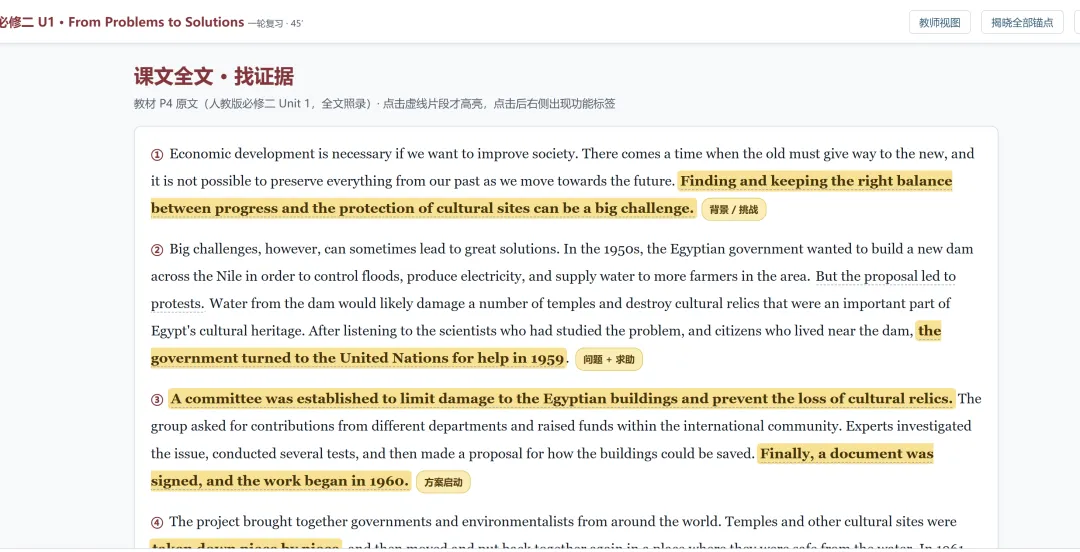
本文实际形态:①背景/挑战 → ②问题 + 求助 → ③方案启动 → ④方案执行 → ⑤结果+评价 → ⑥意义升华
What|六段写了什么(含原文锚点,按段号引用,不臆造页码)
Why|为什么这样写(价值与育人落点)
· 把「发展 vs 保护」这对真矛盾摆到学生面前:建坝能防洪发电供水,却会淹掉千年神庙——先替埃及政府犯难,再看拆解搬迁的巧思,对 "balance" 的理解从口号变判断。 unit1· 落点不是「石头被保住了」,而是「多国协作证明了一条不必牺牲文明的未来之路」——文化意识(遗产属于全人类)与思维品质(代价与价值权衡)同时到位。
· 一轮复习的处理纪律:本课不再重讲内容细节;Why 层只在 exit ticket 用一句话回扣,避免把复习课上成第二遍新授课。
How|怎样写成这样(可迁移的语言与结构特征)
5.1 三道例题(用课文,教师解析话术)
2017 年新课标全国卷 III · 阅读理解 C 篇 (约 290 词,原题 28–31;真题原文,未改写)
来源:2017 年普通高等学校招生全国统一考试英语(新课标全国卷 III)阅读理解 C 篇。原文与四道选择题照录;段号 ①–⑤ 与 displaced 下划线为本学案所加,供标注与第 29 题使用。
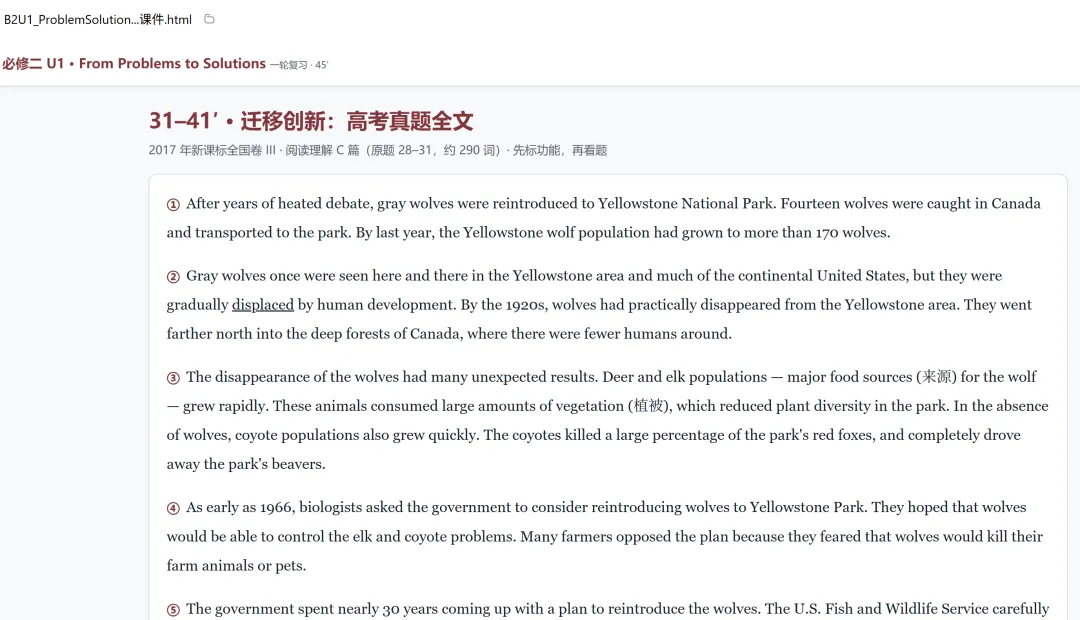
① After years of heated debate, gray wolves were reintroduced to Yellowstone National Park. Fourteen wolves were caught in Canada and transported to the park. By last year, the Yellowstone wolf population had grown to more than 170 wolves.
② Gray wolves once were seen here and there in the Yellowstone area and much of the continental United States, but they were gradually displaced by human development. By the 1920s, wolves had practically disappeared from the Yellowstone area. They went farther north into the deep forests of Canada, where there were fewer humans around.
③ The disappearance of the wolves had many unexpected results. Deer and elk populations — major food sources (来源) for the wolf — grew rapidly. These animals consumed large amounts of vegetation (植被), which reduced plant diversity in the park. In the absence of wolves, coyote populations also grew quickly. The coyotes killed a large percentage of the park's red foxes, and completely drove away the park's beavers.
④ As early as 1966, biologists asked the government to consider reintroducing wolves to Yellowstone Park. They hoped that wolves would be able to control the elk and coyote problems. Many farmers opposed the plan because they feared that wolves would kill their farm animals or pets.
⑤ The government spent nearly 30 years coming up with a plan to reintroduce the wolves. The U.S. Fish and Wildlife Service carefully monitors and manages the wolf packs in Yellowstone. Today, the debate continues over how well the gray wolf is fitting in at Yellowstone. Elk, deer, and coyote populations are down, while beavers and red foxes have made a comeback. The Yellowstone wolf project has been a valuable experiment to help biologists decide whether to reintroduce wolves to other parts of the country as well.
任务 1|标功能(备选标签:结果预览 / 背景·问题 / 危害 / 方案 / 结果+评价)
提醒:①段不是背景,是结果倒叙开场——这正是它与课文顺叙的差别。别一看首段就贴「背景」。
任务 2|按图答题(真题 28–31;普通班做 Q1/Q3/Q4,Q2 词义题选做)
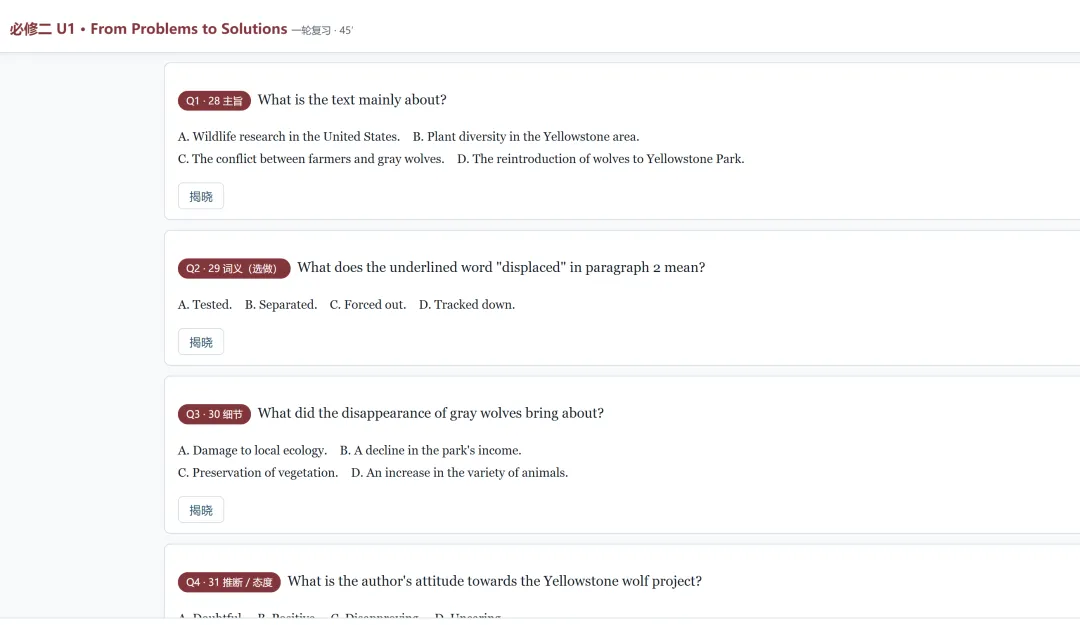
Q1(28 · 主旨) What is the text mainly about?
A. Wildlife research in the United States. B. Plant diversity in the Yellowstone area.
C. The conflict between farmers and gray wolves. D. The reintroduction of wolves to Yellowstone Park.
Q2(29 · 词义,选做) What does the underlined word "displaced" in paragraph 2 mean?
A. Tested. B. Separated. C. Forced out. D. Tracked down.
Q3(30 · 细节) What did the disappearance of gray wolves bring about?
A. Damage to local ecology. B. A decline in the park's income.
C. Preservation of vegetation. D. An increase in the variety of animals.
Q4(31 · 推断/态度) What is the author's attitude towards the Yellowstone wolf project?
A. Doubtful. B. Positive. C. Disapproving. D. Uncaring.
任务 3|错项归因(任选一题,写一句)
我排除 ________ 项,因为它出自 ________ 段(功能:________),属于「局部当整体 / 逻辑方向相反 / 无中生有」中的 ________。
Exit ticket
Why was the Aswan Dam project a success beyond saving temples? ________________
任务1:①结果预览(were reintroduced/had grown to more than 170,倒叙开场)②背景·问题(were gradually displaced/had practically disappeared)③危害(unexpected results/grew rapidly/reduced plant diversity/drove away ... beavers)④方案提出(asked the government to consider reintroducing/Many farmers opposed)⑤结果+评价(spent nearly 30 years/are down/made a comeback/a valuable experiment)。
任务2(官方答案 28 D · 29 C · 30 A · 31 B):
Q1 D:定位首句 gray wolves were reintroduced +末句实验价值;A 过宽,B 是③段一个细节,C 是④段反对意见——局部当整体。
Q2 C:②段 seen here and there → but → went farther north,被迫离开。B Separated 只说分开、不含「被迫」,最强干扰;A/D 无中生有。
Q3 A:定位③段危害链(鹿/麋鹿↑→植被↓→多样性↓;郊狼↑→红狐↓、海狸消失)。C 与 reduced plant diversity 反向;D 把「数量增加」偷换成「种类增加」;B 无中生有。
Q4 B:末句 a valuable experiment 定调;A/D 与 valuable 的情感冲突,C 与 A 同类反向。题干问作者态度,不是④段农民态度(opposed)——区域错位陷阱。
Exit ticket 样例:It showed that countries could work together to find a path to the future without destroying cultural heritage.
依据:普通班「控难度、重基础、少仿写多巩固」
· 语篇知识(课标「语篇类型 / 语篇结构 / 衔接手段」):把 problem-solution 结构从「这篇课文」抽象为「一类语篇的图式」,并用信号词与段落功能显性化。
· 英语学习活动观:标注功能=学习理解;画骨架=应用实践;按图解题+陌生语篇迁移=迁移创新。三层次与 PWP 对应:pre(矛盾导入)—while(标注+画图)—post(解题+迁移)。
· 文化意识:从「遗产是石头」到「遗产是身份与国际协作的对象」,用 Exit ticket 落实,不空喊文化自信。
· 思维品质:区域排除法、逻辑方向排除法=逻辑性;「值得吗」的判断(本课只在优质课档展开)=批判性。
· 高考评价体系:直指「综合性」(篇章逻辑)与「应用性」(解题迁移);结构意识让学生从译者变成篇章逻辑建构者。

