十天复习CFA一级之组合构建
- 2026-11-23 16:12:25
视频在开头
PDF免费下载在片尾
2027考纲版 · 10天通关 · 考点速览(不讲原理,只梳理考点)
Topic 1 · Portfolio Risk and Return: Part I
LOS 1.1 · describe characteristics of the major asset classes that investors consider in forming portfolios
⚠️ 避坑提醒 题目'从组合构建看主要资产类别'→股票传统资产里期望回报最高但波动最高、现金等价物低风险低回报作近无风险锚。别选'现金回报最高'(流动性≠回报)也别选'固收回报比股票高'。 |
📝 习题演练 Which statement most accurately characterizes the major asset classes from a portfolio-construction perspective? A. Cash equivalents offer the highest expected return because they are the most liquid B. Equities generally offer the highest expected return among traditional assets but with the highest volatility, while cash equivalents offer low risk and low return and serve as the near-risk-free anchor C. Fixed income has higher expected return than equities because coupons are contractually guaranteed ✅ 答案:B 📖 解析:Equities carry residual ownership risk and reward, so they offer the highest expected return among traditional asset classes but with the highest volatility; cash equivalents (T-bills, money market) have the lowest risk/return and proxy the risk-free asset. Option A confuses liquidity with return; option C is wrong—equities, not bonds, carry the highest expected return among traditional assets despite bond coupons being contractual. |
LOS 1.2 · explain risk aversion and its implications for portfolio selection
8.1 风险偏好
• Risk averse: Investors want to minimize risk for the same amount of return; Investors want to maximize return for the same risk
• Risk neutral: Investors are indifferent about gamble or guaranteed outcome; Investors care only about return
• Risk seeking: Investors get extra "utility" from the uncertainty; Investors love higher risk given certain expected return
8.2 效用函数
• Utility function reflects the relative satisfaction that an investor drives from different investment portfolios
• U = E(R) − 1/2 Aσ²; A is a measurement of risk aversion
• A > 0, when investor is risk-averse; A = 0, when investor is risk-neutral; A < 0, when investor is risk-seeking
⚠️ 避坑提醒 题目'两组合同期望回报、一个σ12%一个σ18%'→风险厌恶者选σ小的那个(同回报下最小化风险)。别选'高风险高回报'(那是风险偏好)也别选'无所谓'(那是风险中性)。 |
📝 习题演练 Two portfolios offer the same expected return, but Portfolio X has a standard deviation of 12% and Portfolio Y of 18%. A risk-averse investor will most likely: A. Prefer Portfolio Y because higher risk implies higher return B. Prefer Portfolio X because for the same return they want to minimize risk C. Be indifferent because expected returns are equal ✅ 答案:B 📖 解析:Per the 2024 handout, risk-averse investors want to minimize risk for the same amount of return (equivalently maximize return for the same risk). With equal expected returns, they choose the lower-risk portfolio (X). Option A describes a risk-seeking attitude; option C describes a risk-neutral investor. |
LOS 1.3 · explain the selection of an optimal portfolio, given an investor's utility (or risk aversion) and the capital allocation line
9.3 有效前沿上的最优投资组合
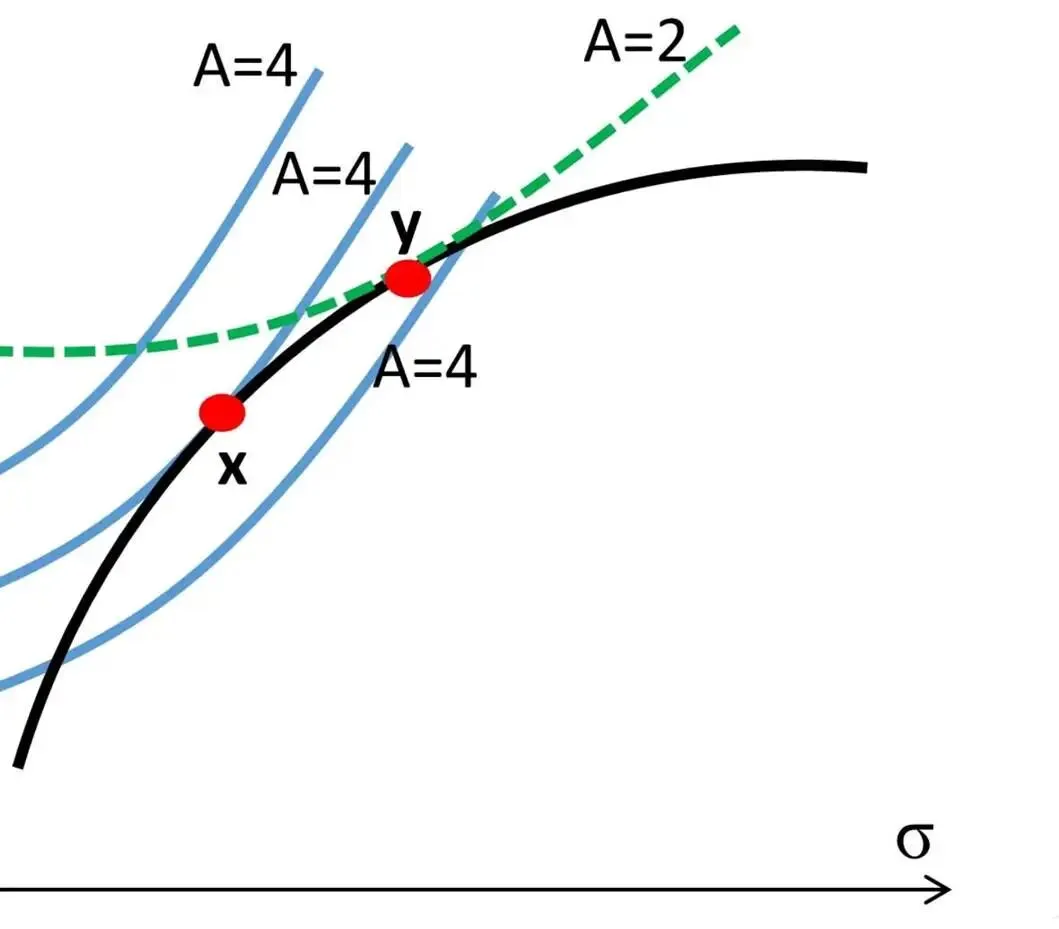
有效前沿上的最优投资组合
• Optimal portfolio along efficient frontier: Investor (A=4) should choose portfolio "x", the tangent point of indifference curve to efficient frontier
• Less risk-averse investor (A=2) will select portfolio "y" (more in risky asset)
10.2 资本配置线上的最优投资组合
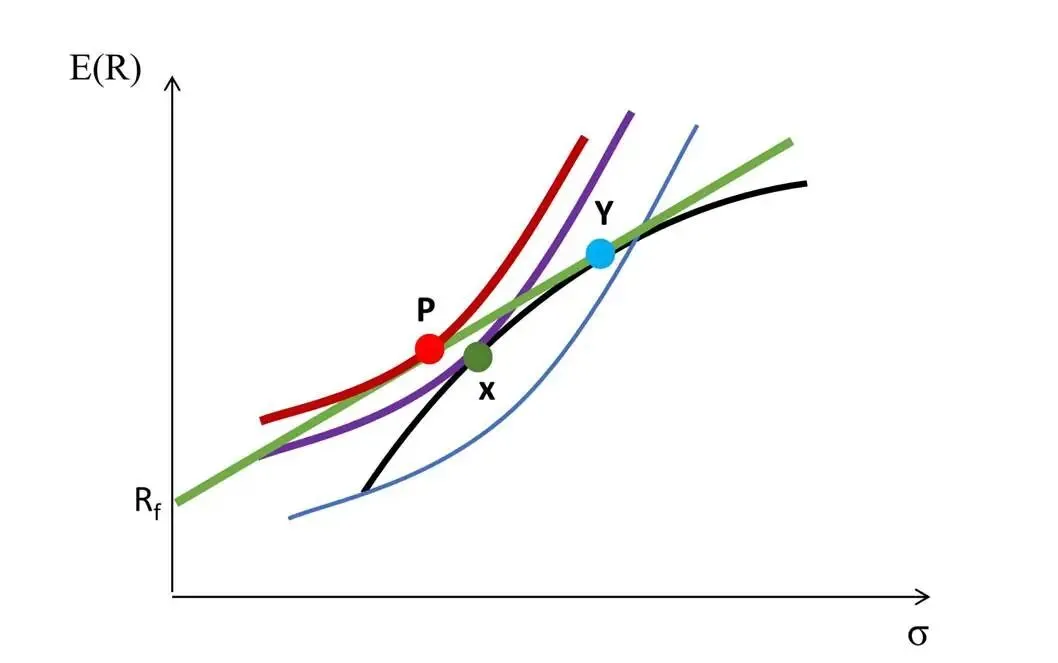
最优风险组合与最优投资者组合
• Investor should choose "Y" as the optimal risky portfolio, which will be combined with risk-free asset
• Investor should choose portfolio "P" as the optimal investor portfolio
⚠️ 避坑提醒 题目'有效前沿上高厌恶和大厌恶'→各自无差异曲线与前沿的切点、厌恶弱的选更多风险资产权重。别选'都选全局最小方差组合'(不同投资者最优不同)也别选'厌恶弱的只持无风险资产'。 |
📝 习题演练 On the efficient frontier, a highly risk-averse investor (large A) and a less risk-averse investor (small A) each choose their optimal portfolio. Which statement is most accurate? A. Both investors choose the global minimum-variance portfolio because it minimizes risk B. Each investor's optimum is the tangency point of their own indifference curve with the efficient frontier; the less risk-averse investor selects a portfolio with more weight in risky assets C. The less risk-averse investor should hold only the risk-free asset ✅ 答案:B 📖 解析:Per the 2024 handout, the optimal portfolio along the efficient frontier is the tangency point of the investor's indifference curve with the frontier; a less risk-averse investor (A=2) selects portfolio "y" with more in risky assets than a more risk-averse investor (A=4) who chooses "x". Option A is wrong—different investors have different optima, not the global minimum-variance point; option C inverts the relationship. |
LOS 1.4 · calculate and interpret the mean, variance, and covariance (or correlation) of asset returns based on historical data
• The 2024 handout uses these inputs in the two-asset portfolio risk formula: σₚ² = w₁²σ₁² + w₂²σ₂² + 2w₁w₂Cov(R₁,R₂) = w₁²σ₁² + w₂²σ₂² + 2w₁w₂σ₁σ₂ρ₁,₂ (2024讲义P25).
⚠️ 避坑提醒 例题:A均值8%σ20%、B均值12%σ30%、协方差0.024→ρ=0.024/(0.2×0.3)=0.024/0.06=0.40。别用平均标准差(0.6)也别漏一个标准差(0.8)。 |
📝 习题演练 Using historical data, the mean return of Asset A is 8% (standard deviation 20%) and of Asset B is 12% (standard deviation 30%). Their covariance is 0.024. The correlation between A and B is closest to: A. 0.40 B. 0.60 C. 0.80 ✅ 答案:A 📖 解析:ρ = Cov(Rᵢ,Rⱼ)/(σᵢ×σⱼ) = 0.024/(0.20×0.30) = 0.024/0.06 = 0.40. Option B (0.60) might come from dividing covariance by the average standard deviation; option C (0.80) from omitting one standard deviation. |
LOS 1.5 · calculate and interpret portfolio standard deviation
9.1 投资组合的收益与风险
• Return of the portfolio with two assets: Rₚ = w₁R₁ + w₂R₂
• Risk of the portfolio with two assets: σₚ² = w₁²σ₁² + w₂²σ₂² + 2w₁w₂Cov(R₁,R₂) = w₁²σ₁² + w₂²σ₂² + 2w₁w₂σ₁σ₂ρ₁,₂
⚠️ 避坑提醒 注意:ρ在交叉项是原始值(0.5)不是平方;标准差要转小数算(15%写0.15);算完开根号得到组合标准差,别把方差当标准差。加权平均标准差19%(0.6×15+0.4×25)是忽略分散化的错误。 |
📝 习题演练 A portfolio invests 60% in Asset 1 (σ₁ = 15%) and 40% in Asset 2 (σ₂ = 25%), with correlation ρ = 0.5. The portfolio standard deviation is closest to: A. 16.5% B. 19.0% C. 20.7% ✅ 答案:A 📖 解析:σₚ² = 0.6²×0.15² + 0.4²×0.25² + 2×0.6×0.4×0.15×0.25×0.5 = 0.0081 + 0.0100 + 0.0090 = 0.0271; σₚ = √0.0271 ≈ 0.1646 ≈ 16.5%. Option B (19.0%) is the weighted-average standard deviation 0.6×15% + 0.4×25% = 19%, which ignores the diversification effect; option C (20.7%) results from an incorrectly inflated covariance term. |
LOS 1.6 · describe the effect on a portfolio's risk of investing in assets that are less than perfectly correlated
9.1 相关系数与组合风险
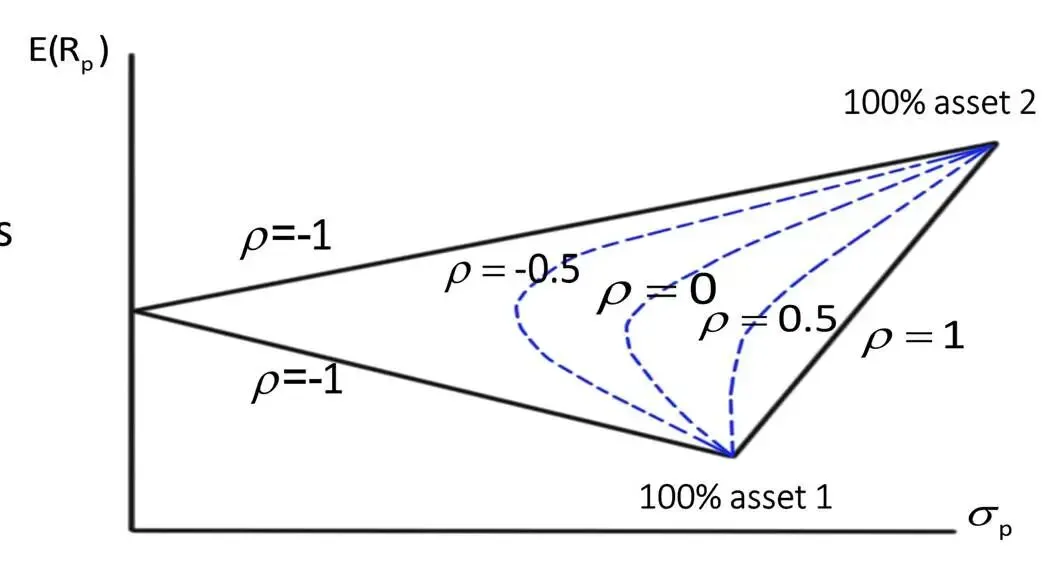
不同相关系数下的组合风险-收益

