2026乌鲁木齐初三一模试卷分析:抓核心考点,定冲刺方向
- 2026-09-24 23:48:56
- 乌鲁木齐市中考一模
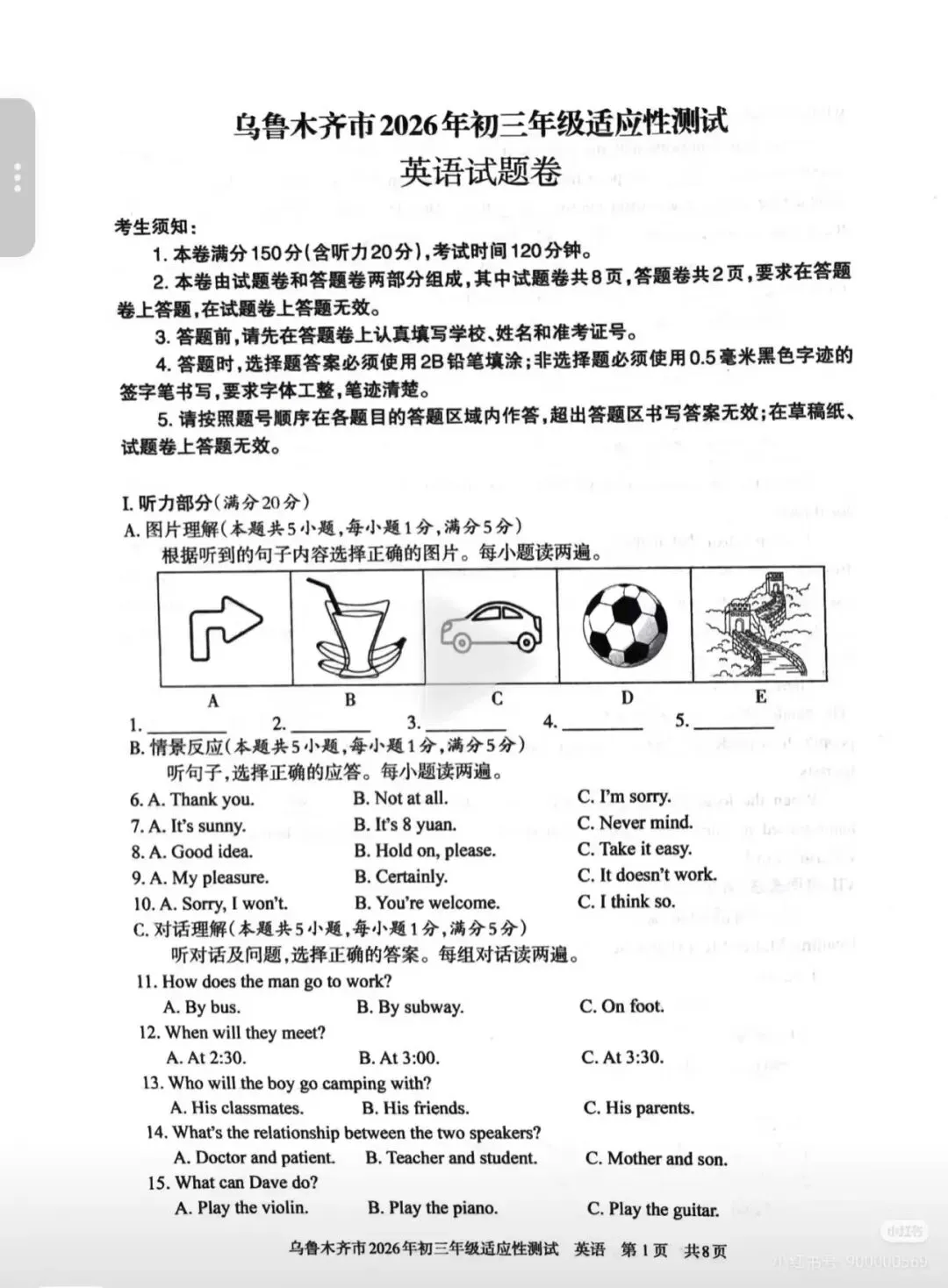
满分:150分(含听力20分)
- 1. 整体结构与分值分布
| 题型 | 题量 | 分值 | 考查重点 |
|---|---|---|---|
| 听力部分 | 20题 | 20分 | 图文匹配、情景反应、对话理解、短文理解 |
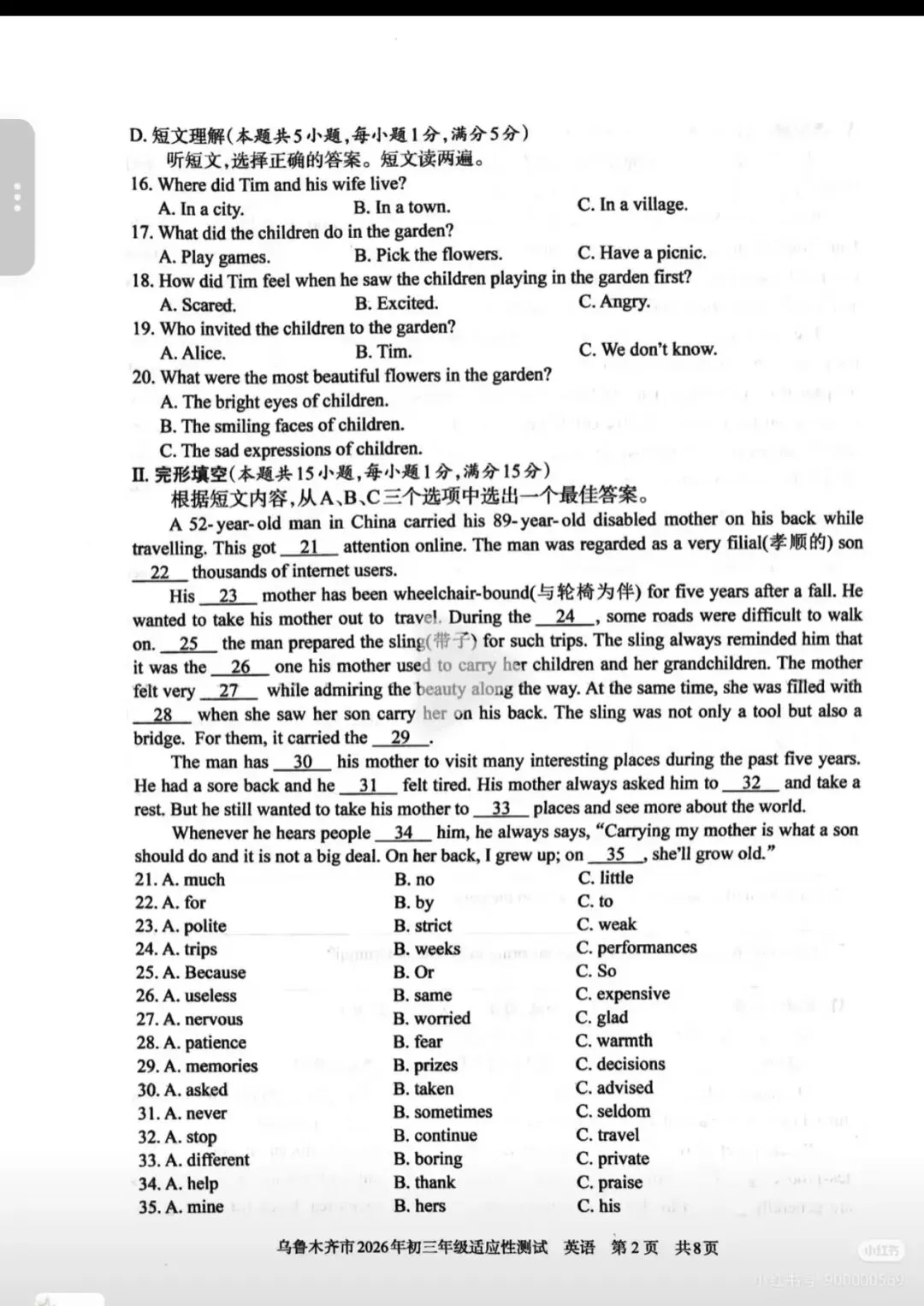
| 完形填空 | 15题 | 15分 | 语篇理解、词汇辨析、固定搭配、逻辑关系 |
| 阅读理解 | 23题 | 46分 | 细节理解、主旨归纳、推理判断、信息匹配、语篇结构 |
| 补全对话 | 6题 | 12分 | 语境连贯、功能性语言、礼貌表达 |
| 读写题 | 11题 | 15分 | 阅读填空(单词形式)、短文填空(语境补全) |
| 书面表达 | 1题 | 20分 |
 各题型重难点分析
考点句型:
原句:The sign shows a right turn.
句型:The sign shows...
仿写中文:这个标志显示右转。
仿写英文:The sign shows a right turn.
3.1.3 对话理解(11-15题)
- 重点:细节抓取(时间、地点、人物、交通方式、活动)。
原句:How does the man go to work? → By bus.
句型:How does sb. go to...? → By + 交通工具.
仿写中文:这个人怎么去上班?→ 乘公交车。
原句:When will they meet? → At 3:30.
句型:When will they...? → At + 时间点.
难点:需快速捕捉关键信息,如“By bus.”“At 3:30.”“His friends.”
考点句型:
3.1.4 短文理解(16-20题)
重点:整体理解+细节推断(人物关系、事件发展、情感态度)。
难点:代词指代、时间顺序、因果关系易混淆,如“Tim’s feeling”“who invited the children”。
考点句型:
原句:Where did Tim and his wife live? → In a village.
句型:Where did sb. live? → In + 地点.
原句:How did Tim feel when he saw the children playing in the garden first? → Angry.
句型:How did sb. feel when...? → 情绪形容
3.2.1 语篇理解
主题:52岁男子背89岁残疾母亲旅行,自制吊带,引发网友称赞。
情感线索:孝顺→感动→分享→温暖。
难点:逻辑关系(转折、因果)、词语辨析(如weak/glad/warmth)、固定搭配(be regarded as, carry sb. on one’s back)。
- 3.2.3 考点句型(原句+句型+仿写)
原句:The man was regarded as a very filial son to thousands of internet users.
句型:sb. was regarded as... to...
原句:He wanted to take his mother out to travel.
句型:sb. wanted to do sth.
仿写中文:他想带母亲出去旅行。
原句:The sling always reminded him that it was the same one his mother used to carry her children and her grandchildren.
句型:sth. reminded sb. that...
原句:She was filled with warmth when she saw her son carry her on his back.
句型:sb. was filled with... when...
原句:Carrying my mother on my back, I grew up; on mine, she’ll grow old.
句型:On my back, I grew up; on mine, she’ll grow old.
3.3 阅读理解(46分)
3.3.1 A篇(T/F判断)
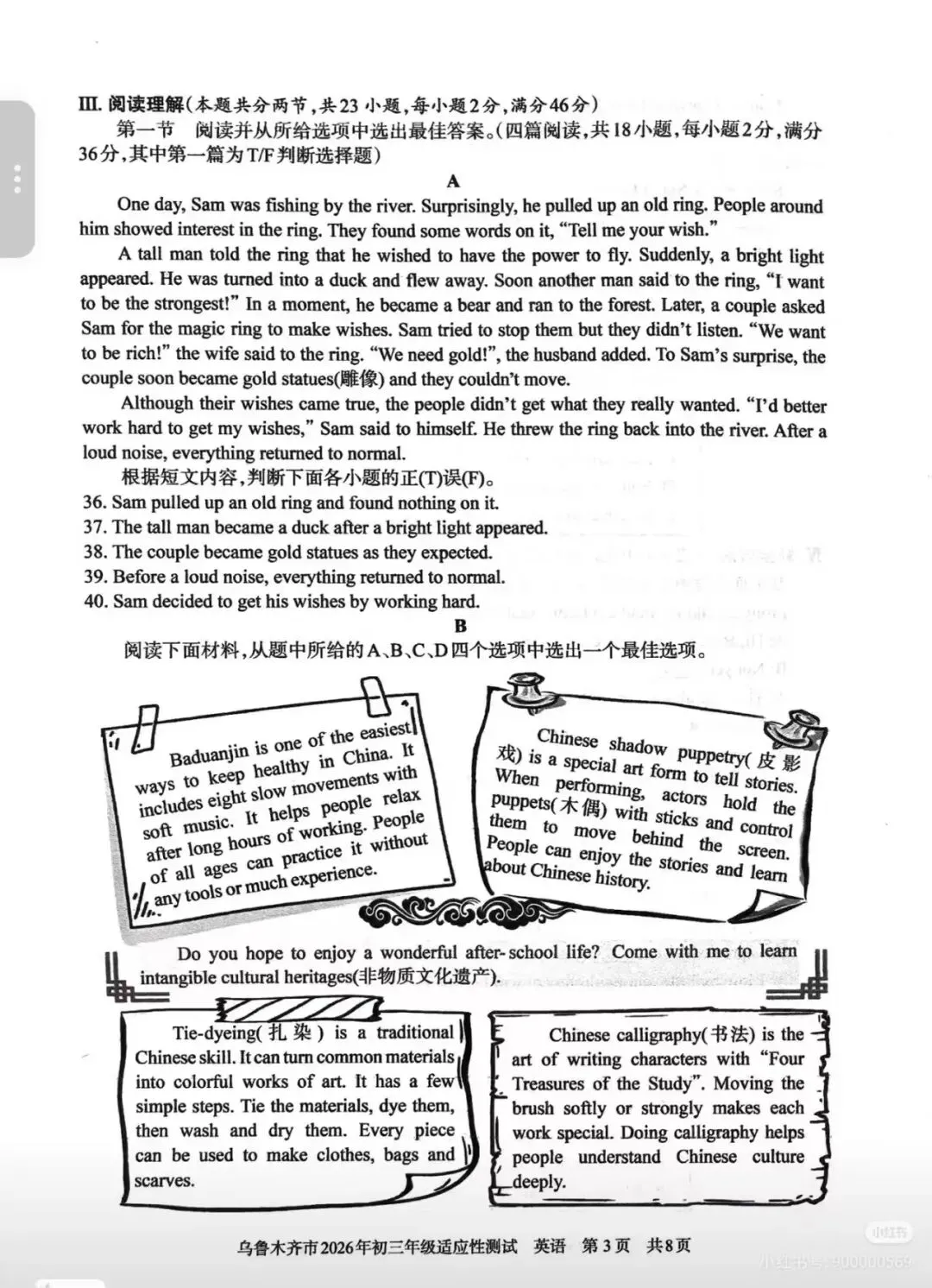
- 主题:Sam捡到魔法戒指,实现愿望后扔回河中。
考点句型:
原句:Sam tried to stop them but they didn’t listen.
句型:sb. tried to do sth. but sb. didn’t listen.
原句:After a loud noise, everything returned to normal.
句型:After + 名词, everything returned to normal.
重点:细节理解+推理判断(如“Sam threw the ring back into the river.”“everything returned to normal.”
3.3.2 B篇(非遗介绍)
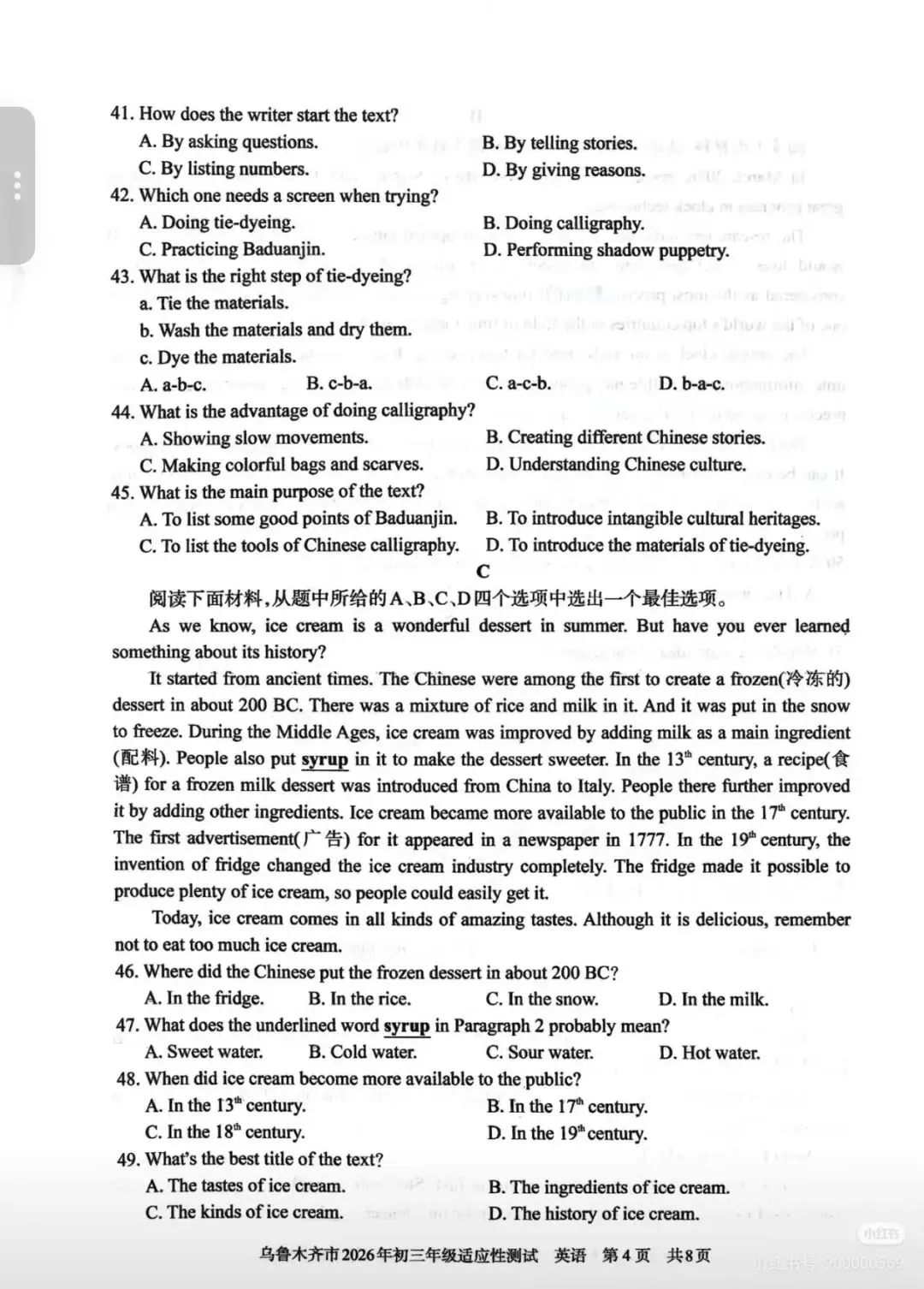
主题:介绍四种中国非物质文化遗产(八段锦、皮影戏、扎染、书法)。
重点:信息提取+主旨归纳。
考点句型:
原句:Baduanjin is one of the easiest ways to keep healthy in China.
句型:...is one of the easiest ways to...
原句:People can enjoy the stories and learn about Chinese history.
句型:People can enjoy... and learn about...
3.3.3 C篇(冰淇淋历史)
主题:冰淇淋从古代中国到现代的发展史。
重点:时间线+因果逻辑(如“improved by adding milk”“became more available in the 17th century”)。
考点句型:
原句:The Chinese were among the first to create a frozen dessert about 200 BC.
句型:sb. were among the first to do sth.
原句:Ice cream became more available to the public in the 17th century.
句型:sth. became more available to the public in...
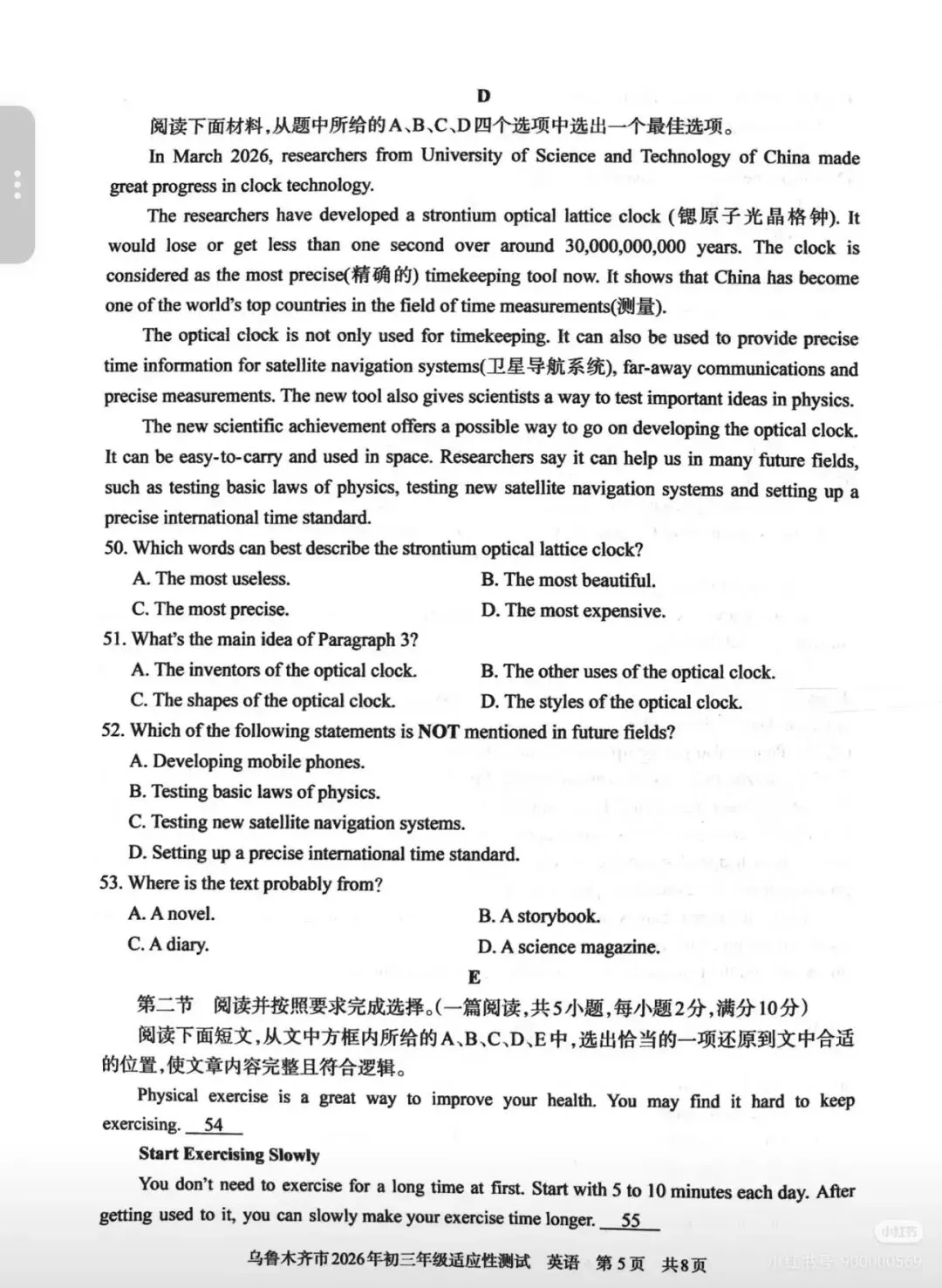
3.3.4 D篇(科技说明文)
主题:中国科技大学研发锶原子光晶格钟,精度极高。
重点:专业术语+功能说明(如“optical lattice clock”“precise measurement”)。
考点句型:
原句:It would lose or get less than one second over around30,000,000,000 years.
句型:It would lose or get less than one second over... years.
原句:It can also be used to provide precise time information for satellite navigation systems.
句型:It can also be used to provide... for...
3.3.5 E篇(七选五)
主题:如何坚持锻炼,养成运动习惯。
重点:上下文衔接(代词、逻辑词、同义复现)。
考点句型:
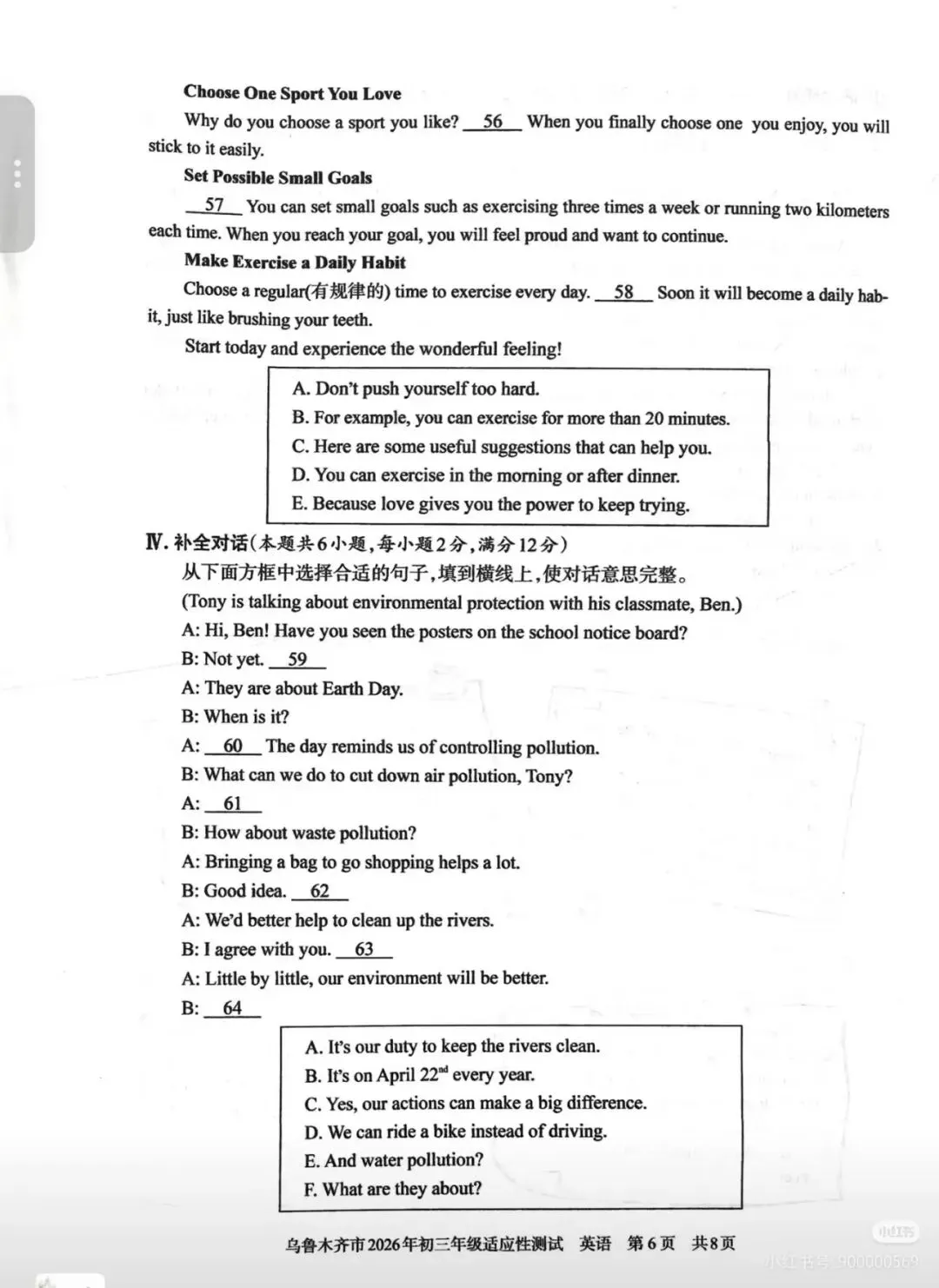
原句:Start Exercising Slowly
句型:Start + 动名词 + Slowly
句型:Don’t push yourself too hard.
3.4 补全对话(12分)
3.4.1 主题:Tony和Ben讨论地球日海报及环保行动。
3.4.2 重点词块
Earth Day(地球日)
April 22nd(4月22日)
control pollution(控制污染)
ride a bike instead of driving(骑自行车代替开车)
clean up the rivers(清理河流)
water pollution(水污染)
3.4.3 考点句型(原句+句型+仿写)
原句:When is it? → It’s on April 22nd every year.
句型:When is it? → It’s on + 日期.
原句:What can we do to cut down air pollution? → We can ride a bike instead of driving.
句型:What can we do to...? → We can + 动词短语.
仿写中文:我们能做什么来减少空气污染?→ 我们可以骑自行车代替开车。
原句:We’d better help to clean up the rivers.
句型:We’d better + 动词原形 + to do sth.
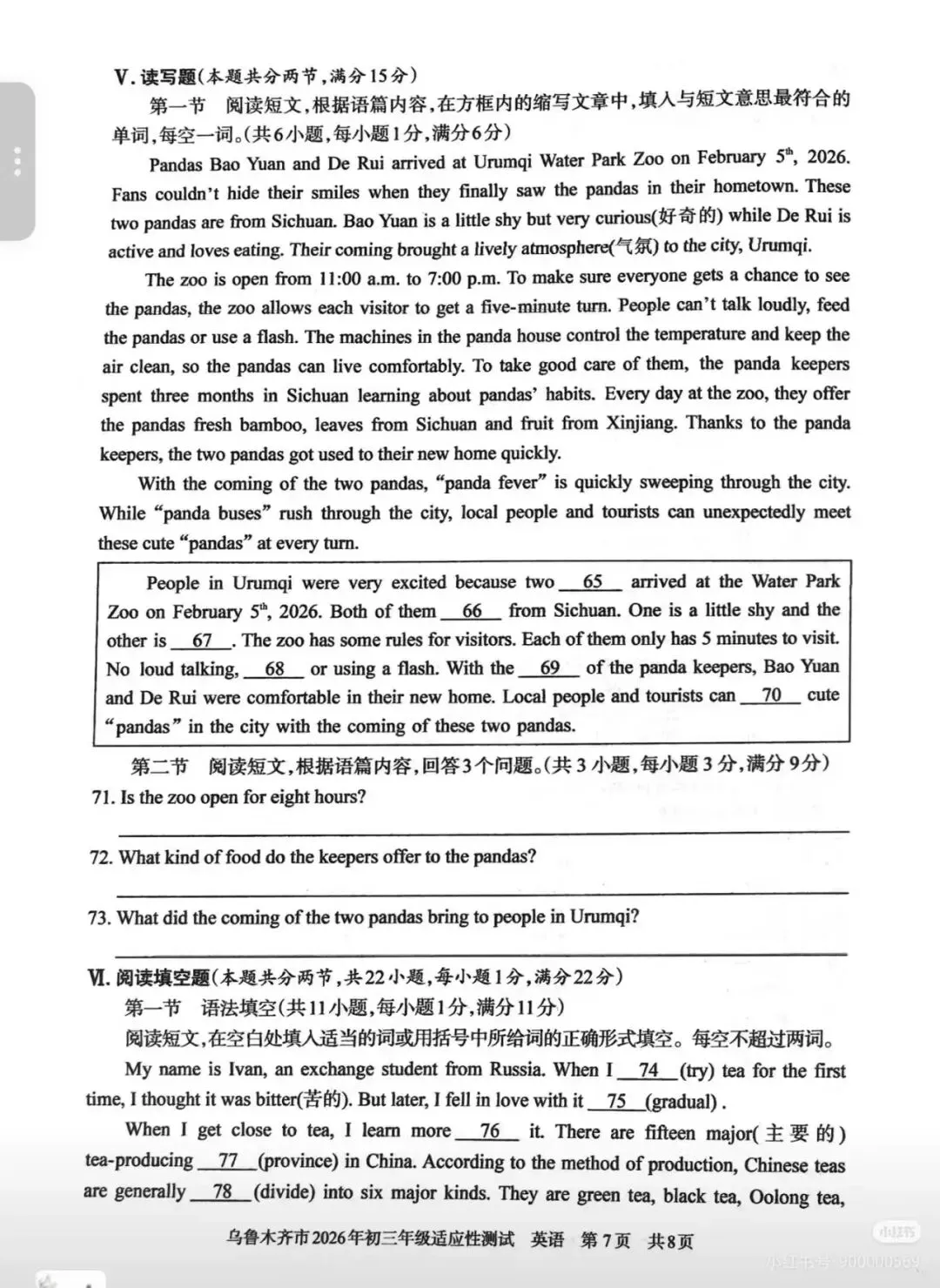
3.5 读写题(15分)
3.5.1 阅读短文填空
主题:Ivan介绍中国茶文化。
- 重点:时态(过去式、现在式)、词性转换(provinces, divided)、固定搭配(serve guests with tea, half cup for tea)。
考点句型:
原句:When I was Ivan, an exchange student from Russia.
句型:When I was + 身份, ...
原句:I thought it was bitter. But later, I fell in love with it gradually.
句型:I thought... But later, I fell in love with it gradually.
3.5.2 阅读填单词(6题)
主题:乌鲁木齐大熊猫馆开馆,市民热情迎接。
重点:语境补全(panda, shy, noisy, care, meet, cute)。
考点句型:
原句:People in Urumqi were very excited because two pandas arrived at the Water Park Zoo.
句型:People in... were very excited because...
原句:Each of them only has a five-minute visit.
句型:Each of them only has + 时间段 + visit.

重点词块提炼
be regarded as(被视为)
carry sb. on one’s back(背着某人)
be filled with warmth(充满温暖)
prepare for(为……准备)
remind sb. that...(提醒某人……)
grow up(长大)
one of the easiest ways to...(最简单的方式之一)
enjoy the stories and learn about...(欣赏故事并了解……)
be among the first to do sth.(最早做某事的人之一)
become more available to the public(对公众更普及)
lose or get less than one second(误差不超过一秒)
provide precise time information for...(为……提供精确时间信息)
start exercising slowly(慢慢开始锻炼)
don’tsh yourself too hard( pu不要逼自己太狠)
Earth Day(地球日)
April 22nd(4月22日)
cut down air pollution(减少空气污染)
ride a bike instead of driving(骑自行车代替开车)
clean up the rivers(清理河流)
serve guests with tea(用茶招待客人)
half cup for tea(茶倒半杯)
fell in love with it gradually(逐渐爱上它)
tea-producing provinces(产茶省份)
divided into six major kinds(分为六大种类)
green tea, black tea, Oolong tea, white tea, yellow tea, dark tea(绿茶、红茶、乌龙茶、白茶、黄茶、黑茶)
national treasure(国宝)
art of life(生活艺术)
try the amazing local food(尝试美味的当地食物)
make one’s mouth water(让人垂涎欲滴)
roast mutton(烤羊肉)
hand-pulled noodles(手拉面)
pilaf(抓饭)
a kind of traditional food(一种传统食物)
made of mutton, carrots and onions(由羊肉、胡萝卜和洋葱制成)
a choice for tourists(游客的选择)
every bite tastes like home(每一口都像家)
Is your mouth watering now?(你现在流口水了吗?)
panda fever(熊猫热)
local people and tourists(当地人和游客)
cute pandas(可爱的熊猫)
✅ 总结:本套试卷核心能力考查点
听力理解:细节捕捉 + 语境推断 + 情感态度识别
完形填空:语篇逻辑 + 词汇辨析 + 固定搭配
阅读理解:信息提取 + 主旨归纳 + 推理判断 + 语篇结构
补全对话:语境连贯 + 功能性语言 + 礼貌表达
读写题:时态运用 + 词性转换 + 固定搭配 + 文化常识。

Reading Makes Me a Better Self
我们来仔细看这个题目。它包含三个核心要素:
Reading:这是核心动作。我们要围绕“阅读”来写。
Me:这是主体。必须是“我”的亲身经历和感受,要个人化、真实。
A Better Self:这是结果和核心目标。全文必须回答:我“好”在哪里了?是知识更多了,还是性格更好了?
如何搭建三段式框架?
很简单,就是把题目拆解成三个具体的、可回答的问题,分别放进三个段落:
- 第一段 (开头段):回答——“是的,阅读确实让我成为了更好的自己。” (亮出核心观点)
- 第二段 (主体段):回答——“怎么证明?” 从三个方面展开细节:
- 我的读书习惯是什么样的?(证明“Reading”是真实发生的)
- 我喜欢读什么书?为什么?(让“我”的形象具体化)阅读具体让我在哪些方面变好了?(紧扣“Better Self”)
- 第三段 (结尾段):回答——“总之,这就是阅读对我的意义。” (总结并升华主题)
第三步:列出主干句子 (Topic Sentences)
现在,我们为每一段写出一个核心句(Topic Sentence),这是段落的“脊柱”。
第一段核心句 (Paragraph 1 Topic Sentence):
Reading is more than a hobby for me; it’s a daily practice that helps me grow.
阅读对我来说不只是爱好,更是一种帮助我成长的日常练习。
- 第二段核心句 (Paragraph 2 Topic Sentence):
- 这种成长源于我简单的阅读习惯、我爱的书籍,以及我在自己身上看到的真实变化。
第三段核心句 (Paragraph 3 Topic Sentence):
In short, reading builds me up, page by page, into the person I want to be.
总之,阅读一页一页地将我塑造成我想成为的人。
第四步:为主干句子添加细节 (Adding Details)
现在,我们像给大树添上枝叶一样,为每个核心句加上支持它的细节句。
第一段构建
主干句:Reading is more than a hobby for me; it’s a daily practice that helps me grow.
细节句1 (解释):It’s my quiet time to talk to great minds and explore new worlds.
这是我的静心时刻,用来与伟大的思想对话,探索新世界。
细节句2 (点题):Slowly but surely, it is shaping a better version of me.
(它正在缓慢而坚定地塑造一个更好的我。)
第二段构建 (这是重点,分三层)
主干句:This growth comes from my simple reading routine, the books I love, and the real changes I see in myself.
第一层细节:习惯
I make it a rule to read for at least twenty minutes before turning off the light.
(我规定自己睡前至少阅读二十分钟。)
第二层细节:书籍 (My Books)
I’m especially drawn to stories of courage and kindness, like those in many coming-of-age novels.
(我尤其被关于勇气和善良的故事吸引,比如许多成长小说中的故事。)
They show me that even small actions can make a big difference.
(它们告诉我,即使是微小的行动也能带来巨大的改变。)
第三层细节:变化 (My Changes)
The most direct change is in my writing—my expressions are now richer and clearer.
(最直接的变化在我的写作上——我的表达现在更丰富、更清晰了。)
- 第三段构建
主干句:In short, reading builds me up, page by page, into the person I want to be.
细节句1 (总结价值):It gives me not just knowledge, but also strength, empathy, and hope.
(它给予我的不仅是知识,还有力量、同理心和希望。)
细节句2 (升华/展望):Every book is a step forward on my journey to becoming a better self.
(每一本书都是我通往更好自我的旅程上向前的一步。)
第五步:整合、修饰,形成完整范文
现在,我们把所有句子流畅地连接起来,加上一些连接词(如 For example, However, Because of this)和修饰语,形成一篇连贯、优美、有思想的完整作文。

最终范文 :
Reading Makes Me a Better Self
To me, reading is a daily habit that quietly shapes a better me. It’s my favorite way to learn and grow.
This growth is real. First, I read for about twenty minutes every night. It’s my peaceful time to explore new ideas. Second, I love stories about courage and friendship, which teach me the power of kindness. Most importantly, reading has changed me. My vocabulary and writing have improved a lot. Even better, I’ve become more patient and understanding by seeing the world through different characters’ eyes.
In short, reading gives me more than knowledge. It builds my character and fills me with hope. Every book is a step on my journey to becoming a better self.
一模终于结束了。
我想先跟每一位同学说一句:这一场考试,不管结果如何,都值得你们认真肯定自己。
今天我想跟大家把“考试这件事”捋一捋,弄明白它到底为什么要考、对你们真正的意义是什么。
一、考得好:恭喜你,要稳住
这次考得好,说明你们前段时间的努力看得见、摸得着。
但请记住:好成绩是阶段性的,不是终点标签。
你们现在要做的,是把这个好状态稳住:保持习惯、保持节奏、同时把薄弱点补上,继续往前走。
二、没考好:更要恭喜你
为什么?
第一次模拟考试,其实是给你们送了一份“答案”。
这份答案叫:
你真实的知识漏洞在哪里。
一模考出来不会的题、错的题、粗心的点,全都是你们的“学习体检报告”。
现在找到的每一个问题,都是在帮你们提前排除中考风险。
你们今天发现得越早、补得越快,中考就越稳。
所以,不要懊恼、不要否定自己。
你们要做的,是:把这次考试当成一次精准的查漏补缺。
三、一模真正的意义
一模最重要的作用,不是给你们下定义,而是:
• 让你们知道:到底掌握了什么
• 让你们看清:还有什么没掌握
• 让你们把握:最后这段时间该补什么、怎么补
一模不是定论,它是给你们接下来冲刺的“路线图”。
四、接下来怎么做,才更有力量?
我给你们三个很简单、很落地的方向:
1. 先看问题,再解决问题
把错题分类:不会的、粗心的、时间分配的,一条一条理清楚。
2. 每天进步一点点
一个知识点、一道题、一个词块,慢慢积累。
你们的进步,不是一天完成的,而是每天都在发生。
3. 相信自己的节奏
有人跑得快,有人慢一点,这不重要。
重要的是:你们每个人都在往前走,都在变得更强。
孩子们,考试从来不是为了让你们焦虑,而是为了让你们更清楚前方的路。
你们每一次发现问题,都是在为中考加分;
你们每一次补上漏洞,都是在为自己攒底气。
凌老师会一直陪着你们:
查缺补漏、打牢基础、稳住心态、提高效率。
我们一起,把这次的“答案”,变成你们中考的“优势”。
孩子们,稳住心态,继续加油。
我们一定行,我们一定会稳稳地走向属于你们的胜利终点。