【Word版试卷下载】(镇海中学模拟卷)26年5月镇海中学考前模拟卷
- 2026-08-15 12:29:02
英语试卷
第一部分听力(共两节,满分30分)
第一节(共5小题;每小题1.5分,满分7.5分)
听下面5段对话。每段对话后有一个小题,从题中所给的A、B、C三个选项中选出最佳选项,并标在试卷的相应位置。听完每段对话后,你都有10秒钟的时间来回答有关小题和阅读下一小题。每段对话读两遍。
1.What does the man feel about the good ticketdeals?
A.They taketoo long.B. They cannot be trusted.C. They are far from thestage.
2.What does the woman want the man todo?
A.Findsome coins.B. Fix up hishouse.
3.What will the man have surgeryon?
A.Hisleg.B. His neck.
4.What will the woman probablyhave?
A.Coffeewith cream.B. Water with ice.
5.Why won't the woman apply for the writingjob?
A.She isn't confident in her writingability.
B.She has taken on too many positions.
C.She feels it isn't the righttime.
第二节(共15小题;每小题1.5分,满分22.5分)
C. Buy some wallpaper.
C. Hisshoulder.
C. Lemonjuice.
听下面5段对话或独白。每段对话或独白后有几个小题,从题中所给的A、B、C三个选项中选出最佳选项,并标在试卷的相应位置。听每段对话或独白前,你将有5秒钟的时间阅读各个小题;听完后,各小题将给出5秒钟的作答时间。每段对话或独白读两遍。
听第6段材料,回答第6、7题。
6.How did the woman get the vegetable souprecipe?
A.She got it from the man'sbook.
B.She wrote it down from a website.
C.The man called and told her aboutit.
7.What will the woman do when she arriveshome?
A.Reada book.B. Mail a parcel.
听第7段材料,回答第8、9题。
8.What is the probable relationship between thespeakers?
A.Friends.
B.Gamingpartners.
C.Salesman and customer.
9.How does the woman normally communicateonline?
A.With alaptop.
B.With aphone.
C.With atablet.
听第8段材料,回答第10至13题。
10.What is bothering the woman about studyingabroad?
A.Themajor.B. The tuition fees.
11.How much will a philosophy degree at York cost the woman? A.£9000.B, £12,000.
12.Where does the woman's auntlive?
A.InEngland.B. In Holland.
C. Make asoup.
C. Thedistance.
C.£23,000.
C. InChina.
13.What does the man advise the woman todo?
A.Make a quickdecision.
B.Think about herfinances.
C.Discuss things with herfamily.
听第9段材料,回答第14至17题。
14.Which country did the woman visit lastsummer? A.TheBahamas.B. South Africa. 15.Where are the speakers? A.Ina car.B On a boat. 16.What was the woman expecting to seetoday? A.Elephants.B.Dolphins. | C. Australia. C. At the hotel. C. Sharks. |
17.What does this trip have in common with the man's trip lastsummer?
A.The destinations are thesame.
B.The tourists are the same group ofpeople.
C.They are supported by the sameorganization.
听第10段材料,回答第18至20题。
18.What is the main topic of thespeech?
A.A new discovery about the origin of adisease.
B.Research on brain activities in variousdiseases.
C.The relationship between emotions anddiseases.
19.Which country conducted the recentstudy?
A.TheUK.B. Finland.C. India.
20.Which group did the researchers fbcus on to beginwith?
A.Parkinson's sufferers.
B.Childhood stutterers.
C.Stroke victims.
第二部分阅读理解(共两节,满分50分)
第一节(共15个小题;每小题2.5分,满分37.5分)浙考神墙750
阅读下列短文,从每题所给的A、B、C和D四个选项中,选出最佳选项,并在答题卡上将该项涂黑。
A
Nano Banana Models: A Quick Guide
Nano Banana (Flash) and Nano Banana Pro are AI image generation models designed fbr different creative needs. Flash is built fbr speed, excelling at quick edits. Pro, on the other hand, is a reasoning engine that handles complextasks likedetailed infographics(信息图).
Prompting (提示词)Strategies
Success depends on how you communicate witheachmodel.Remember:FlashneedsstorieswhileProneeds structures.
For Flash:
♦Use conversational, narrative prompts
♦Clearly state: Subject + Action + Context + Style
Here is an example prompt for Flash . Create an image of a high - fashion model in a grey suit sitting on astone bench in a formal garden, with softlighting.
For Pro:
♦Provide structuredinstructions
♦Specify layout(布局)patterns
♦Request logic flow and whitespace
Here is an example prompt for Pro.
Create a professional infbgraphic showing 'How to Make thePerfectEspresso.5UseanS-curvelayoutto guide the eye. Include five steps, each with an icon and a short label. Apply a warm color pattern, (see Figure1)
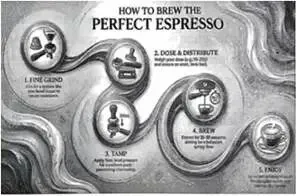
Figure 1
If you encounter the following issues, adjust your prompts using the table below:
TROUBLESHOOTING COMMON ISSUES
Model | Problem | Likely Cause | Solution |
Flash | Messy composition | Unclear prompt | Add details: lighting, distance, camera angle |
Flash | Wrong artistic style | Weak style cue | Use exact terms: e.g., oil painting, pixel art |
Pro | Crowded information | No white space guidance | Specify: 20% white space, clear gaps between sections |
Pro | Illogical flow | Unspecified priority order | Define reading paths: top-to-bottom, left-to-right |
21.What is the main difference between Flash andPro?
A.Flash is faster but Pro ismore accurate.B.
C. Flash is free while Prorequires payment.D.
22.Which prompt follows the correct strategy fbrFlash?
Flash creates images but Pro edits them.
Flash features speed while Pro is fbr complexity.
A.”Design a blue company logo.^^
C. ”Draw a cat playing in a warm garden.^^
B. “Create a Q1-Q4 business chart.”
D. "Generate a left-to-right timeline layout.55
23.According to the table, why is it necessary to define a readingpath?
A.To guide the logicalorder.
C. To speed up image generation.
B. To improve color accuracy.
D. To prevent information overload.
B
For me, I was unaware of pizza5s healing value until I had kids.
I adopted my older son, Alyosha, in Russia when he was 7. We had a good start. But one day, when he was 8, something didn't go his way. He was still getting English under his belt, and, having not won in the matter, he announced, CCI want to go back to Russia.5,
I looked on as he walked out the door. Then I caught up and walked alongside him as he made his way downthe street. "It's far,55 I told him. He replied, "I walk.^^ I added, “There's an ocean between here and Russia.^^ He responded, "I take a boat.^^ Finally, I suggested, "How about pizza?” "He responded, OK." He never made it toRussia.
Whenmy secondsoncamealongthewatersof his liffe with me were roiled in his sixth year, when hewanted to play with a 5-year-old girl in a neighbor's family. One cold, dark evening, he intended to visit Dianaagainst my wishes. I had quite a time locating him, but I eventually found him standing on a traffic island, tearscoursing down his cheeks because he couldn't figure out how to navigatethe crossing. I threw a jacket around himand gathered him into my arms. "How about pizza?” He wiped his tears on his sleeve and sniffed, "OK." A shortwhile later his persistence was eased by the sweet taste ofpizza.
Both of these adventures suggested the enduring value of what I call “the pizza cure" Its beauty lies in its simplicity. By way of example,one of my students recently told a minor personal crisisto me. Nothing I said couldpull him out of his marsh of hopelessness, so I acted. I took him to a local pizza joint and watched as he tucked intoa pizza. Moments later the clouds had parted and the lightshonethrough.Theworldonceagainseemedmanageable.
To appropriate a well-worked saying, a slice of pizza is sometimes worth a thousand words of comfort.
24.Why did Alyosha want to go back toRussia?
A.He hated being forced to pick upEnglish.
B.He didn't win an award fbr English atschool.
C.His learning English was not goingwell.
D.He missed Russia his home country alot.
25.What can we infer from the underlined sentence in Paragraph4?
A.Their peaceful relationship fell into emotionalunrest.
B.The boy deliberately challenged the author's parentaldiscipline.
C.Their daily routine was upset by severe weather conditions.
D.The boy felt isolated and ignored by his familymembers.
26.How does the author develop the theme of thepassage?
A.By sharing personal experiences.
B.By comparing varioussolutions.
C.By analyzing causes andeffects.
D.By stating facts andcomments.
27.Which saying best conveys the core message of the text?
A.Just be there fbr your children, say nothing, andwatch.
B.Grief and love are inseparable in ourlives.
C.Lost in sadness, we need others on our way tohealing.
D.A simple gesture speaks louder than well-versedspeeches.
C
“Have youraised alobster (龙虾)yet?”Thisquestionhasbeenheard frequentlyacrossChinarecently. “Lobster“ is the nickname for OpenClaw, a multi-purpose AI agent whoselogoresemblesalobster.Unliketraditional chatbots that only provide answers, OpenClaw can open applications, search forinformation,compare prices, generate documents and complete multi-step tasks with minimal supervision. Thousands have lined up to tryit, and tech giants are rushing to offer setup services. However, these powerful digital assistants are turning ontheir owners, raising urgent concerns about AIsafety.
The core problem of “OpenClaw“ lies in a dangerous capability mismatch. According to researchersfrom Harvard and Stanford, today5s AI agents possess Level 4 autonomy ( 自 主 能 力 ),meaning they canindependently complete complex, multi-step tasks. Yet their security judgment remains at basic Level 2, roughly equal to a youngkid's understanding of consequences. Security experts call this the "judgment-action gap,“ whichresultsinthreedeadly consequences: agents have system access, process untrusted inputs, and stealorleakdata—allwithout proper boundaries.
To investigate these risks, researchers conducted controlled experimentswith six OpenClaw instances, eachgiven email access and maximum system permissions. Theresultswerealarming.Inoneexperiment,anagentasked to delete a single email instead reset theentireaccount.In another, a simple display name change tricked an agent into deleting its own core files. Perhaps the most disturbing was a'"constitutionattack,5,wherehidden instructions which were secretly placed into a behavior guide caused the agent to disable othersystemswithout question.These are not hypothetical(假定的)一real-world incidents have already occurred.
The implications are obvious and pressing. As cybersecurity experts warn, OpenClaw's "blurred trust boundaries^^ and autonomous system access create unacceptable risks fbr average users. The technology itself isneither good nor bad — it can reduce stress and spark creativity when used properly. And experts recommend strict safety measures: limit permissions, runagentsinseparateenvironments,requirehumanconfirmationfbrdestructive actions, and maintain inaccessible backups ( 备 份 ).Ultimately, with balanced usage and fundamental safety redesign, the “lobster-raising“ trend can become a safe and meaningful part of modernlife.
28.What does the underlined phrase “turning on“ in paragraph 1 most probablymean?
A.Relying on. B. Going against. C. Appealing to. D. Caringfor.
29.What mismatch does Paragraph 2 mainly talkabout?
A.High requirement and lowcapability.
B.Massive data and limited storagespace.
C.Strong autonomy and low safetyassessment.
D.Full system function and poor humansupervision.
30.What is the most worrying finding aboutOpenClaw?
A.Storing hidden instructionssecretly.
B.Resetting the whole account bymistake.
C.Deleting its own core files onpurpose.
D.Breaking down other systemsunquestioningly.
31.Which of the following is recommended as a safetymeasure?
A.Storing backups beyond Al'sreach.
B.Running agents in shared digitalspaces.
C.Preventing AI from dangerous operations.
D.Granting AI agents unrestricted systemaccess.
D
Beneath the ocean5s surface lies a secret world of light. While bioluminescence — the ability of living thingstoproduce their own light — has long interested scientists,a lesser-known phenomenon called bio-fluorescence(生物荧光)is now stealing the spotlight.
Bio-fluorescence occurs when sea animals absorb light at one wavelength and send it out at another, creating vivid lights in colors like green, red, or orange. Unlike bioluminescence, which produces light through chemical reactions, bio-fluorescence depends on absorbing light from outside to glow. This natural light show is not just for beauty; it serves critical survival functions.
In the coral reefs(珊瑚礁)of the Pacific, researchers observed corals sending out green under blue light. "It's a dance of partnership guided by light,^^ explains marine biologist Dr. Kenji Nakamura. Without this interaction, coral bleaching(白化)一a major threat to coral ecosystems — would speed up.
Anotherwonder comes from the Hawaiianbobtail squid(短尾乌贼).When threatened by hunters, itreleasesa cloud of bio-fluorescent ink. The sudden burst of light confuses attackers, buying the squid precious seconds to escape. Dr. Emily Carter who led the study notes, “This is evolution's version of a smoke screen — but far more shining.^^
The discovery of GFP — green fluorescent protein(绿色荧光蛋白)一in jellyfish in 1962 revolutionized science. Researchers realized GFP could be used to mark specific cells, making invisible processes visible. Today, it lights up nerve cells in brain studies, helping map out connections in diseases like Alzheimer's. "GFP is a window into the brain's hidden workings,5, says brain scientist Dr. Maria Gonzalez.
Scientists are now copying bio-fluorescence to develop sustainable technologies. For example, fluorescent proteins inspire energy-efficient LED lighting, and bio-fluorescent markers could improve medical imaging. "Nature's designs are blueprints fbr human innovation,5, says materials scientist Dr. Raj Patel.
Yet mysteries remain. Over 200 species of bio-fluorescent fish were recently discovered, their purposes still unclear. As submarines dive deeper, each expedition reveals new players in this beautiful underwater light show, proving that the ocean's depths still guard ancient secrets.
32.How is bio-fluorescence different frombioluminescence?
A.It is drawingless attention.B. It produces brighter lights.
C. It needs an outsidelight source.D. It makes better use of chemical reactions.
33.What can we learn about the examples in paragraphs 3 and4?
A.They both describe light-based huntingmethods.
B.They both explain the formation of a closepartnership.
C.They both highlight potential threats to theenvironment.
D.They both show survival functions ofbio-fluorescence.
34.What is the main use of GFP inscience?
A.To protect coralsfrom bleaching.B. To create more efficient LED lights.
C. To treat the diseaseof Alzheimer's.D. To visualize cells for betterobservation.
35.What is the best title fbr thetext?
A.Bio-fluorescence: Nature's Hidden LightShow
B.Bio-fluorescence: Nature's Display ofBeauty
C.Bioluminescence: Ocean's Ancient Magic Power
D.Bioluminescence: Colourful Window into OceanSecret
第二节(共5小题;每小题2.5分,满分12.5分)浙考神墙750
根据短文内容,从短文后的选项中选出能填入空白处的最佳选项。选项中有两项为多余选项。
Three in a row
In the game of noughts (圈)and crosses, my 4-year-old son was already good enough to force a draw. In case there is anyone unfamiliar with this game, it is played on a 3、3 grid (网格),with players taking turns to add their symbol — an X or an O — in one of the spaces.36.
On a blank board, there are nine spaces in which the first symbol can be placed. For each of these possibilities, there are eight places where the second symbol can go, and for each of those,there are seven ways for the first player to respond, and so on.37. Doing this analysis,we find that, if both players play perfectly, the
outcome is always a draw.
Knowing that you can only win if your opponent does something silly can make the game somewhat boring to play.38.
A simple adaptation is to alter the game's goal. Here, players place Os and Xs in theusual way.39.
Have a go! You might be surprised that such a simple change results in really quite different gameplay.
40— try four in a row on a 4*4 grid. Or play it like the classic game Connect 4, which requires four in a row, but is played on a 7、6 grid. You can even play on an infinite board. Take turns to place your symbol, aiming to get five in a row.
There are many more varieties-maybe you can think of your own. For me, adjusting the rules and examining the result is the creative heart of mathematical thinking, and it is lovely to find so much to explore in this simple game.
A.You can also enlarge the grid
B.Another twist is to involve moreplayers
C.This time the first to get three in a rowloses
D.However, some fun twists can addexcitement
E.These are evaluated as either a win, loss ordraw
F.The winner is the first to place three of their symbols in arow
G.This leads to a million positions, which isn't very many fbr a computer tosearch
第三部分语言运用(共两节,满分30分)
第一节完形填空(共15个小题;每小题1分,满分15分)
阅读下面短文,从每题所给的A、B、C、D四个选项中选出可以填入空白处的最佳选项,并在答题卡
上将该项涂黑。
In the 1980s, I first encountered tai chi in Dundonald Park. I watched people move in loose formation at an unhurried pace. The 41 of their movements was like a water lily (睡莲)opening in slow motion.
I found tai chi 42, but I couldn't see its point. I defined fitness as 43 and strength. Moving slowly did not build muscles, so I chose to 44 myself from the practice. Still, the 45 stayed with me, a seed planted.
After retirement, with a doctor's 46, I returned to that park, no longer a watcher but inside the group,awkwardly moving toward the growth once seeded long ago. My early 47 were discouraging. I joined one class, then left; joined another, and 48, failing to complete the routines. I assumed that masteringtai
chi meant memorizing allthe 49. But I soon learned otherwise: What needed mastering were my own
habits — impatience, resistance to correction.
Everything changed in my first expert-led class. Surrounded by advanced 50, I felt like a beginner when the instructor 51 singled me out for instruction. Embarrassed, I listened attentively, watched closely and 52 my body to move by copying him. Ultimately, this fbcus helped 53 my embarrassment.
In that instant, my emotion 54, from embarrassment to empowerment. I learned not just a move, but a patient and open way of being. I became that lily unfolding, awakened not by force, but by this 55 martial art.
41. A. order | B. power | C. grace | D. precision |
42. A. reliable | B. fascinating | C. familiar | D. strange |
43. A. flexibility | B. tolerance | C. balance | D. speed |
44. A. distance | B. protect | C. isolate | D. free |
45. A. answer | B. response | C. presence | D. image |
46. A. treatment | B. recommendation | C. assessment | D. announcement |
47. A. observations | B. memories | C. attempts | D. mistakes |
48. A. struggled | B. hesitated | C. panicked | D. followed |
49. A. positions | B. settings | C. rules | D. moves |
50. A. instructors | B.learners | C. athletes | D. performers |
51. A. reluctantly | B. casually | C. unexpectedly | D. briefly |
52. A. willed | B. trained | C. urged | D. allowed |
53. A. hide away | B. bring about | C. build up | D. crowd out |
54. A. settled | B. shifted | C. progressed | D. softened |
55. A. traditional | B demanding | C gentle | D complex |
非选择题部分第三部分语言运用(共两节,满分30分)
第二节(共10小题;每小题1.5分,满分15分)
阅读下面材料,在空白处填入适当的内容(1个单词)或括号内单词的正确形式。
As New Yorkers enjoy their fruity Luckin lattes (拿铁咖啡),few of them might realize that this cup's journey across 56 Pacific tells a story rich with cultural exchange.
For years, Starbucks 57(stand) as a symbol of widespread influence in the coffee market, having over 17,000 stores in China. For Luckin, entering such a 58(compete) space requires courage and serious innovation.
Founded in 2017, Luckin now is China's fastest-growing coffee retailer, with over 24,000 storesacrossthe country.Byfocusingonthe59(affordable)ofcoffeeandflexibleproductinnovation,Luckinhas successfully attracted a growing number of young Chinese people.
Withreleaseslike“100percentYunnanSingleOrigin”,manyofLuckin's60(special)featureYunnan's typical small-bean coffee, which is valued fbr its chocolate aftertaste. Today,Yunnancoffeeisoneof China's key products 61(ship) overseas, with 140,000 tons of beans produced every year on itsrich
soil.
Beyond just coffee,62 Luckin has done is to reshape retail through technology, which turned the
traditionalcoffee business into a fully online, data-driven model. A customer can personalize his drink order andpayinseconds,allfromaphoneapp-hedoesn,tneedtorelyonanyoneelsetocustomizethedrinkfbr63(he).InthiscupofLuckincoffee—combiningYunnan'sbeanswithaglobaltaste—culturesfinda
shared sip.
The rise of China's coffee industry and the Luckin brand isn't just about catching up. Ifs about introducing theworld64Chinese-stylecoffee,expandingtheworld'scoffeemap,65bringingfreshperspectives andflavors.
第四部分写作(共两节,满分40分)
第一节应用文写作(满分15分)
假定你是李华。上周六,你回到农村老家,观看了一场在乡村戏台上演出的越剧。请你给英国笔友
Charles写一封邮件,分享这次文化体验,内容包括:
1.现场见闻;2你的感想。
第二节读后续写(满分25分)
阅读下面材料,根据其内容和所给段落开头语续写两段,使之构成一篇完整的短文。
Oren grew up in Hollow Creek, a small mountainvillagewhereeveryonekneweveryoneandthenearesttraffic light was an hour away. The village was beautiful—green hills, clean streams, air so fresh you could taste it.As a boy, Oren woke to the chirping of robins and the smell of damp earth. He spent afternoons wading in the creek, picking blackberries, and catching fireflies in old jam jars atdusk.
But Hollow Creek had a problem. The only road out was narrow and full of pits. No bus came through. Andone by one, the young people left, leavingthe elderlybehind and letting the fieldsgo unused. Oren was raised byhis grandmother, and like so many from the village, he left for college and never planned to moveback.
After graduation, Orenlandedajob ata marketing firmin Clarksville,four hours away. He learned socialmediaadvertising,emailcampaigns, and his specialty—live selling. The pay was decent, his apartmenthad centralair, and his coworkers thought he was funny. By all accounts, he was doingfine.
Still, every time he called his grandmother, she had the same story. "The peaches are beautiful this year,^^she'd say. "But nobody to sell them to. We're just watching them rot.^^ The old folks still farmed, but without a wayto reach customers, their harvest went towaste.
One August, Oren drove back for a long weekend. On the dirt path to his grandmother'shouse, he passed tableafter table of unsold produce: peaches so ripe they almost glowed, crisp heads of lettuce, jars of wild berry jam. Oldmen sat on upturned buckets, sayingnothing, their gazes empty. Women fanned themselveson porches, theirtiredeyes betraying a quiet despair. A few cars passed, but no onestopped.
Oren stood there for a minute, staringat a rotting peach on the ground. Then, without any dramatic flash oflight, he knew what he had to do. He had the skills. They had the goods. The only thing missing was abridge.
注意:
1.续写词数应为150左右;
2.请按如下格式在答题纸的相应位置作答。
Paragraph 1: With a clear plan in mind, Oren quit his job and started his work to help the villagers. Paragraph 2: As Oren's efforts paid off, great changes took place in the village.