酌情取舍,仅供参考
2026北京西城初三二模
英 语
考生须知 | 1.本试卷共11 页,共两部分,共38 题。满分60 分。考试时间90 分钟。 2.在试卷和草稿纸上准确填写姓名、准考证号、考场号和座位号。 3.试题答案一律填涂或书写在答题卡上,在试卷上作答无效。 4.在答题卡上,选择题用2B 铅笔作答,其他试题用黑色字迹签字笔作答。 5.考试结束,请将本试卷、答题卡和草稿纸一并交回。 |
第一部分
本部分共33 题,共40 分。在每题列出的四个选项中,选出最符合题目要求的一项。
一、单项填空(每题 0.5 分,共6 分)
从下面各题所给的A、B、C、D 四个选项中,选择可以填入空白处的最佳选项。
1. —Is this blue bottle yours? —No,
______ is white.
A. myB. mineC. yourD. yours
2. I bought a dress ______ my mom on Mother’s Day.
A. onB. atC. forD. in
3. You ______ speak loudly in the library. It’s against the rules.
A. mustB. needn’tC. couldD. shouldn’t
4. This is ______ book I’ve ever read. It introduces Chinese history in a fun way.
A. the most amazing B. more amazingC. most amazingD. amazing
5. —______ do you plan to travel this summer vacation?
—I’m thinking about somewhere cool.
A. WhyB. WhenC. WhoD. Where
6. The basketball game was really difficult, ______ our team didn’t give up.
A. butB. soC. orD. for
7. My grandmother takes a walk every day. She ______ the habit twenty years ago.
A. was developing B. developedC. has developedD. develops
8. —I’m nervous about the speech.
—Take it easy. I’m sure you ______ a great job tomorrow.
A. didB. have doneC. will doD. do
9. So far, Tom ______ at the local nursing home for two years, and he will continue
to do so in the future.
A. will volunteerB. volunteeredC. has volunteeredD. volunteers
10. —Have you seen Tony?
—Yes. He ______ football when I passed by the playground just now.
A. is playingB. was playingC. will playD. played
11. We will send you an e-mail if your article ______.
A. will acceptB. acceptsC. will be accepted D. is accepted
12. —Do you know ______ on the far side of the moon?
—On January 3, 2019.
A. when Chang’e-4 landedB. when Chang’e-4 lands
C. when did Chang’e-4 landD. when does Chang’e-4 land
二、完形填空(每题 1 分,共 8 分)
阅读下面的短文,掌握其大意,然后从短文后各题所给的A、B、C、D 四个选项中,选择最佳选项。
Maya was a perfectionist. Her world was beautifully 13. Her notebooks were clearly organized by color, her desk was always clean, and her socks were always a perfect, matching pair. However, her best friend, Chloe, was her 14. Chloe’s backpack was a black hole of forgotten papers and unfinished art projects. Yet, their friendship was perfect because they balanced each other out.
One Monday morning, Maya overslept. She raced through her morning activities. Without checking carefully, she grabbed (抓起) two dark socks, put them on and 15out of the door. It wasn’t until she was sitting in her first-period class, feeling proud of having made it on time, that she mindlessly looked under her desk. The socks on her feet were different! A wave of heat rushed to her face. She spent the whole lesson 16her feet under her chair, believing that every word and laugh was about her mismatched feet.
At lunch, she sat next to Chloe. “I might as well go home now,” she said, finally telling Chloe about her mismatched socks. Chloe stared (凝视) for a second and said, “That’s wonderful! I love it! It’s like your 17are having an argument!”
“We should start a trend (潮流)! Let’s make tomorrow ‘Mismatched Sock Day’! I’ll tell everyone! It must be fun!”
Maya thought her friend had lost her mind. “No one will do it.”
But Chloe was already on her phone, her fingers flying across the screen, 18their whole grade and posting on the class social page. The whole grade responded (回应) quickly and positively.
The next day, Maya 19put on mismatched socks. She walked into school with her head down, prepared to be laughed at. But to her surprise, there were flowers and animals, polka dots and stars, knee-highs and short socks—all proudly mismatched. Even her history teacher had one sock with cats and another with dogs. People were laughing, pointing at each other’s feet, and high-fiving.
Maya looked down at her own crazy socks and felt a huge smile spread across her face. She realized she had been hiding behind the idea of “20” for so long. That day, she learned that true confidence is about being brave enough to be a little different, and sometimes, the best ideas are the imperfect ones that bring everyone together in laughter.
13. A. brightB. timedC. orderedD. simple
14. A. oppositeB. matchC. supporterD. competitor
15. A. lookedB. stoleC. reachedD. flew
16. A. feelingB. shakingC. hidingD. comparing
17. A. feetB. shoesC. classmatesD. fingers
18. A. answeringB. messagingC. pleasingD. encouraging
19. A. proudlyB. unwillinglyC. independentlyD. carelessly
20. A. positivityB. confidenceC. creativityD. perfection
三、阅读理解(每题 2 分,共 26 分)
(一)下图展示了学校为学生提供的四个职业体验工作坊。请根据三名学生的喜好及需求,匹配最适合他们的工作坊,并将其所对应的选项(A、B、C、 D)填在相应位置上。其中一个选项为多余选项。
A
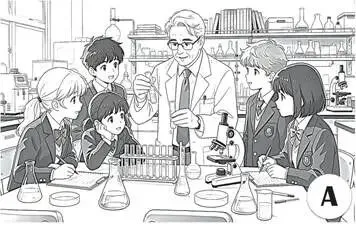
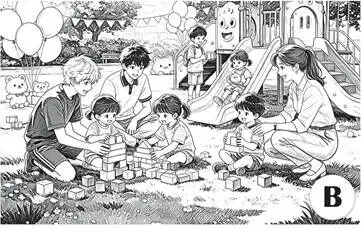
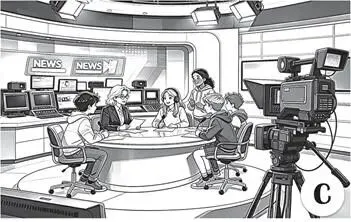
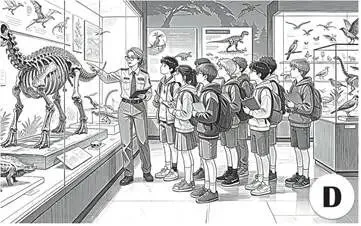
David 21. ______ | I love to learn through exploration. Visiting museums has always been one of my hobbies. If I could become a museum guide one day, I’m sure I would be able to give visitors the best-ever experiences! |
Alice 22. ______ | Actually, I haven’t decided what I want to do in the future. But I’m very interested in doing scientific research. I like finding truth through experiments. I’m excited to have a chance to talk with a scientist. |
Mike 23. ______ | It’s cool to share information from all over the world with the public. That’s why I want to be a news reporter. I’m looking forward to learning about the work of a news reporter in person this time. |
(二)阅读下列短文,根据短文内容,从短文后各题所给的 A、B、C、D 四个选项中,选择最佳选项。
B
Mrs. Lee’s garden was the most beautiful place on Parks Street. It was a living painting that changed with the seasons. To the neighborhood, it was a symbol of peace and beauty, but to a group of teenagers, led by a bored and restless boy named Mark, it was a target (目标).
They picked flowers, knocked down the fence, and threw empty cans. The police suggested that Mrs. Lee should build a taller fence, but she had a different idea, born not from anger, but from a deep understanding of loneliness.
One Saturday, she saw Mark and his friends on the playground. Taking a deep breath, she walked over, a basket in her hand. “My roses are being attacked by insects,” she said calmly. “I need some strong hands to help me put soapy (肥皂的) water on them. I just made some apple pies. Would you like to help me and have a snack?” Mark and his friends were surprised. Free pies? They were not sure, but they followed her.
In the garden, she showed them how to make the soapy water. She told them the names of the flowers and the bees that visited them. They worked in silence at first, but Mrs. Lee’s calm presence slowly relaxed them. In her garden, they ate pies and drank tea. She asked them about school, about their music, listening with real interest. A strange feeling grew inside them. They were treated as helpers.
Mark started coming by after school, sometimes with friends, sometimes alone, to see if Mrs. Lee needed anything. One evening, Mark saw a younger boy from the neighborhood aiming a kick at the fence. “Hey!” Mark shouted, running over. “Watch it! There are bees in there!” The younger boy ran off. Mark stood there for a moment, realizing with shock that he was now protecting the garden.
Mark didn’t receive a lecture (训斥) about right and wrong from Mrs. Lee. Instead, he received responsibility, trust, and the sweet taste of apple pies. He learned that anger builds walls, but kindness builds bridges. Mrs. Lee taught him that forgiveness (原谅) isn’t about forgetting the harm; it’s about planting something new and beautiful in the messed-up soil.
24. What did the neighborhood see Mrs. Lee’s garden as?
A. A place for painting.B. A new playground.
C. A symbol of peace and beauty.D. A messed-up target.
25. Why did Mark feel shocked after the younger boy ran off?
A. Because the bees were attacking the boy.
B. Because Mrs. Lee had asked for his help.
C. Because the fence had suddenly fallen down.
D. Because he realized he was protecting the garden.
26. What did Mark learn about forgiveness from Mrs. Lee?
A. It comes after someone says sorry.
B. It gives someone a chance to grow.
C. It means letting go of the pain of the past.
D. It is about telling others right from wrong.
C
In 2025, researchers from the UK published a finding that humanity’s connection to nature has dropped by over 60% since 1800.
This has serious outcomes for our ability to solve environmental problems. Our personal ties with nature can shape how we take care of our local environments and how we act on bigger problems like climate change. Disconnection from nature also influences our shared future in less noticeable ways. Our personal relationship with the natural world is necessary for our mental (心理的) health and even our connection to one another. In an age of rising distrust and loneliness, we need connection to nature more than ever.
What It Means to Belong in Nature
Belonging is not only about social connection. It’s also about how we’re connected to the physical world.
As recent studies show, spending time in green and blue spaces lowers stress, improves sleep, and helps children with attention and creativity. Time in natural settings is also necessary to our ability to connect. When we’re cut off from natural settings, it’s hard to really listen, to care, or to put ourselves in another person’s shoes. What’s more, nature can offer us sensory richness and a sense of awe (敬畏), which also strengthens our ability to connect.
Is It Possible to Turn Things Around?
We need to restore our ties with nature, but we also need to do something much more fundamental (根本的). We need to fall back in love with the natural world. It’s about responsible dependence. We depend on our places, so we owe (欠) them our care. To belong in nature is to be in relationship. That means receiving gifts from the lands and waters where we live, while taking responsibility for their long-term well-being. This is a relationship that we call “reciprocal.” And that’s what belonging is all about.
Then how do we return to this relationship with nature? I’ve seen many solutions. For example, there is a land-based project in Canada that teaches fishing, natural medicine, and local history alongside traditional language, which rebuilds a lived relationship to home while passing responsibility from elders to their children.
There are many practical examples that are scalable (可扩展的) around the world. Cities should spend more on street trees, pocket parks, and safe wildlife passages. Schools and communities should consider early-childhood programs: forest and gardening education, and ways for parents to help their kids learn about nature.
Of course, the work of falling back in love with nature is up to each one of us. It’s valuable to have our own practices of paying attention and finding connection to the place we call home. Belonging is about feeling our place in the greater whole.
27. What can we learn about the human-nature connection from the passage?
A. Creative children usually connect with nature more easily.
B. Disconnection from nature weakens our ability to relate to others.
C. To belong in nature requires us to build more social connections.
D. Rising distrust and loneliness are caused by losing touch with nature.
28. What does the word “reciprocal” in Paragraph 5 most probably mean?
A. Benefiting each other.B. Going one-way.
C. Working independently.D. Changing all the time.
29. How does the writer develop his ideas in this passage?
A. State an idea → Prove it with examples → End with an opinion
B. Introduce two cases → Explain differences → Give a final point
C. Present a problem → Explain why it matters → Offer ways to solve it
D. Show a problematic event → Describe causes → Make predictions
D
You’ve probably pressed a like button many times today, or kept checking what you posted as the like count rises. But why do we like the like button so much?
In 2018, neuroscientist Lauren Sherman and her team studied that question. They asked 58 teens to choose some photos they had posted recently. Each teen then viewed the photos chosen by the whole group ona specially-designed social media that included a like button. They did so while lying in an fMRI (功能磁共振成像) machine, which allowed researchers to see if the brain lit up when they hit the like button—and if so, what parts of it.
Sure enough, there was activity, and a lot of it. In the experiment, when teens saw their own photos with many likes, their brains showed activity in many different areas. Notably, Sherman also found that viewing photos with many (compared with few) likes was related to greater brain activity. That means we don’t just like to receive likes; we also like things more when other people have liked them.
Why do we like likes so much? According to Nicholas Christakis, a sociologist at Yale University, it is because “the like button is built on the back of evolutionary (进化的) biology.” All animals learn and evolve as they interact with a challenging world, from experience they get through trying and making mistakes, but only certain primates (灵长类动物) have the ability to learn from others’ experience. This social learning allowed early humans to raise their chances of survival by avoiding mistakes they saw others making, and copying the successful moves.
This helps explain why human beings have the preference for “mild hierarchy” (轻微等级制度). In the animal world, animals become leaders by force. Humans, however, recognize the one from whom they learn most as the leader. Members follow standout performers considering what they have done and how well they share the lessons to be taken from their experience.
The evolved social learning ability also helps develop our habits of expressing thankfulness. Because we are willing to keep learning, we show thankfulness in a way that encourages others to keep sharing. For example, we give likes to their posts. In turn, they respond to the likes they receive. It’s what keeps us sharing what we discover.
All this explains why we have evolved to enjoy liking and being liked. What has been chosen in human evolution is not just physical characteristics, but also urges (冲动) and feelings.
And this is the very deep psychological (心理的) area the like button was able to tap in to. Seeing likes come in gives us pleasure. Giving a like, knowing it will make someone happy, also makes us feel good. This is the key to the rise of the like button: Its popularity has very much to do with something fundamental in our biology.
30. Why does the writer introduce the experiment in Paragraph 2 and 3?
A. To explain why seeing likes causes brain activity.
B. To prove that liking behavior is supported by biology.
C. To suggest a biological method to study brain activity.
D. To stress the difference between giving and receiving likes.
31. According to the passage, what might social learning allow people to do?
A. Respect those who rise to the top by force.
B. Make more knowledgeable friends by giving likes.
C. Use likes to encourage sharing what can be learned.
D. Survive better by telling others how to correct mistakes.
32. Which of the following would the writer most probably agree with?
A. Liking behavior results from the evolution of social media.
B. Human’s social learning ability evolved first to choose leaders.
C. Seeing our liked photos causes greater brain activity than seeing others’.
D. The pleasure of liking and being liked has popularized the like button.
33. Which of the following is the best title for this passage?
A. Humans Evolved to Like Likes
B. The Evolution of Ways to Give Likes
C. The Like Button Evolved with the Times
D. Liked by Others: Human Evolution’s Driving Force
第二部分
本部分共 5 题,共 20 分。根据题目要求,完成相应任务。
四、阅读表达(第 34-36 题每题2 分,第 37 题 4 分,共 10 分)
阅读短文,根据短文内容回答问题。
The heart of learning is tranquility (宁静), not excitement.
We often connect the idea of learning with the moments of inspiration and excitement. But these moments don’t last. True learning happens in the quiet, daily steps we take. The key is to stay consistent (一贯的) without being burned out by the pressure of achieving quick results. The most meaningful learning takes place in the space between pushing too hard and doing nothing. It’s about finding the balance.
Learning is not a race but a journey. It requires patience.
Set realistic goals and increase the difficulty of what you learn over time. This way, you can make progress without forcing it.
Learning requires the courage to bear boredom, which is what leads to mastery. The repetition of small tasks is the true training ground for developing expertise (专长). Whether reading the same unit again or practicing the same skill, consistency is key. The true value of learning lies in making daily effort and continuing without expecting quick results. This is what results in mastery.
So how to learn with tranquility? It’s important to set a clear goal and break down the learning tasks into smaller, manageable ones which should be clear and achievable. Remember to focus on progress, not perfection, and allow yourself to make mistakes without feeling ashamed.
As you follow the correct method, each step builds upon the last. There’s no need to rush—step by step, calmly, you’ll make progress. True growth begins with acceptance— recognizing where we are and where we need to go. By accepting where we are, we can plan our next steps calmly and effectively, without the need to force change.
Learning is not about running away from our problems but dealing with them. When we accept the challenges and discomforts of our learning journey and take action, we develop resilience (韧性).
From this foundation (基础), we can shape the future, one step at a time. When we understand that change takes time and requires patience, we’ll stop expecting quick results and focus on our progress.
34. According to the passage, what is the heart of learning?
35. What kind of courage does learning require?
36. When will we stop expecting quick results and focus on our progress?
37. To learn with tranquility, what ways would you like to try? Explain how these ways benefit you. (Please give two ways.)
五、文段表达(10 分)
38. 从下面两个题目中任选一题,根据所给的中文和英文提示,完成一篇不少于50词的英语文段写作。文中已给出内容不计入总词数。所给提示词语仅供选用。请不要写出真实的校名、姓名和地名。
题目①
某国际青少年健康组织将与你校联合举办“健康生活”主题活动,现面向学生征集方案。假设你是李华,你为此调查了学生最想了解的健康生活内容(下图是部分统计结果)。请你用英文给该组织写一封邮件,简要分析调查结果,并针对同学们感兴趣的某一方面提出具体活动方案。
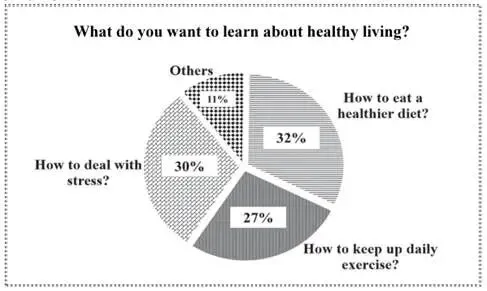
提示词语: balanced, invite, group, share, practical
内容提示:What have you learned from the results?
What activity do you suggest based on the results?
Dear Sir/Madam,
I did a survey on what students in my school want to learn about healthy living.
__________________________________________________________________ I hope my idea can be considered. Thanks.
Yours,
Li Hua
题目②
初中三年匆匆而过。回首来路,你也许曾战胜过胆怯,也许曾为梦想努力拼搏……这一路,你应该感谢自己。某英文网站正在举办以“谢谢你,曾经的自己” 为主题的征文活动。假设你是李华,请用英文写一篇短文投稿,讲述一次你想感谢自己的经历,并说明为什么感谢当时的自己。
提示词语: encourage, confident, brave, success, improve
内容提示: Describe a time when you wanted to thank yourself.
Why do you want to thank yourself?
Looking back on the past three years, there’s a time when I truly wanted to thank myself. _______________________________________________________
参考答案
一、单项填空(每题0.5分,共6分)
1. B2. C3. D4. A5. D6. A
7. B8. C9. C10. B11. D12. A
二、完形填空(每题1分,共8分)
13. C14. A15. D16. C17. A18. B19. B20. D
三、阅读理解(每题2分,共26分)
21. D22. A23. C24. C25. D26. B
27. B28. A29. C30. B31. C32. D33. A
四、阅读表达(34-36题,每题2分;37题4分。共10分)
34.Tranquility.
35.The courage to bear boredom.
36.When we understand that change takes time and requires patience.
37.略。
五、文段表达(10分)
38. 参考范文:
题目①
Dear Sir/Madam,
I did a survey on what students in my school want to learn about healthy living.
The results show that students’ interests are quite balanced: 32% of the students want to learn about healthy eating, followed by 30% about dealing with stress, and 27% about daily exercise. 11% choose other topics.
Even though the three topics are all popular, healthy eating is still the most preferred choice. So, I suggest holding a “Healthy Cooking Workshop.” First, we could invite an expert to give a talk on balanced diets. Then, students would work in groups to make simple yet healthy snacks with the provided materials. After that, we would share our dishes. This activity would be both fun and practical, and it would surely help us develop good eating habits.
I hope my idea can be considered. Thanks.
Yours,
Li Hua
题目②
Looking back on the past three years, there’s a time when I truly wanted to thank myself.
It was the first time I had taken part in the school English Speech Competition. Standing backstage, I felt my heart racing, and I even wanted to run away. But then I took a deep breath and encouraged myself, “You’ve prepared well. Just do it!” I walked onto the stage. After speaking the first few words, I felt more confident, and then gave the whole speech successfully.
I want to thank the past me who bravely overcame the fear at that moment. I learned that true courage is to face what makes you afraid and take action. With that small success, I started to believe in myself, which really improved my life.
Thank you, my past self, for taking that first step to become a better me.