专题01 句子成分与基本句型(期中复习讲义) (解析版)
- 2026-10-12 03:44:42
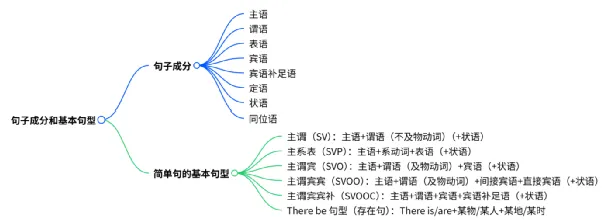
 句子成分与基本句型

01 期中考情透视
02 复习目标锚定
03 知识体系构建
04 核心考点精讲
考点一 主语/ 考点二 谓语/ 考点三 宾语 / 考点四 表语 / 考点五 宾语补足语 /
考点六 定语 / 考点七 状语 / 考点八 同位语 / 考点九 六种基本句型
05 限时分层演练
基础固本练 / 综合进阶练
本专题核心考点覆盖8种句子成分的辨析、6种基本句型的识别、并列连词与从属连词的选择,以及长难句主干的快速提取。命题上常结合语法填空、阅读理解长难句、完形填空语义搭配、写作句子结构等真实题型设置情境。整体以基础送分为主,但“定语vs状语”“宾语补足语vs双宾语”“同位语从句vs定语从句”是拉开分差的关键点。
识记 | 准确复述主语、谓语、宾语、表语、定语、状语、补语、同位语的定义与常见构成;牢记 SV / SVP / SVO / SVOO / SVOC / There be 六种基本句型。 |
理解 | 精准辨析易混成分:定语与状语、宾语补足语与双宾语、同位语从句与定语从句;理清并列连词与从属连词的功能差异。 |
应用 | 能在语法填空中判断空格成分;能拆分阅读理解长难句主干;能写出结构正确且逻辑通顺的简单句、并列句和复合句。 |
考点一主语
1.位置:通常位于句首,在陈述句中,主语位于谓语动词之前;在疑问句中,主语位于助动词之后。
2.作用:句子叙述的主体,是句子说明的人或事物,是执行句子的行为或动作的主体。
3.构成:名词、代词、数词、名词化的形容词、不定式(短语)、动名词(短语)或主语从句等都可作主语
①名词:普通名词或专有名词。
The cat is sleeping on the sofa. 猫正在沙发上睡觉。
②代词:人称代词主格、不定代词、指示代词等。
She loves playing the piano. 她喜欢弹钢琴。
③数词:表示数量的词。
Two-thirds of the students are from China. 三分之二的学生来自中国。
④动词不定式 (to do):具有名词性。
To travel around the world is my dream. 环游世界是我的梦想。
⑤动名词 (V-ing):具有名词性。
Swimming is a good exercise. 游泳是一项很好的运动。
⑥名词化的形容词或分词:如 “the rich”(富人)
The poor need more help.穷人需要更多帮助。
⑦从句:主语从句。
How he solved the problem inspired everyone. 他解决这个问题的方法鼓舞了所有人。
⚠️概念辨析
形式主语 vs 真正主语当主语过长时,常用 it 作形式主语,把真正的主语(不定式、动名词或主语从句)放在句尾。 例:Itis important to learn English well.(it 为形式主语,to learn English well 为真正主语)
⚠️避坑指南
There be 句型中,there 是引导词,不是主语;真正的主语是 be 动词后面的名词。
4.总结:主语是句子的主角,动作的____________,可以是_________,可以是_________;主语一般位于句子的_____________,动词的____________________;一句话里 __________(能/不能)没有主语;通常由_______、 _________、________ 、 ____________、______________ 、 _______________或_________________构成。
5.练习:找出下面句子的主语
The apple is red and big.
Nobody can help you but yourself.
Four and five makes nine.
The sick and the old need our help.
To become a teacher is my dream.
Swimming is good for our health.
That he forgot to tell me the time for the meeting caused lots of trouble.
There are many volunteer activities in our school.
答案: 4. 发出者,人,物;句首;前面,不能;名词、代词、数词、名词化的形容词、不定式(短语)、动名词(短语)或主语从句
5.The apple;Nobody;Four and five;The sick and the old ;To become a teacher;Swimming;That he forgot to tell me the time for the meeting;many volunteer activities
考点二谓语
1.位置:谓语一般位于主语后面(倒装句除外),必须是动词, 具有和时态和语态的变化,且主谓的人称和数需保持一致(主谓一致原则)。
2.作用:说明主语发出的动作或具有的特征状态,即主语做什么/是什么/怎么样。
3.构成:谓语动词包括:系动词(6类)(不能单独做谓语,需配合表语,构成系表结构)、实义动词(2类)、助动词(不能单独做谓语,需配合实义动词)和情态动词(不能单独做谓语,需配合实义动词)。
(1)系动词——虚词,必须与表语连用,构成完整的系表结构.
①be动词——表示主语状态
I am a student./She is my teacher./ They were in the supermarket.
②持续系动词——表示主语继续或保持一种状况或态度 keep, remain, stay, lie, stand...
This matter remains a mystery.
③表像系动词——表示"看起来像"这一概念,seem, appear, look等
He seems (to be) very sad.
④感官系动词——表示人的感官feel, smell, sound, taste等
This flower smells very sweet.
⑤变化系动词——表示主语变成什么样,become, grow, turn, fall, get, go, come, run.
She grew rich within a short time.
⑥终止系动词——表示主语已终止动作,主要有prove, turn out, 表达"证实","结果是"之意
The search proved difficult.
(2)实义动词——与系动词相对,实义动词能独立用作谓语。
①及物动词 (transitive verb) vt:后面必须跟宾语,意义才完整。
I believe that the committee will consider our suggestion.我相信委员会将会考虑我们的建议。
②不及物动词 (intransitive verb) vi:本身意义完整,后面不用跟宾语。
Birds can fly.鸟会飞。
(3)助动词——帮助实义动词实现时态、语态、语气的变化。
① am,is,are,was,were,been,being(帮助变进行时态 , 帮助变被动语态)
② do, does, did(帮助句子变疑问句 , 否定句 , 强调谓语动词作用)
③ has, have(帮助句子变现在完成时态作用)
④ had(帮助句子变过去完成时态 , 以及虚拟语气倒装)
⑤will, shall(帮助句子变一般将来时态)
⑥ would, should(帮助句子变过去将来时态)
(4)情态动词 —— 情态动词是一种本身有一定的词义,没有人称和数的变化,不能单独作谓语,只能和其他动词原形构成谓语表示说话人的观点、态度或语气的词。种类:can, could, (be able to), may, might, shall, should(ought to), will, would, dare, need, must(have to)
4. 总结:谓语动词按结构划分:
(1). 简单谓语:由一个动词/或动词词组构成的谓语。
I (like) walking. / I ( made) your birthday cake last night.
(2). 复合谓语:
①由情态动词/助动词+实义动词构成的复合谓语。
I’ll go and move away the bag. /You’d better catch a bus.
②由系动词+表语构成的复合谓语。
You look the same. / My pen is in my bag.
4.练习:找出下面句子的谓语
①I don't like this dirty room.
②I found my classmates kind and friendly.
③There will be a lecture tomorrow.
④His plan turned out a success.
答案:don't like,found,will be,turned out
考点三宾语
1.位置:宾语一般位于及物动词和介词后面。
2.作用:宾语用来表示及物动词所表示的动作的对象,或是介词所表示的某种联系的对象。
3.结构:名词(短语)、代词、数词、名词化的形容词、不定式(短语)、动名词(短语)及宾语从句。
Eg. We love our motherland./Where did you buy that? /If you put 5 and 7 together, you’ll get 12.
注意辨析:
宾语有时会分为直接宾语(DO)和间接宾语(IO)两种情况。可以带两个宾语的动词:bring, give, buy,show, send, pass, tell, make, offer...
例句:The sun gives us light and warmth./ I sent you a flower./You gave me a ring.
记忆技巧:人是间接宾语,物是直接宾语——人间物直
4.总结: 宾语是_____________所表示的动作的对象,或是________所表示的某种联系的对象;宾语放在及物动词或介词的________;宾语一般由_____、____、_____、__________、__________、_________及___________充当;有些及物动词要求两个宾语,通常一个为_____________(指的是动词所涉及的物),另一个为_______________(指受益于动词所表示行为的人)。
5.练习:找出下列句子的宾语
①I love you.
②They sent the boy to hospital.
③I enjoyed learning.
④He did not want to leave.
⑤ I don’t know what she has said.
答案:4.及物动词,介词;后面;名词(短语)、代词、数词、名词化的形容词、不定式(短语)、动名词(短语)及宾语从句;直接宾语,间接宾语
5.you, the boy,learning, to leave, what she has said.
考点四表语
1.位置:表语位于系动词的后面。
2.作用:表语用来说明主语的身份或特征,即是什么/怎么样,即主语“是什么”,“怎么样”。
3.结构:表语通常由名词(短语)、代词、形容词、数词、副词、介词短语、不定式(短语)、动名词(短语)、分词(短语)或表语从句等充当。
例句:She is beautiful./Angela was the first to leave.
4.总结:表语位于__________之后,说明主语的__________或_____________;通常由名词短语、______、____、_____、_____、________、_________、_________、____________及_________等充当。
5.练习:找出下列句子中的表语。
My mother is a teacher.
I want to keep healthy.
The music sounds great.
The leaves turn green in spring.
It seems as if the world were at an end.
答案:4.系动词,身份,特征;形容词、代词、数词、副词、介词短语、不定式(短语)、动名词(短语)、分词(短语)及表语从句。
5.a teacher,healthy, great,green,as if the world were at an end
考点五定语
1.位置:定语可分为前置定语(位于被修饰词之前)和后置定语(位于被修饰词之后)。
2.作用:定语为句子的次要成分,起修饰限制名词或代词的作用。
3.结构:定语一般由形容词、名词、形容词性物主代词、数词、副词、介词短语、动词不定式、动名词、分词 ( 短语 )或从句充当。
例句: He is an honest boy./We love our country.
4.总结:定语分为____________和____________,起到____________的作用;通常由形容词、______、____、_____、_____、________、_________、_________、____________及_________等充当。
5.练习:找出下列句子中的定语。
What’s your telephone number?
She is a beautiful girl.
This is a basket full of flower.
This is a basket that is full of flower.
答案: 4.前置定语和后置定语,修饰限定;名词、形容词性物主代词、数词、副词、介词短语、动词不定式、动名词、分词 ( 短语 )或从句
5.your,beautiful,full of flower,that is full of flower
考点六状语
1.位置:状语的位置比较灵活,可放句首,句中或句末。
2.作用:状语是用来修饰动词、形容词、副词、句子或某一句子成分的一种成分。它可以表示时间、地点、方式、程度、原因、目的、结果、条件、让步或比较等。
3.结构:状语通常由副词、介词短语、不定式(短语)、分词(短语)、形容词、名词(短语)、从句或独立主格结构等充当。
例句: Tom speaks English very fast./he meeting is going to be held in Room 321 tomorrow morning.
4.总结:状语是用来修饰_________、_________、__________、________或__________的一种成分;它可以表示时间、地点、方式、程度、原因、目的、结果、条件、让步或比较等情况。通常由副词、________、__________、__________、__________、___________从句活独立主格结构等充当。。
5.练习:找出下列句子中的状语。
I went there to see my grandmother.
Arriving there, call me up.
He returned home, safe and sound.
We’ll go where people need us.
Time permitting, we’ll take a break.
答案:动词,形容词,副词,句子,某一句子成分;介词短语、不定式(短语)、分词(短语)、形容词、名词(短语)
5.to see my grandmother,Arriving there,safe and sound,where people need us,Time permitting
考点七 补语
1.分类:补语分为宾语补足语和主语补足语,位置灵活。
2.作用:宾语补足语是用来补充说明宾语的性质、状态等的一种句子成分;主语补足语是用来说明主语的性质、状态等的一种句子成分。
3.结构:名词(短语)、形容词(短语)、副词、介词短语、不定式(短语)、分词(短语)等皆可作补足语。
4.总结:补语分为______________和_____________;用来补充说明宾语或主语的性质状态的句子成分;补语常用_________、__________、__________、__________、___________或分词(短语)充当。
5.练习:找出下列句子中的补语。
I found the book very interesting.
He made himself known to them first.
She asked me to lend her a hand.
There are many students playing in the playground.
答案: 4.宾语补足语,主语补足语;名词(短语)、形容词(短语)、副词、介词短语、不定式(短语) ;5 very interesting,known to them,to lend her a hand, playing in the playground
考点八同位语
1.概念: 表示对一个名词或代词进行解释或补充说明的词或句子,在语法上和这一成分处于同一地位。
2.练习:找出下面句子中的同位语。
Their friend, Danny Lin, was waiting at the airport.
Mr.Smith, our new teacher, is very kind to us.
Beijing, the capital city of China, is a bustling city.
The fact that he had not attend the meeting surprised me.
答案:Danny Lin,our new teacher, the capital city of China,that he had not attend the meeting
考点九六种基本句型
句型1 主谓: 主语+谓语(SV)She comes./The dog cried
注意:谓语为不及物动词
句型2:主+谓+宾
I love her./The monkey beat the dog/I couldn’t concentrate on the experiment.
 注意:两种情况:及物动词+宾语
不及物动词+介词宾语
句型3:主+系+表 She is beautiful./You are my sunshine.
句型4:主+谓+间宾+直宾 She gives me a smile./His father bought him a cake.
句型5:主+谓+宾+宾补 She makes me happy.
句型6:主+谓+状 I live in the countryside.
句型7:主+谓+宾+状 I saw a dog in the park.
句型8:there be 句型 There are many dogs.
判断句型结构(SV/SVO/SP/SV IO DO/SVOC/SVA/SVOA/There be)
1. We must act. ________
2. The 100-year-old school lies in the centre of the city. ________
3. The maths homework looks easy. ________
4. The teacher found the classroom empty. ________
5. My mum bought me a new dictionary. ________
6. There is an English Corner at our school. ________
7. We had chemistry in the newly built lab. ________
8. I miss my grandma. ________
【答案】
1.SV2.SVA3.SP4.SVOC5.SV IO DO6.There be7.SVOA8.SVO
 基础固本练(限时:5分钟)
一、指出下面划线部分的句子成分。
1.She runs in the park every morning.
A.宾语 B.状语 C.主语 D.表语
【答案】B
【解析】考查句子成分分析。句意:她每天早上在公园里跑步。根据句子成分分析可知,主语为 “She”,谓语为 “runs”,“every morning” 为时间状语;划线部分 “in the park” 表示动作 “runs” 发生的地点,作地点状语。故选 B 项。
2.We made him monitor.
A.宾语补足语 B.谓语 C.定语 D.状语
【答案】A
【解析】考查句子成分。句意:我们选他当班长。分析句子成分可知,主语为 “We”,谓语为 “made”,宾语为 “him”;划线部分 “monitor” 补充说明宾语 “him” 的身份,使宾语意义更完整,作宾语补足语。故选 A。
3.My friend Tom is coming to see me.
A.宾语 B.同位语 C.表语 D.谓语
【答案】B
【解析】考查句子成分分析。句意:我的朋友汤姆要来看我。根据句子成分分析可知,主语核心为 “My friend”,谓语为 “is coming”,“to see me” 为目的状语;划线部分 “Tom” 与 “my friend” 所指对象一致,补充说明朋友的名字,作同位语。故选 B 项。
4.To learn English well is important.
A.状语 B.宾语 C.主语 D.表语
【答案】C
【解析】考查句子成分。句意:学好英语很重要。分析句子成分可知,该句为 “主系表” 结构,系动词为 “is”,表语为 “important”;划线部分 “To learn English well” 是动词不定式结构,在句中充当叙述的主体,作主语。故选 C。
5.Swimming is good for health.
A.谓语 B.主语 C.宾语补足语 D.定语
【答案】B
【解析】考查句子成分分析。句意:游泳对健康有益。根据句子成分分析可知,该句为 “主系表” 结构,系动词为 “is”,表语为 “good”,“for health” 为状语;划线部分 “Swimming” 是动名词,具有名词性质,在句中充当叙述的主体,作主语。故选 B 项。
二、分析句子成分并写出基本句型(限时:10分钟)
6.The students agreed.______
7.My sister is writing a letter.______
8.I heard him sing a song.______
9.He asked me to come back soon.______
10.My teacher gave me a book.______
11.His face turned red.______
12.This is an English-Chinese dictionary.______
13.There are many customs in the village.______
14.A sports meeting will be held in our school next week.______
【答案】
6.主语+谓语7.主语+谓语+宾语8.主语+谓语+宾语+宾补9.主语+谓语+宾语+宾补10.主语+谓语+间接宾语+直接宾语11.主语+系动词+表语12.主语+系动词+表语13.there be 句型 谓语+主语+地点状语14.主语+谓语+地点状语+时间状语
【解析】6.考查句子结构。分析句子可知,这是主谓结构,The students“学生们”是主语,agreed“同意”是谓语。所以,这个句子的结构是:主语+谓语。
7.考查句子结构。分析句子可知,这是主谓宾结构,My sister“我的妹妹”是主语,is writing“正在写”是谓语,a letter“一封信”是宾语。所以,这个句子的结构是:主语+谓语+宾语。
8.考查句子结构。分析句子可知,这是主谓宾宾补结构,I“我”是主语,heard“听到”是谓语,him“他”是宾语,sing a song“唱歌”是省略to的不定式作宾补。所以,这个句子结构是:主语+谓语+宾语+宾补。
9.考查句子结构。分析句子可知,这是主谓宾宾补结构,He“他”是主语,asked“要求”是谓语,me“我”是宾语,to come back soon“快点回来”是宾补。所以,这个句子结构是:主语+谓语+宾语+宾补。
10.考查句子结构。分析句子可知,这是主谓双宾结构,My teacher“我的老师”是主语,gave“给”是谓语,me“我”是间接宾语,a book“一本书”是直接宾语。所以,这个句子结构是:主语+谓语+间接宾语+直接宾语。
11.考查句子结构。分析句子可知,这是主系表结构,His face“他的脸”是主语,turned“变成”是系动词,red“红色的”是表语。所以,这个句子结构是:主语+系动词+表语。
12.考查句子结构。分析句子可知,这是主系表结构,This“这”是主语,is“是”是系动词,an English-Chinese dictionary“一本英汉字典”是表语。所以,这个句子结构是:主语+系动词+表语。
13.考查句子结构。分析句子可知,这是there be 句型结构,many customs“许多风俗习惯”是主语,There are“有”是谓语,in the village“在村子里”是地点状语。所以,这个句子结构是:there be 句型 谓语+主语+地点状语。
14.考查句子结构。分析句子可知,这是主谓状结构,A sports meeting“一场运动会”是主语,will be held“将被举办”是谓语,in our school“在我们学校”是地点状语,next week“下周”是时间状语。所以,这个句子结构是:主语+谓语+地点状语+时间状语。
 综合进阶练(限时:15分钟)
一、语法填空 (注意分析空格处所充当的句子成分)(2025∙全国二卷)
IwasbornandraisedinCleveland, OhiointheUnitedStates.Yetnow, IliveinthecountrysideofZhejiang, ChinawithmyChinesehusbandandhisfamily, 56.bamboo and tea bushes (灌木) grow wild in the mountains, chickens are always free-range, and 57. (center) heating doesn’t exist.
Nothing in my life before prepared me 58. this one — and to be sure, the first time I came here I never imagined I would ever feel comfortable in this area.But it’s amazing how you can adapt 59. learn in a new environment.Over time, I’ve found 60. (I) feeling extremely at home here.And in the process, I’ve experienced things that really surprise me at times.The “sunshine scent (香味)” of freshly sunned clothes 61. (be) one of them.
Growing up, my family and our neighbors never used clotheslines to dry clothing, denying me the chance 62. (discover) one of the great wonders of sunshine — the sweet “sunshine scent” after sunning clothes for an entire day.The sun-dried clothes smell especially pleasant where I live, thanks to the 63. (absent) of smog and plenty of blue sky 64. (afternoon) with lots of fresh air.
If you’ve never experienced the “sunshine scent” from a sheet or shirt 65.__ (leave) to sun for a day, well, you’re missing out on one of life’s wonders.
【答案与解析】
56.where 考查关系副词。空处引导非限制性定语从句,先行词是the countryside of Zhejiang, China,从句成分完整,应用where,相当于in which。
57.central 考查形容词。分析句子结构可知,空处作定语,修饰名词heating,应用所给词center的形容词central。
58.for 考查介词。prepare sb for sth是固定用法,意为“使某人为某事做好准备”。
59.and 考查连词。分析句子结构可知,adapt和learn都是谓语动词,两者为并列关系,应用并列连词and。
60.myself 考查代词。“find oneself+分词”表示“发现自己处于某种状态”,此处的主语是I,应用反身代词myself。
61.is 考查时态和主谓一致。本句的主语是单数sunshine scent,句中缺少谓语,根据上文时态可知,此处描述的是客观情况,应用一般现在时。
62.to discover 考查非谓语动词。the chance to do sth是固定用法,意为“做某事的机会”,空处应用to discover作后置定语。
63.absence 考查名词。此处为“the+名词+of ...”结构,空处应用所给词absent的名词absence。
64.afternoons 考查名词复数。根据上文的plenty of可知,此处要用afternoon复数形式。
65.left 考查非谓语动词。从句中已有谓语,空处应用非谓语动词;a sheet or shirt与leave之间为逻辑上的动宾关系,应用过去分词作后置定语。
二、翻译句子(限时:10分钟)
1.一群交换生来了。(S+V)(汉译英)
______________________________________________________________________________
【答案】A group of exchange students came.
【详解】考查句型结构、名词短语和时态。根据括号内的要求可知,本句应用“主语(S) + 谓语(V)”结构表达句子。“一群交换生”是主语,其中“一群”用a group of,“交换生”译为exchange student,用复数形式,组合为名词短语a group of exchange students,位于句首,首字母应大写;句子描述过去发生的事实,应用一般过去时,“来了”表示过去发生的动作,用动词come的过去式came作谓语。故翻译为A group of exchange students came.
2.他分析了这个句子。(S+V+O) (汉译英)
______________________________________________________________________________
【答案】He analysed the sentence.
【详解】考查时态。句子描述的动作发生在过去用一般过去时,主语为he;表示“分析”用动词analyse;使用过去式形式analysed作谓语,表示“句子”用名词sentence,作宾语。故翻译为He analysed the sentence.
3.我们的数学老师又高又帅。(S+V+P) (汉译英)
______________________________________________________________________________
【答案】Our math teacher is tall and handsome.
【详解】考查基本句型。根据句意,句子描述客观事实,使用一般现在时;表示“我们的数学老师”应用our math teacher作主语,位于句首单词首字母需大写;“是”为系动词be,主语为第三人称单数,系动词用is;“又高又帅”为tall and handsome作表语。故翻译为Our math teacher is tall and handsome.
4.我祖父给我一块手表。(S+V+IO+DO) (汉译英)
______________________________________________________________________________
【答案】My grandpa gave me a watch.
【详解】考查动词短语和时态。主语“我祖父”为my grandpa;表示“给某人某物”短语为give sb. sth.;me为间接宾语,“一块手表”为a watch,是直接宾语。动作发生在过去用一般过去时,句首单词首字母大写。 故翻译为My grandpa gave me a watch.
5.他说的话使我很高兴。(S+V+O+OC) (汉译英)
______________________________________________________________________________
【答案】What he said made me happy.
【详解】考查句子结构及主语从句。表示“他说的话”,应用主语从句What he said作句子的主语 (what引导主语从句并在从句中作宾语);表示“使我高兴”应用made me happy (“使某人高兴”用固定搭配make sb. happy。此处描述过去发生的事,用一般过去时) made是谓语,me是宾语,happy是宾语补足语。故翻译为What he said made me happy.。
6.我们的英语老师说话太快了。(S+V+Ad) (汉译英)
______________________________________________________________________________
【答案】Our English teacher speaks too quickly.
【详解】考查动词时态。表示“我们的英语老师”应用our English teacher,作主语;表示“说话”应用speak作谓语,陈述客观事实,使用一般现在时,主语为单数名词,谓语动词使用第三人称单数形式;表示“太快了”应用too quickly,作状语。故翻译成:Our English teacher speaks too quickly.。
7.我上星期在书店买了一本词典。(S+V+O+Ad) (汉译英)
______________________________________________________________________________
【答案】I bought a dictionary in the bookstore last week.
【详解】考查基本句型和词汇。表示“我”,作主语,应用I;表示 “买”,作谓语,应用动词bought (buy的过去式,体现动作发生在上星期);表示“一本词典”作宾语,应用a dictionary;表示“在书店”,作地点状语,应用in the bookstore;表示“上星期”,作时间状语,应用last week。故翻译为I bought a dictionary in the bookstore last week.。
8.市中心有一个很大的公园。(There be) (汉译英)
______________________________________________________________________________
【答案】There is a large park in the centre of the city.
【详解】考查固定句型。There be句型的基本结构为“There be + 主语 + 地点状语”。主语是a large park,主语是第三人称单数形式,句子表述客观事实,be动词是is,地点状语是in the centre of the city。故填There is a large park in the centre of the city.。
9.他把墙漆成了白色。(S+V+O+C) (汉译英)
______________________________________________________________________________
【答案】He painted the wall white.
【详解】考查动词、时态和句子结构。主语“他”用人称代词he,谓语“把……漆成”用动词paint,讲述过去的事情用一般过去时态painted,宾语“墙”用名词the wall,“白色”作宾语补足语,用形容词white;全句为“主谓宾宾补”句型,即S+V+O+C。故译为:He painted the wall white.
10.玛丽不能工作,因为她病了。(S+V+A) (汉译英)
______________________________________________________________________________
【答案】Mary couldn’t work because she was ill.
【详解】考查时态和从句。根据句意可知,陈述过去发生的事情,为一般过去时。玛丽不能工作翻译为:Mary couldn’t work 。因为为“because”,引导原因状语从句,她病了为“she was ill”。故翻译为:Mary couldn’t work because she was ill.

