基础阅读|高考模拟题2026深圳一模D篇
- 2026-10-21 03:36:19
【原题】
【个人解析】
1. What problem do the NUS researchers aim to solve?
【细节理解题】正确答案:C
【定位点】:NUS;aim to solve—定位到第三段第一句
【选项对比】To solve this problem, the NUS team built a special device.为何先定位到这句呢?因为作者说为了解决这个问题,在段首很容易就找到了。那真的这句就是答案定位句了吗?看到没,this problem!用了this,前文肯定出现过,我们网上找找。诶嘿,刚好就是上一句了就说了。
In this way, researchers can collect charges, but it is far from effective.【这句就是我们答案的定位句了】。看看和选项匹配一下哪个最合适。
A. The difficulty of separatingcharges.
【不对。定位句说的是收集,这里说的是分离(separating)】
B. The lack of clean electricity sources.
【答案定位句没说缺少清洁电能】
C. The inefficiency of charge harvesting.
【就是它了,匹配上了~我们详细看看是如何达成同义替换的】
【原文】In this way, researchers can collect charges, but it is far from effective.
【选项】The inefficiency of charge harvesting.
原文中的but it is far from effective,说的就是远远不够有效率,选项中通过添加前缀in-来表示否定以达成同义替换。
在选项A of B的结构中,B部分用的是harvesting(采集、获取、收获)与原文中的collect达成了同义替换
collect charges= charge harvesting
在这个小节中,我们可以明白:达成同义替换可以使用A of B的结构对原文进行浓缩,接着再使用词的变形。
D. The damage of traditional hydropower.
【文中没有提到传统水电的破坏】
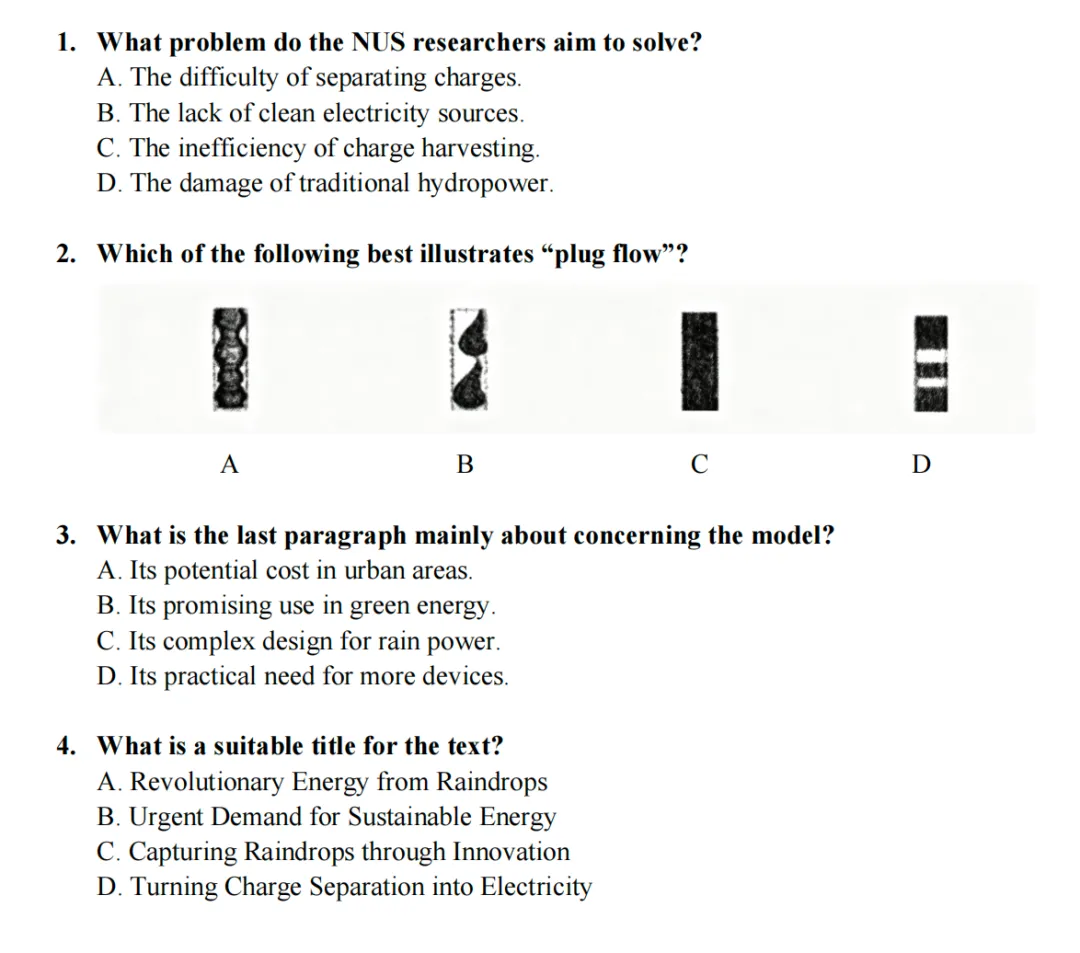
2. Which of the following best illustrates “plug flow”?

【概念理解题】正确答案:D
【定位点】plug flow—定位到第三段--When these droplets enter the tube, their impacts create “plug flow,” in which the water forms mini columns separated by air gaps.
【选项比对】
这题还是蛮新颖的,很有意思。我们来看看怎么做这道题。定位到答案句后,看看里面的细节。
When these droplets enter the tube, their impacts create “plug flow,” in which the water forms mini columns separated by air gaps.
在这句话中,你觉得细节是啥呢?那来看看题?四个选项中,我们可以看到不同的阴影区域和空白区。
来,精读一下。
When these droplets enter the tube(when引导的时间状语从句), their impacts【主】create 【谓语动词】“plug flow,”【宾】in which the water forms mini columns separated by air gaps.【非限制性定语从句】
时间状从说明了产生的条件,主句说明了结果(产生了plug flow这个效应),非限制性定语从句则对主句中“plug flow”进行了解释。
现在,来做题。但从plug flow中一词比较难推断出是哪个图案。所以,应主要看非限制性定语从句中的内容。
in which the water forms mini columns separated by air gaps
mini column—小柱子
separated by air gap—被空气间隙分隔开
这是两个主要特征,接着匹配选项。
A—不对,图中有空气间隙,但没有体现分隔开,阴影部分还是连接的团块。
B—不对,图中的阴影部分呈滴状且下部并未完全分离。
C—不对,未呈现间隔,全为阴影。
D—正确,小柱子+间隔。
Ok,做对之后我们再次回归 plug flow 的词意
plug(塞子)+flow(流)--塞流
plug flow在tube形成了column--柱塞流
直观的样子:一段水柱、一段空气、一段水柱,交替排列在管子里,像一个个水塞被空气隔开。
3. What is the last paragraph mainly about concerning the model?
【段落主旨大意题】正确答案:B
【定位点】last paragraph mainly about concerning the model
【选项匹配】
这种题要咋做?因为不是细节理解,我觉得可以先把文段速读一下,首句要认真读。
According to the study’s lead author, this model shows how rain can be used to generate clean electricity effectively and sustainably, especially in rainy places such as Singapore. Its potential is enormous, as it offers an alternative energy source even in cities. Imagine a rain collection device on your roof, producing small amounts of electricity whenever it rains—a small step for a raindrop, but a giant leap for sustainable energy technology.
这段讲的主要还是利用雨水来产生有效和可持续的清洁能源及其如何利用。所以,段首句—利用+清洁能源,后面还提到了Its potential(潜力/潜在)和在城市里的应用。
A. Its potential cost in urban areas.
【错,未提及潜在支出】
B. Its promising use in green energy.
【promising use 前景广阔的应用+ green energy—中心同义替换】
C. Its complex design for rain power.
【错,未提及复杂的设计】
D. Its practical need for more devices.
【未提及实用的需求】
4. What is a suitable title for the text?
【标题归纳题】正确选项:A
【定位点】a suitable title for the text
【选项匹配】
我们来看看文章各段的核心
第1段:引入电荷分离的概念,接着说本文新技术—利用液滴发电。
第2段:表达旧方案的局限性,小水流下收集电荷效果差。(这也是后文要解决的问题。
第3段:细说新装置—构造、工作原理、优势、实验效果。
第4段:新技术的前景、应用场景与价值(绿色能源潜力)。
A. Revolutionary Energy from Raindrops
【源于雨滴的革命性能源】--贴合原文
B. Urgent Demand for Sustainable Energy
【对可持续能源的迫切需求】--文中没提及“迫切需求”
C. Capturing Raindrops through Innovation
【通过创新以收集雨滴】--没有体现文中所说的发电&能源,Capturing Raindrops说的只是收集雨滴,没有呈现generate electricity这个核心。
D. Turning Charge Separation into Electricity
【将电荷分离转化为电能】--没覆盖完全,文章说的还是雨滴发电!电荷分离还只是一个物理现象,并不能概括出发电这个事件。
--------

