【RJ版八上】UNIT1 单元复习要点
- 2026-10-16 23:15:40
【【RJ版八上】Unit 1Happy Holiday
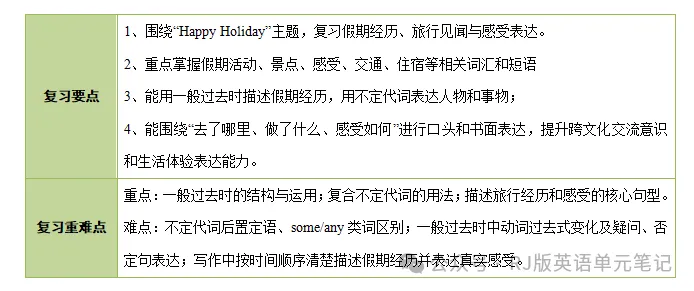
复习要点


知识点1:How do people spend their holidays?人们怎么度过他们的假期?
1. spend:及物动词,此处含义为花费(时间),主语需为人。
变形:spends(三单),spent(过去式/过去分词),spending(现在分词)
【固定搭配】
①spend + 时间/金钱 + on sth. (在某物上花时间/钱)例:spend time on books
②spend + 时间/金钱 + (in) doing sth. (花时间/钱做某事)例:spend time reading
【易混辨析】
spend/ cost/ take/ pay | ||
spend | sb.+spend+time/money+on sth. “某人花时间/金钱在某物上” | He spends much of his pocket money on science books. 他把很多零花钱用在买科学书上。 |
sb.+spend+time/ money+(in) doing sth. “某人花时间/金钱做某事” | She spent most of her life caring for others. 她花了大半辈子的时间照顾他人。 | |
cost | sth.+cost+sb.+money “某物花费某人多少钱” | It cost me 60 dollars to go to New York by train. 我乘火车到纽约花了60美元。 |
take | It+takes+sb.+time+to do sth. “做某事花费某人多长时间” | It took me ten minutes to go to the post office. 到邮局花了我10分钟。 |
pay | sb.+pay+money+for sth. “某人为某物付多少钱” | He has paid the doctor 50 yuan for the medicine. 他买药付给医生50元。 |
sb.+pay for+sth. “某人为某物付款” | Mr. Green needn’t pay for his son’s tuition fees this year. 今年格林先生不需要给他儿子付学费了。 |
知识点2:一般过去时(单元核心语法)
一、含义:表示过去某一时间发生的动作或存在的状态。
二、时间标志词:①yesterday系列:yesterday, yesterday morning/afternoon/evening, the day before yesterday;
②last系列:last night/week/weekend/month/year...
③ago系列:two hours/three days/ten years ago...
④in+过去的年份:in 2025...
⑤this morning...
三、谓语结构:动词过去式(V-ed)
四、句型
1. 谓语动词是be(was/were)动词
①肯定句:主语+was/were+其它.
例如: He washappy yesterday.
②否定句:主语+wasn’t/weren’t+其它.
例如: He wasn’thappy yesterday.
③一般疑问句:—Was/Were+主语+其它?
—Yes, 主语+was/were. / No, 主语+wasn’t/weren’t.
例如: —Washe happy yesterday?
—Yes, he was. / No, he wasn’t.
④特殊疑问句:特殊疑问词+was/were+主语+其它?
例如: How was he yesterday?
2. 谓语动词是实义动词
①肯定句:主语+动词过去式+其它.
例如: She playedbasketball last week.
②否定句:主语+didn’t+动词原形+其它.
例如: She didn’t playbasketball last week.
③一般疑问句:
—Did+主语+动词原形+其它?
—Yes, 主语+did. / No, 主语+didn’t.
例如: —Didshe playbasketball last week?
—Yes, she did. / No, she didn’t.
④特殊疑问句:特殊疑问词+did+主语+动词原形+其它?
例如: Whatdid she do last week?
五、动词过去式变化规则
1. 规则变化:
① 一般情况,直接+ed:work—worked
② 以e结尾+d:live—lived
③ 以辅音字母+y结尾,变y为i+ed:study—studied
以元音字母+y结尾,+ed: play—played
④ 重读闭音节结尾,且末尾只有一个辅音字母,双写辅音字母+ed:stop—stopped
2. 单元高频不规则过去式:
go—went;see—saw;take—took;spend—spent;eat—ate;buy—bought;visit—visited
知识点3:复合不定代词(单元核心语法)
1. 概念:由 some , any , no , every 这几个前缀,与 -one , -body , -thing 这几个后缀组合而成的不定代词,用来指代不确定的人或物。
单词 | one 指人 | body 指人 | thing 指物 | where 指地点 |
some 某个 | somebody 某人 | somebody 某人 | something 某事;某物 | somewhere 某地 |
any 任何 | anyone 任何人 | anybody 任何人 | anything 任何事 | anywhere 任何地方 |
every 每一 | everyone 每个人 | everybody 每个人 | everything 每件事 | everywhere 每个地方 |
no 没有;不 | no one 没有人 | nobody 没有人 | nothing 没有事 | / |
2. 核心考点:
(1)作主语视为单数,谓语动词用三单。
例如: Everyone was excited about the trip.
(2)当形容词、动词不定式、else修饰不定代词时,形容词、动词不定式要后置。
something interesting 有趣的事(√)
interesting something(×)
nothing to eat 没有可以吃的东西(√)
to eat nothing(×)
(3)some类(something/someone)多用于肯定句;any类(anything/anyone)多用于否定、疑问句
例如: Did you buy anything special?
例如: I found something interesting in the shop
特殊用法:在表示请求、建议或希望得到肯定回答的疑问句中,即使是个问句,也要用some类。
例如: Would you like something to drink? (你想喝点什么吗?)
这句话是提供服务,希望对方回答“是”,所以用 something 。
3. 易错提醒:
not 与every类连用表示部分否定,表示“并非所有都……”,而不是“所有都不……”。
e.g. Not everyone likes watching TV. (并非人人都喜欢看电视。)

(1) spend one’s holiday 度过假期
(2) free/spare time 空闲时间
(3) go on vacation 去度假
(4) take photos 拍照
(5) quite a few 相当多(可数)
(6) most of the time 大部分时间
(7) arrive in+大地点arrive at+小地点到达某地
(8) decide to do sth. 决定做某事
(9) try doing sth. 尝试做某事
try to do sth. 尽力做某事
(10) feel like doing sth. 想要做某事
(11) because of + 名词/短语
because+句子 因为
(12) wait for 等待
(13) buy sth. for sb.=buy sb. sth.给某人买某物
(14) have a good time =have fun =enjoy oneself 玩得开心
(15) forget to do sth. 忘记去做某事(未做)
forget doing sth. 忘记做过某事(已做)
(16) remember to do sth. 记得去做某事(未做)
remember doing sth. 记得做过某事(已做)

(1) Where did you go on vacation? I went to...
你去哪里度假了?我去了.....
(2) What did you do there? I visited... / I took many photos.
你在那里做了什么?我参观了....../我拍了许多照片。
(3) How was your holiday? It was wonderful/great/boring.
你的假期怎么样?很精彩/很棒/很无聊。
(4) Did you go with anyone? Yes, I went with my family.
你和任何人一起去了吗?是的,我和我的家人一起去的。
(5)Everything tasted really good!
所有东西尝起来都很棒。
(6)There was nothing to do in the evening.
在晚上没有事可做。
(7)I felt so tired but happy.
我感到累但很快乐。
(8) It was my first time to visit this place.
这是我第一次参观这个地方。


【免责声明】
本号为个人教学分享,非学校官方。笔记内容仅供参考,部分素材源于网络或教材,版权归原作者,侵权请联系删除。

