2024 考研英语(一)真题
- 2026-11-04 18:42:55
【Part B 新题型就是咱们前面说的文化类主题】
2024 考研英语(一)真题
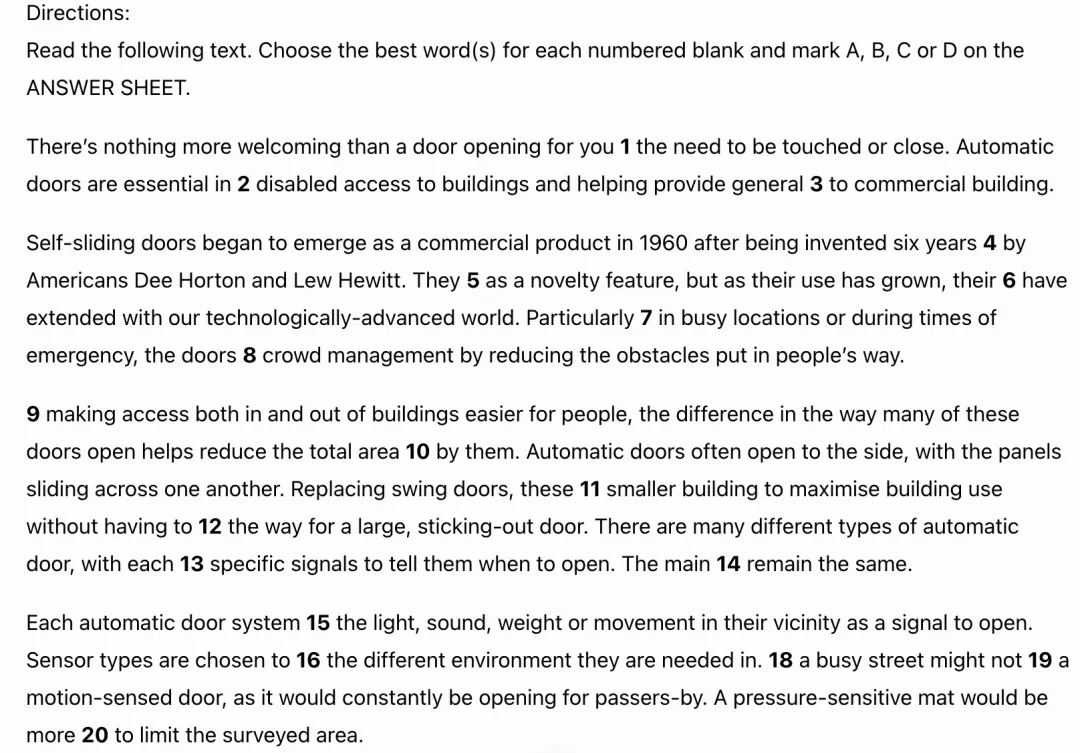
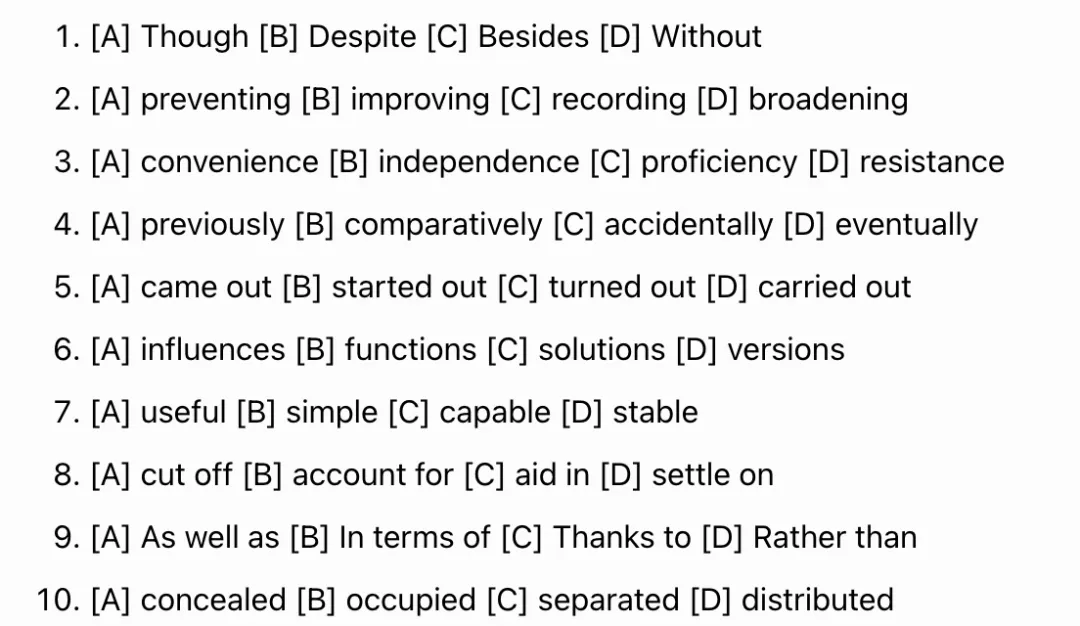
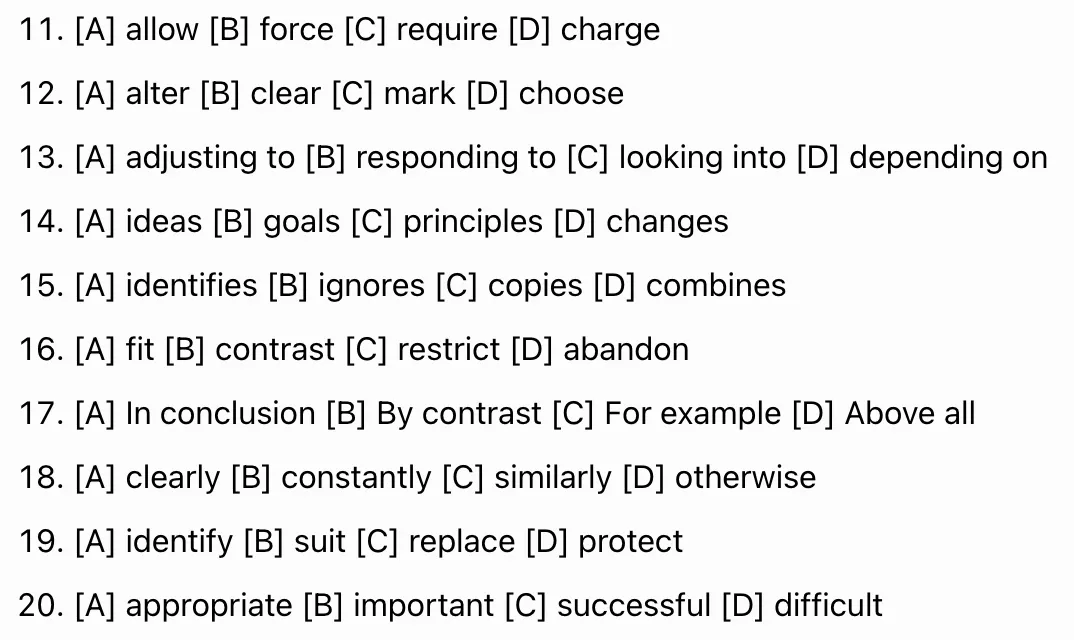
Section II Reading Comprehension
Part A (40 points)
Directions: Read the following four texts. Answer the questions below each text by choosing A, B, C or D. Mark your answers on the ANSWER SHEET.
Text 1
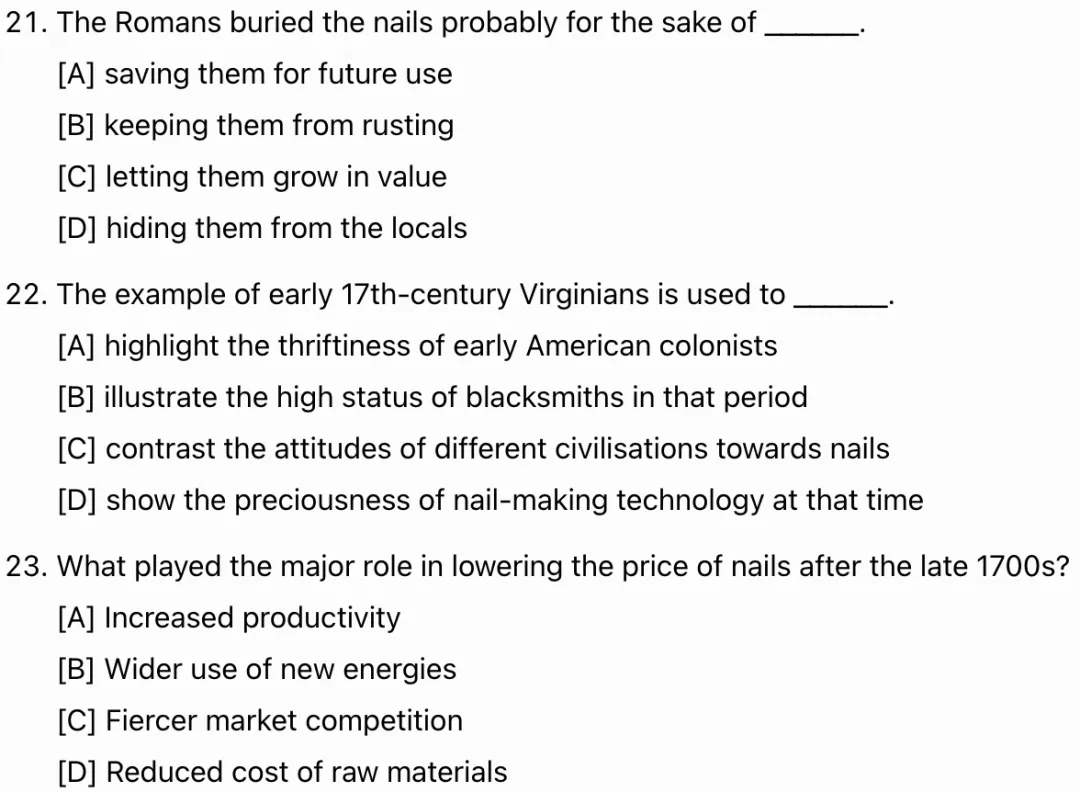
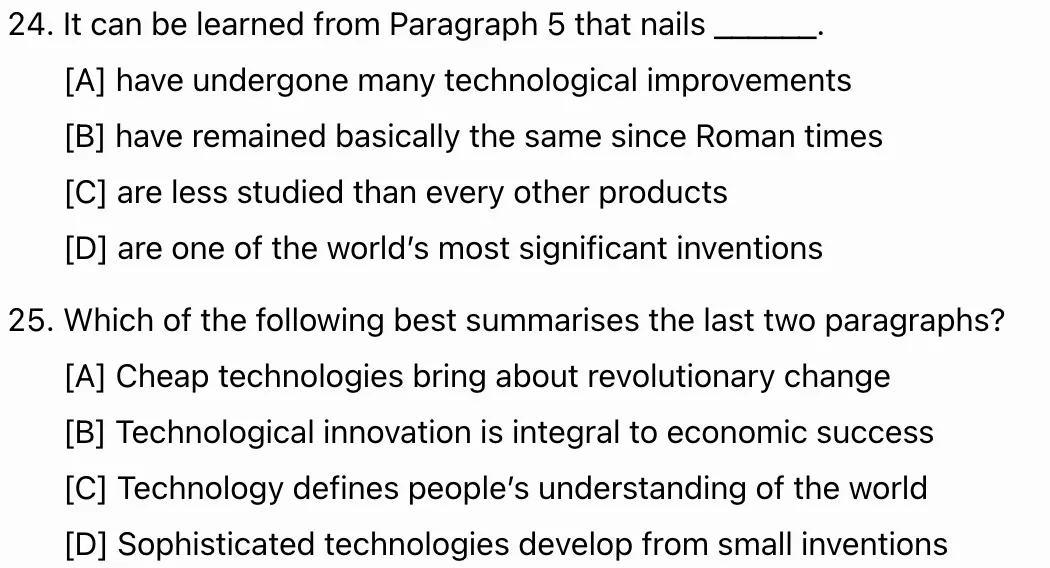
Nearly 2000 years ago, as the Romans began to pull out of Scotland, they left behind a curious treasure: 10 tons of nails, nearly a million of the things. The nail hoard was discovered in 1960 in a four-metre-deep pit covered by two metres of gravel.
Why had the Romans buried a million nails? The likely explanation is that the withdrawal was rushed, and they didn’t want the local Caledonians getting their hands on 10 tons of weapon-grade iron. The Romans buried the nails so deep that they would not be discovered for almost two millennia.
Later civilisations would value the skilled blacksmith’s labour in a nail even more than the raw material. As Roma Agrawal explains in her new delightful bookNuts and Bolts, early 17th-century Virginians would sometimes burn down their homes if they were planning to relocate. This was an attempt to recover the valuable nails, which could be reused after sifting the ashes. The idea that one might burn down an entire house just to reclaim the nails underlines how scarce, costly and valuable the simple-seeming technology was.
The price of nails fell by 90% between the late 1700s and mid-1900s, as economist Daniel Sichel points out in a research paper. According to Sichel, although the falling price of nails was driven partly by cheaper iron and cheaper energy, most of the credit goes to nail manufacturers who simply found more efficient ways to turn steel into nails.
Nails themselves have changed over the years, but Sichel studied them because they haven’t changed much. Roman lamps and Roman chariots are very different from LED strips and sports cars, but Roman nails are still clearly nails. It would be absurd to try to track the changing price of sports cars since 1695, but to ask the same question of nails makes perfect sense.
I make no apology for being obsessed by a particular feature of these objects: their price. I am an economist, after all. After writing two books about the history of inventions, one thing I’ve learnt is that while it is the enchantingly sophisticated technologies that get all the hype, it’s the cheap technologies that change the world.
The Gutenberg printing press transformed civilisation not by changing the nature of writing but by changing cost — and it would have achieved its wonderful parallel collapse in the cost of paper to write on, thanks to an unknown low-tech technology called cold saponification. Solar panels had to wait until they became cheap; now they are transforming the global energy system.
Text 2
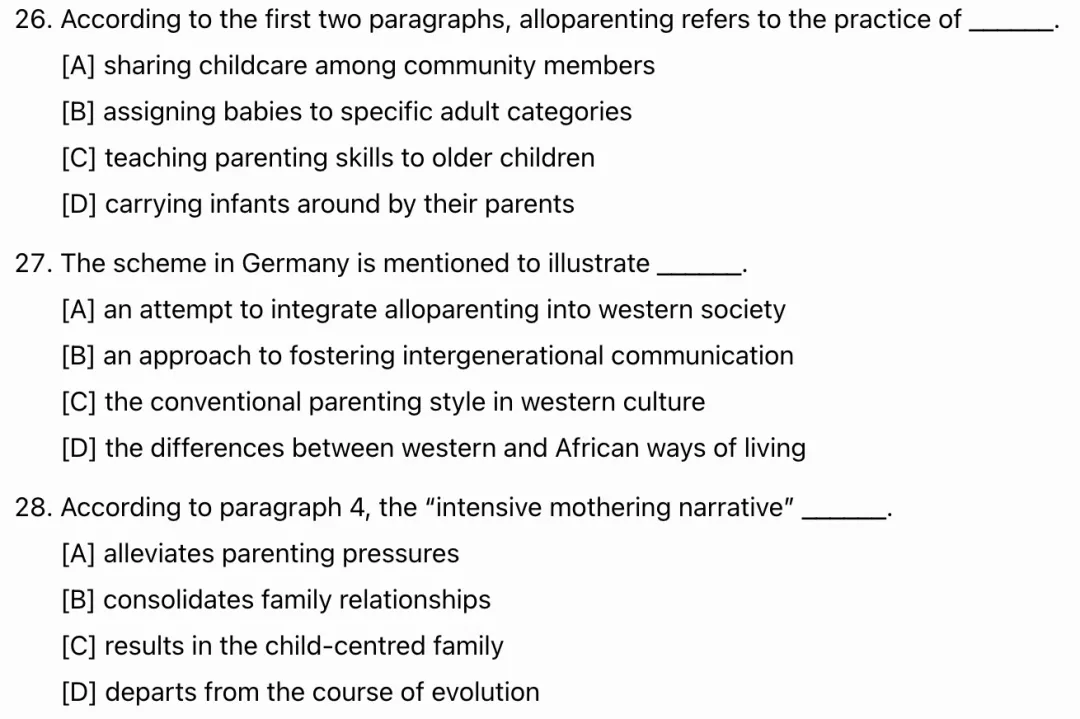
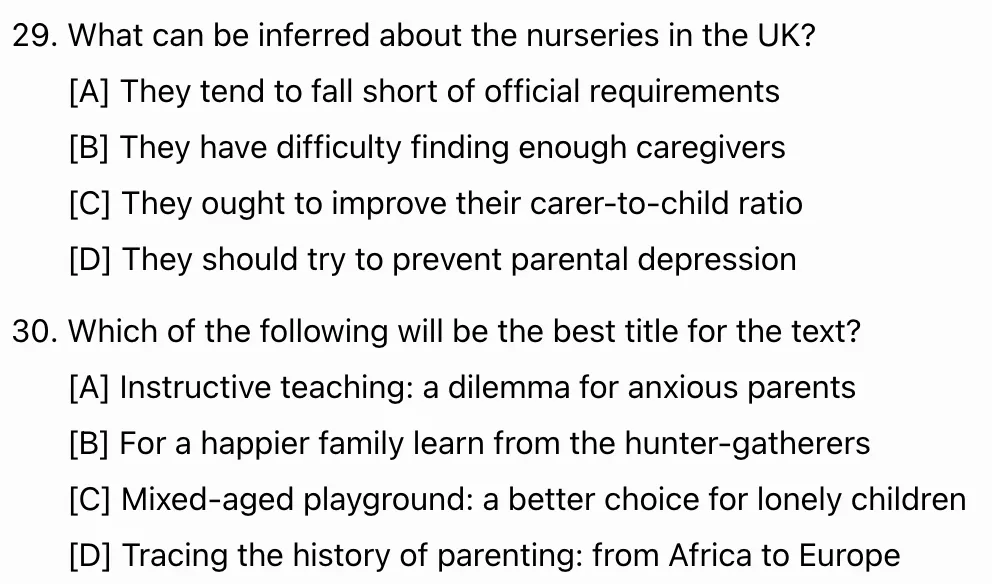
Parenting tips obtained from hunter-gatherers in Africa may be the key to bringing up more contented children, researchers have suggested. The idea is based on studies of communities, such as the King of Bostwana, where each child is cared for by many adults. King children as young as four will help to look after younger ones and “baby-wearing”, in which infants are carried in slings, is considered the norm.
According to Dr Nihal Chaudhary, an evolutionary anthropologist at Cambridge University, these practices, known as alloparenting, could lead to less anxiety for children and parents.
Dr Anne Swainepoel, a child psychiatrist, believes that there are ways to incorporate them into modern western life. In Germany, one scheme has paired an old people’s home with a nursery. The residents help to look after the children, an arrangement akin to alloparenting. Another measure could be encouraging friendships between children in different school years to nurture the unsupervised mixed-age playgrounds in hunter-gatherer communities.
In a paper published in the Journal of Child Psychology and Psychiatry, researchers said that the modern nuclear family was a recent invention which sat awkwardly with evolutionary history. This abrupt shift to an “intensive mothering narrative”, which suggests that mothers should manage childcare alone, was likely to have been harmful. “Such narratives can lead to maternal exhaustion and dangerous consequences,” the author wrote.
By contrast, in hunter-gatherer societies other adults than the parents can provide almost half of a child’s care. One previous study looked at the Efe people of the Democratic Republic of Congo. It found that infants had an average of 14 alloparents a day by the time they were 18 weeks old and were passed between caregivers eight times an hour.
Chaudhary said that parents now had less childcare support from family and social networks, but that drawing most of humans’ evolutionary history, but introducing additional caregivers could reduce stress and maternal depression. Such infant to a hunter-gatherer society could have more than ten caregivers — this constant start to nursery settings in the UK where regulations call for a ratio of one carer to four children aged two to three.
While hunter-gatherer children learnt from observation and imitation in mixed-age playgrounds, western kids are still to sit still, where such “instructive teaching”, where pupils are asked to sit still, may contribute to conditions such as attention deficit hyperactivity disorder. Chaudhary and Swainepoel also explored the possibility that older siblings helping their parents “might also enhance their own social development.”
Text 3
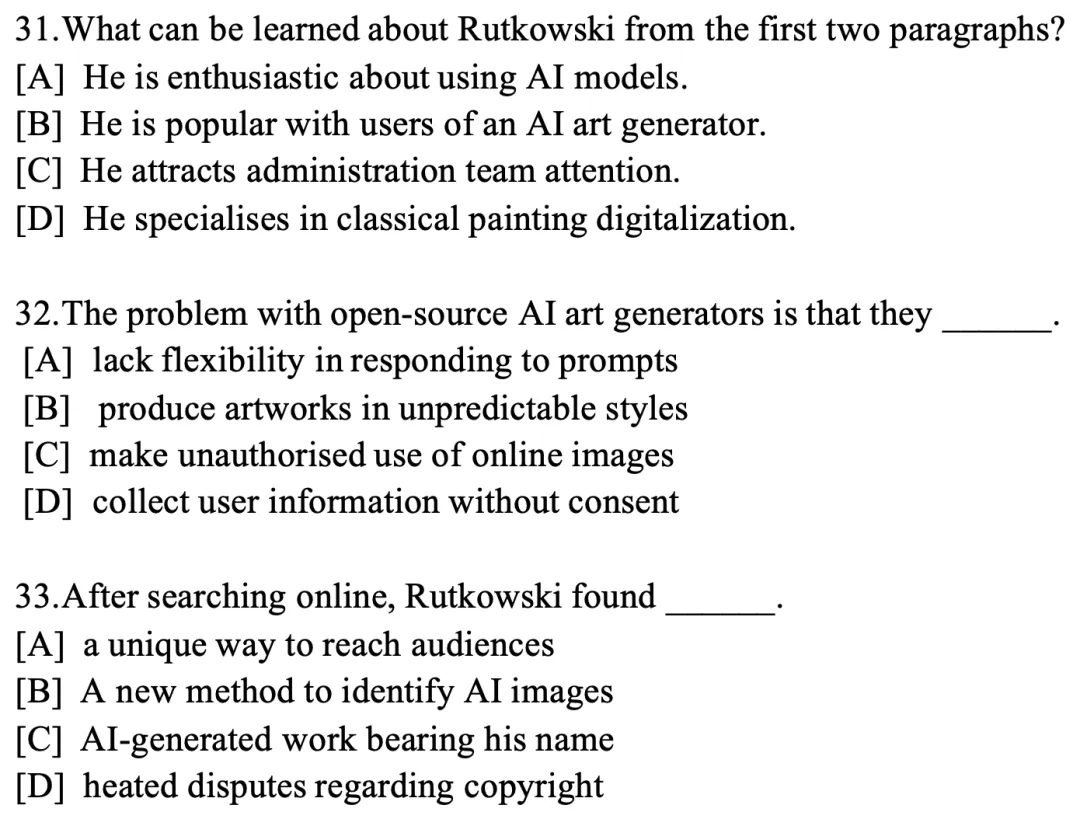
A Polish digital artist who uses classical painting styles to create dreamy fantasy landscapes has made illustrations for games such as Sony’s Horizon Forbidden West, Ubisoft’s Assassin’s Creed, Dungeons & Dragons, and Magic: The Gathering. And he’s become a hidden hit in the new world of text-to-image AI generation.
His distinctive style is now one of the most commonly used prompts in the new open-source AI generator Stable Diffusion, which was launched late last month. The tool, along with other popular image-generation AI models, allows anyone to create impressive images based on text prompts. For example, typing “Wizard with a glowing orb of fire, style Greg Rutkowski,” and the system will produce something that looks not a million miles away from works in Rutkowski’s style.
But these open-source programs are built by scraping images from the internet, often without permission and proper attribution to artists. As a result, they are raising tricky questions about ethics and copyright. And artists like Rutkowski have been surprised by the apparent popularity of their work in text-to-image generators—and some are now fighting back.
According to the website Lexica, which tracks over 10 million images and prompts generated by Stable Diffusion, Rutkowski’s name has been used as a prompt around 93,000 times. Rutkowski was initially surprised but thought it might be a way to reach new audiences. Then he tried searching for his name to see if he had been published. The online search brought back work that he had made but it wasn’t his.
“It’s been just a month. What about a year? I probably won’t be able to find my work out there because the internet will be flooded with AI art,” Rutkowski said. “That’s concerning.”
Other artists besides Rutkowski have been surprised by the apparent popularity of their work in text-to-image generators—and some are now fighting back.
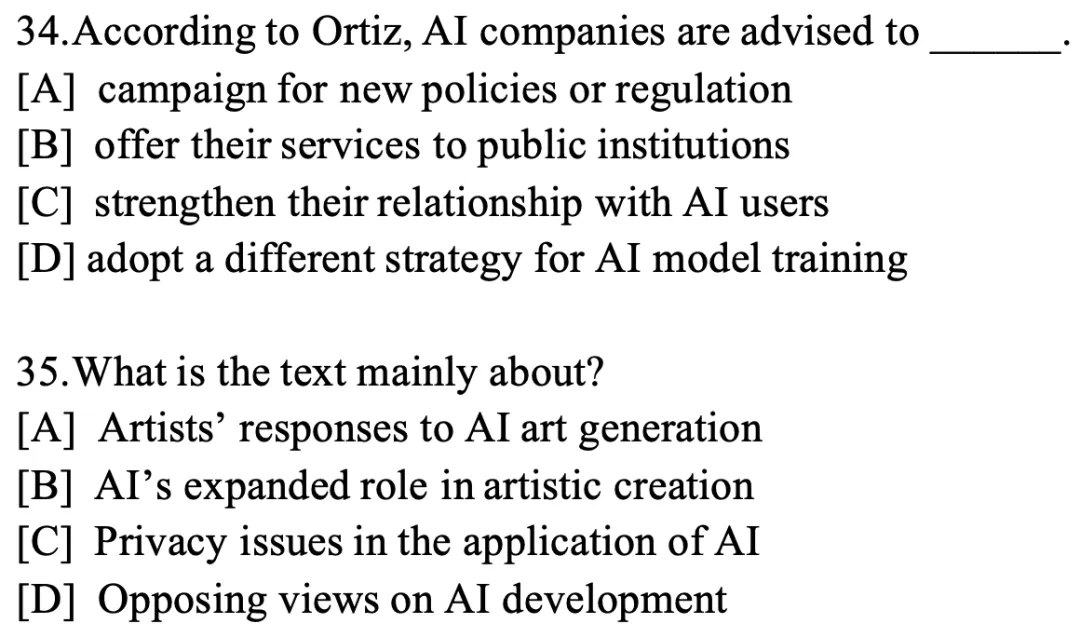
Krita Ortiz, an illustrator based in San Francisco who found her work in Stable Diffusion’s data set, has been raising awareness about the issues around AI art and copyright. Ortiz says they risk losing income as people start using AI-generated art instead of paying for copyrighted material for commercial purposes. But it’s also a lot more personal, Ortiz says, arguing that because art is so closely linked to a person, it could raise data protection and privacy problems.
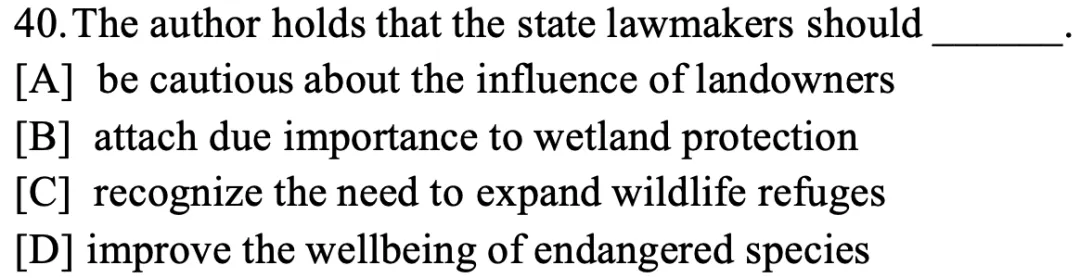
“There is a coalition growing within artist industries to figure out how to tackle or mitigate this,” says Ortiz. The group is in its early days of mobilization, which could involve pushing for new policies or regulation. One suggestion is that AI models could be trained on images in the public domain, and AI companies could forge partnerships with museums and artists, Ortiz says.
Part B (新题型,匹配题)
Directions: Read the following text and match each of the numbered items in the left column to the corresponding statement in the right column. There are two extra choices which you do not need to use. Mark your answers on the ANSWER SHEET. (10 points)
Read the following comments on a report about museum attitudes to artifacts from the long-lost Benin Bronzes and similar items. Match each of the comments (41–45) to the statement.
(41)Hannah We are part of the history and narrative of these Bronzes. These institutions want to be part of their story and are required by the British Museum to be able to show them to their public. And there is also an inspiration aspect to their presence in a museum. They serve as a point of inspiration for the generation to which they belong. They serve as a purpose in a museum in so many ways that they should not be rushed from their place in a museum.
(42)Buck We know very exact explanations of artworks and are regularly produced. Perhaps many of these existing explanations can be kept and updated. The original meaning of existing interpretation of works of art and objects of display is important. 2,000 years ago, a statue was made and it is still a statue. Art is a object. A copy is a copy, and the original is original. The monetary value and cultural significance of originals can never be replaced.
(43)Sara Visiting the British Museum of Art, I saw a simplified Chinese notice. Chinese visitors are to be treated as a special audience. Artifacts in museums are important to learn about and study the cultural past. Artifacts should be preserved, protected and shown to the public. Artifacts that are returned to their countries of origin can be properly displayed, studied and protected locally, especially on account of security, funding and local cultural atmosphere.
(44)Victor Ancient art that is displayed in foreign countries should be returned.
(45)Julia For those of you in the comment section, who are having strong feelings about artifacts being removed from countries and returned to their countries of origin, I would ask you to consider: Why do you think Americans have more of a right to easily access the Benin Bronzes than people of Nigeria? Why are people who live within a day’s drive of London entitled to go and see the Elgin Marbles whenever they want, but the people of Athens can’t?
A. It’s clear that the countries of origin have never been compensated for the stolen artifacts.
B. It is a flawed line of reasoning to argue against returning artifacts to their countries of origin.
C. Museum visitors can still learn much from artifacts’ copies after the originals are returned.
D. Reproductions, even if perfectly made, cannot take the place of the authentic objects. E. The real value of artifacts can only be recognized in their countries of origin rather than anywhere else.
F. Ways to get artifacts from other countries must be decent and lawful.
G. Concern over security is no excuse for refusing to return artifacts to their countries of origin.
Part C翻译(英译汉,10 分)
Directions: Read the following text carefully and then translate the underlined segments into Chinese. Your translation should be written neatly on the ANSWER SHEET.
“Dolphins are smart,” and their intelligence and their playful spirits have long been known to us. (46) The African ocean dolphins off the African coast are distinct, and although they are not kept in zoos, they sometimes swim near fishing boats and are not shy of human divers. They are good at recognising individual divers and can tell the divers apart from one another.
Although the dolphins by African dolphins for long-distance migration are not the same as the ones we see performing in aquariums, they are not necessarily less intelligent. (47) One possibility is that they are not suited to the aquarium environment, which can be stressful for them.
(48) The cognitive abilities of dolphins are not new, and they are not simply the product of being trained by humans. New research suggests that dolphins can create unique signature whistles, which they use to identify themselves. They can also remember the signature whistles of other dolphins they have known for decades. When they meet old dolphin friends, they call out their “name” before they meet. They don’t just call a “group” signal, which is what many animals do.
(49) This ability shows that dolphins can recognise individual dolphins, even when they are not present. It is a form of abstract thought, which is rare in the animal kingdom. (50) What makes this even more impressive is that dolphins can also copy the signature whistles of other dolphins, and sometimes use them to call each other by name.
Section III Writing
Part A 小作文(10 分)
Directions: Read the following email from a student. Write a reply.
Dear Li Ming,
I’ve got a chance to make an oral report on an ancient Chinese scientist. I am not sure how to prepare it. Could you give me some advice? Thank you!
Yours,
Paul
You should write about 100 words.
1.Do not use your own name.
2.Use “Li Ming” instead. Do not write your address.
Part B 大作文(20 分)
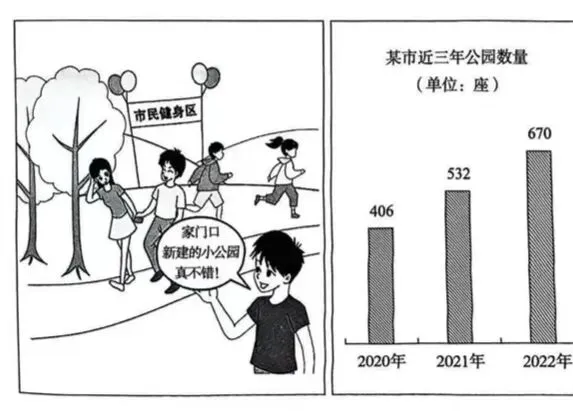
Directions: Write an essay of 160–200 words based on the picture below. In your essay, you should
1. describe the picture briefly,
2. interpret the implied meaning, and
3. give your comments.

 “牵妮蔻的手,提分幸福全都有”

~感谢关注~

