分享我自己也在用的试卷二次开发skill技能包(文末可领取)
- 2026-11-14 06:46:54
大家好。我是Fred。英国曼彻斯特大学TESOL硕士,雅思阅读满分。清北班英语教师、备课组长,班级8名学生考入清北。
本科通信工程专业,曾在某国企从事软件开发工作,参与过南方电网相关实际项目。持有工信部颁发的人工智能应用工程师证书。
近期文章更新:
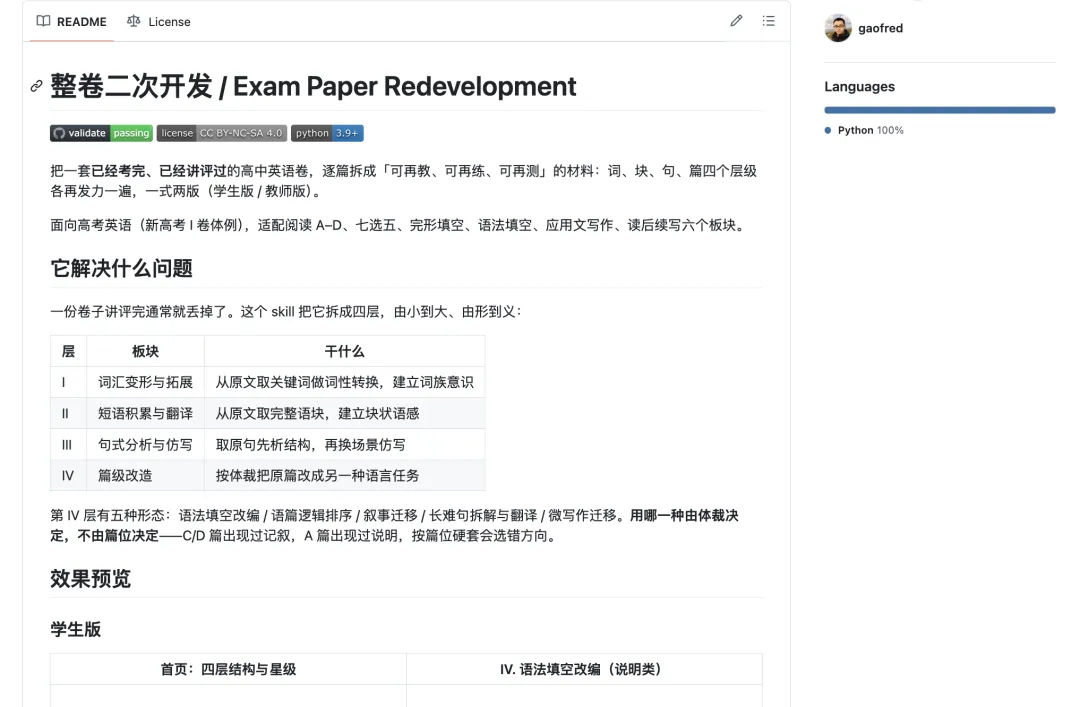
二、该skill所生成的word资料的四层结构
I 词汇变形与拓展——从原文取关键词做词性转换,练词族意识。
II 短语积累与翻译——从原文取完整语块做汉译,练块状语感。
III 句式分析与仿写——取典型句,先析结构,再换场景仿写,练结构迁移。
IV 篇级改造——按体裁把原篇改成另一种语言任务,练篇章再造。
每篇题量按板块定,不平均分配:词汇 6–9 项、短语 6–8 项、句式 2–3 项、篇级改造 1 个。
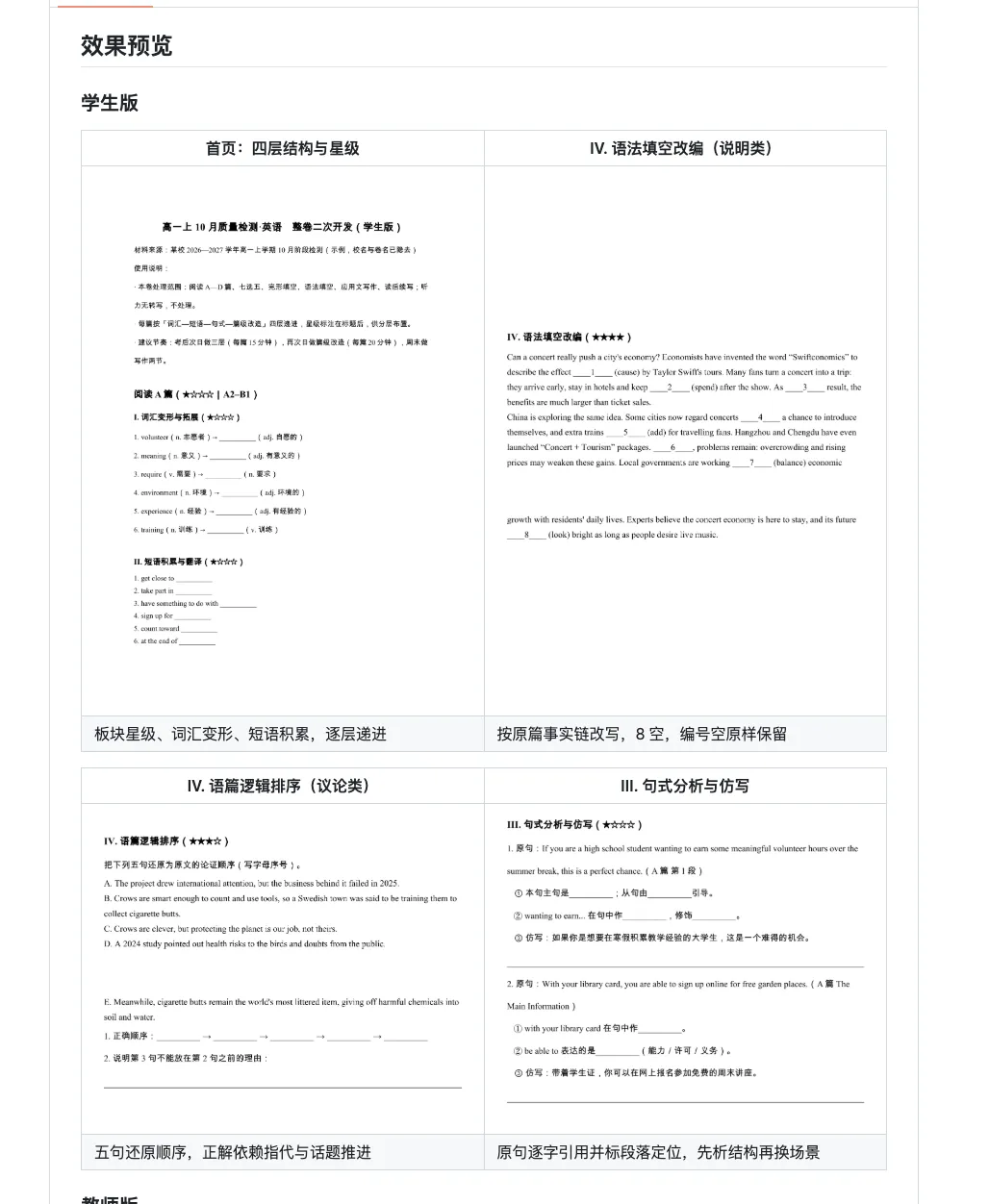
以下是使用该技能包,针对27届高三山东青岛10月调研英语试题生成的学生版和教师版二次开发讲义)
因限于篇幅,仅做学生检测版部分的展示:
2027届高三上10月调研检测·英语 整卷二次开发(学生版)
材料来源:山东省青岛市 2026—2027学年高三上学期10月部分学生调研检测(缺听力)
阅读A篇(★☆☆☆|A2–B1)
I. 词汇变形与拓展(★☆☆☆)
1. celebrate(v. 庆祝)→ __________(n. 庆典)
2. available(adj. 可获得的)→ __________(n. 可获得性)
3. televise(v. 电视播送)→ __________(n. 电视)
4. responsible(adj. 负责的)→ __________(n. 责任)
5. attend(v. 出席)→ __________(n. 出席人数)
6. graduate(v. 毕业)→ __________(n. 毕业典礼)
II. 短语积累与翻译(★☆☆☆)
1. be available to __________
2. in person __________
3. be responsible for __________
4. be subject to __________
5. access to __________
6. on a first-come basis __________
III. 句式分析与仿写(★☆☆☆)
1. 原句:While a ticket grants you access into Harvard Yard, it does not guarantee you a specific seat.(A篇 第8段)
① While 在此引导__________状语从句,意为__________。
② grants you access 是__________结构;does not guarantee you a specific seat 同此。
③ 仿写:虽然门禁卡能让你进入实验楼,但它不保证你有固定的工位。
2. 原句:Each graduate is responsible for claiming tickets for their guests.(A篇 第7段)
① be responsible for 后接__________,claim A for B 意为__________。
② 本句主干是__________;for their guests 在句中作__________。
③ 仿写:每位组长负责为本组领取材料。
IV. 微写作迁移(★☆☆☆)
1. 任务:以活动组织者身份写 40–60 词通知,说明“凭证入场、不保证座位、先到先得”,须用 access to 与 on a first-come basis。
2. 任务:用 be subject to 与 in advance 写 40 词,说明安检与提前到场要求。
阅读B篇(★★☆☆|B1–B2)
I. 词汇变形与拓展(★★☆☆)
1. normal(adj. 正常的)→ __________(n. 常态)
2. survive(v. 幸存)→ __________(n. 存活)
3. identity(n. 身份)→ __________(v. 识别;确认)
4. relate(v. 有共鸣)→ __________(n. 关系)
5. sick(adj. 生病的)→ __________(n. 疾病)
6. treat(v. 治疗)→ __________(n. 治疗)
II. 短语积累与翻译(★★☆☆)
1. a beacon of __________
2. take over __________
3. hold on to __________
4. put aside __________
5. be preoccupied with __________
6. relate to __________
III. 句式分析与仿写(★★☆☆)
1. 原句:In a place where illness takes over daily life, she helps students hold on to who they are beyond being patients.(B篇 第1段)
① where 引导__________从句,修饰__________。
② hold on to 后接的是__________从句;beyond being patients 表示__________。
③ 仿写:在一个以分数衡量一切的地方,她帮学生守住分数之外的那个自己。
2. 原句:The vast majority of even her sickest students will survive, which means that preparing very ill children to return to school is an increasingly important component of care.(B篇 第2段)
① which 指代__________,引导__________从句。
② means that 从句的主语是__________。
③ 仿写:她带的大多数学生最终都能返校,这意味着帮他们重新适应课堂是照护中越来越重要的一环。
3. 原句:“People tend to form a fixed picture of what teachers do, yet what I do HERE hardly fits that picture,” she says.(B篇 第1段)
① 第一个 what 引导__________从句,第二个 what 引导__________从句。
② yet 在此表__________。
③ 仿写:人们容易对医生的工作形成固定印象,而我在这里做的事几乎不符合那个印象。
IV. 叙事迁移(★★☆☆)
1. 框架:In a place where ..., sb helps ... hold on to who they are beyond ...
任务:以“特殊教育学校的老师”为情境写 2 句,场景与原篇不同。
2. 框架:People tend to form a fixed picture of what X do, yet what I do here hardly fits that picture.
任务:以“乡村邮递员”为情境写 1–2 句。
阅读C篇(★★★☆|B2)
I. 词汇变形与拓展(★★★☆)
1. instinct(n. 本能)→ __________(adj. 本能的)
2. opportunist(n. 机会主义者)→ __________(adj. 投机的)
3. diversity(n. 多样性)→ __________(v. 使多样化)
4. migrate(v. 迁徙)→ __________(adj. 迁徙的)
5. abundant(adj. 充足的)→ __________(n. 充足)
6. hinder(v. 阻碍)→ __________(n. 阻碍)
7. behave(v. 表现)→ __________(n. 行为)
II. 短语积累与翻译(★★★☆)
1. apply to __________
2. feed on __________
3. act on __________
4. be rooted in __________
5. over time __________
6. to the point where __________
7. even if __________
III. 句式分析与仿写(★★★☆)
1. 原句:Cities are creating a whole new, specific type of less fearful, more opportunistic, and increasingly human-dependent animals, which have learned behaviors and survival approaches that their wild fellows would never learn.(C篇 第4段)
① which 引导__________从句,修饰__________。
② that 引导__________从句,修饰__________。
③ 仿写:学校正在培养一种新的、更擅长应试却越来越依赖指令的学生,他们掌握的方法,是自学者永远不会用的。
2. 原句:A wild animal will never learn to open a trash can lid or memorize human routines so they can be in a specific spot at a specific time, because they know there will be food there.(C篇 第4段)
① so 相当于__________,引导__________。
② because 从句中 know 后接__________从句。
③ 仿写:一个从没下过厨的人不会去记菜市场的开市时间,只为了在某个时刻出现在某个摊位,因为他知道那时候菜最新鲜。
3. 原句:It all looks like a lot of animals cleverly adapting to their human-dominated surroundings, but “behavioral homogenization” is really reducing diversity both between species and within them.(C篇 第5段)
① look like 后接的是__________结构,其中 adapting 的逻辑主语是__________。
② both ... and ... 连接的是两个__________。
③ 仿写:这一切看起来像是学生在灵活适应考试要求,但这种适应其实正在削弱他们的差异,无论班与班之间还是班内。
IV. 语篇逻辑排序(★★★☆)
把下列五句还原为原文的论证顺序(写字母序号)。
A. All over the planet, urban animals are starting to act the same, even if they're completely different species on totally different continents.
B. We tend to think of Darwinian survival as applying to wild animals in jungles, but does it apply to animals in big cities?
C. The researchers warn that this process is simplifying animal populations to the point where it may one day hinder their own survival.
D. Living long in cities, you'll notice animals stop acting on their natural instincts and start feeding on food waste instead.
E. Cities are creating a less fearful, more opportunistic type of animal that learns behaviors wild animals never would.
1. 正确顺序:__________ → __________ → __________ → __________ → __________
2. 说明 C 为什么必须放在最后:
阅读D篇(★★★☆|B2)
I. 词汇变形与拓展(★★★☆)
1. stimulate(v. 刺激)→ __________(n. 刺激)
2. demonstrate(v. 证明)→ __________(n. 证明;示范)
3. propose(v. 提出)→ __________(n. 提议)
4. influence(n. 影响)→ __________(adj. 有影响力的)
5. produce(v. 生产)→ __________(adj. 高产的)
6. transport(v. 运输)→ __________(n. 运输)
7. absorb(v. 吸收)→ __________(n. 吸收)
8. found(v. 建立)→ __________(n. 基础)
II. 短语积累与翻译(★★★☆)
1. serve as __________
2. set out to do __________
3. rule out __________
4. turn to __________
5. in short supply __________
6. point to __________
7. play a part in __________
III. 句式分析与仿写(★★★☆)
1. 原句:Stanford researchers have uncovered evidence that deep underwater earthquakes can stimulate the growth of phytoplankton blooms at the ocean surface, thus pointing to a previously unknown relationship between the ocean floor and life at the surface.(D篇 第1段)
① that 引导__________从句,说明__________的内容。
② thus pointing to ... 是__________作__________状语。
③ 仿写:研究者收集到证据表明,长期熬夜会影响青少年的记忆巩固,从而指向一个此前被忽视的睡眠与学习之间的联系。
2. 原句:Building on a 2019 discovery that iron from hydrothermal vents fuels phytoplankton blooms in the Southern Ocean, the study authors set out to find out why a particular bloom varied in size year-to-year.(D篇 第2段)
① Building on ... 是__________短语作__________。
② that 引导__________从句,修饰__________。
③ 仿写:在一项 2021 年发现的基础上——课间活动能提升低年级学生的注意力——研究者着手查清为什么各班的提升幅度差异很大。
3. 原句:The common view has been that its transport would take upwards of a decade and likely thousands of miles.(D篇 第4段)
① has been 用现在完成,是因为__________。
② upwards of 意为__________。
③ 仿写:过去的看法是,这种变化要经过几十年才会显现。
IV. 语法填空改编(★★★★)
Phytoplankton are microscopic organisms ____1____ serve as the foundation of the oceanic food chain. Stanford researchers have found evidence ____2____ deep-sea earthquakes can stimulate their growth at the surface. Building on a 2019 discovery that iron from hydrothermal vents fuels blooms, the team set out ____3____ (find) out why one bloom varied in size from year to year.
Quakes can change vents' internal channels, ____4____ (allow) more heated fluids to escape, and more iron may thus reach the surface. When M 5.0 or larger quakes struck months before the southern summer, blooms grew far ____5____ (thick). How the iron rises 6,000 feet within weeks remains ____6____ open question. Understanding what ____7____ (drive) these blooms may help scientists predict how much carbon the ocean can ____8____ (absorb).
七选五(★★☆☆|B1–B2)
I. 词汇变形与拓展(★★☆☆)
1. embarrass(v. 使尴尬)→ __________(adj. 感到尴尬的)/__________(adj. 令人尴尬的)
2. nostalgia(n. 怀旧)→ __________(adj. 怀旧的)
3. collect(v. 收集)→ __________(n. 收藏品)
4. respond(v. 回应)→ __________(n. 回应)
5. consumer(n. 消费者)→ __________(v. 消耗)
6. profit(n. 利润)→ __________(adj. 有利可图的)
II. 短语积累与翻译(★★☆☆)
1. account for __________
2. be embarrassed about __________
3. reconnect sb with __________
4. respond to __________
5. be attached to __________
6. make room for __________
III. 句式分析与仿写(★★☆☆)
1. 原句:Recent industry research shows that adults now account for more than a quarter of global toy sales, while adults buying toys of their own make up over one-fifth of plush-toy purchases.(七选五 第1段)
① shows that 引导__________从句;while 在此表__________。
② adults buying toys of their own 中 buying 作__________。
③ 仿写:最新调查显示,老年人占了短视频用户的近三成,而每周上传作品的中老年人也超过五分之一。
2. 原句:Toys make room for something equally important: joy without a useful purpose.(七选五 第5段)
① 冒号后的内容是对 something 的__________。
② joy without a useful purpose 意为__________。
③ 仿写:散步为另一种同样重要的东西腾出空间:不带目的的发呆。
IV. 语篇逻辑排序(★★☆☆)
把五个段落与五个功能配对(写字母)。
① 第1段(The stuffed animal beside a laptop...)__________
② 第2段(Adult life contains plenty of problems...)__________
③ 第3段(Nostalgia also plays an important part...)__________
④ 第4段(People document their collections...)__________
⑤ 第5段(Toys bring people simple happiness...)__________
A. 供给侧对怀旧需求的回应
B. 市场结构与消费群体的变化
C. 无目的之乐本身的价值确认
D. 社交可见性如何改变羞耻感
E. 成年人压力与玩具“不索取回应”的关系
完形填空(★★☆☆|B1–B2)
I. 词汇变形与拓展(★★☆☆)
1. retire(v. 退休)→ __________(adj. 退休的)
2. immigrant(n. 移民)→ __________(v. 移居)
3. donate(v. 捐赠)→ __________(n. 捐赠)
4. recognize(v. 认可)→ __________(n. 认可)
5. satisfy(v. 使满意)→ __________(n. 满足)
6. distribute(v. 分发)→ __________(n. 分发)
7. generous(adj. 大方的)→ __________(n. 慷慨)
II. 短语积累与翻译(★★☆☆)
1. retire from __________
2. collect dust __________
3. set up __________
4. come over __________
5. look forward to __________
6. so far __________
III. 句式分析与仿写(★★☆☆)
1. 原句:Manuel Vera, 74, who is retired from the local power company, developed some unique ways to support his neighbors.(完形 第1段)
① 74 是__________,who 引导__________从句。
② developed 的主语是__________。
③ 仿写:王阿姨,68 岁,从市医院退休,摸索出一些独特的办法帮楼里的独居老人。
2. 原句:In his tidy backyard shed, its inner walls lined with tools, he'd get to work.(完形 第2段)
① its inner walls lined with tools 是__________结构。
② 该结构的作用是__________。
③ 仿写:在他那间朝南的小屋里,四壁挂满种子袋,他开始分装。
3. 原句:What truly drives him is a simple but powerful purpose: to put a smile on every rider's face.(完形 第5段)
① What 引导__________从句,作__________。
② 冒号后的不定式作用是__________。
③ 仿写:真正推动她的是一个朴素而有力的念头:让每个来借书的孩子带走一本。
IV. 叙事迁移(★★☆☆)
1. 框架:Sb, 年龄, who is retired from ..., has developed some unique ways to ...
任务:以“退休护士在社区教老人用手机”为情境写 2 句。
2. 框架:In ..., its ... lined with ..., sb would get to work.
任务:以“社区厨房的志愿者”为情境写 2 句。
语法填空(★★☆☆|B1–B2)
I. 词汇变形与拓展(★★☆☆)
1. taste(n. 品味)→ __________(adj. 有品位的)
2. culture(n. 文化)→ __________(adj. 文化的)
3. history(n. 历史)→ __________(adj. 历史的)
4. communicate(v. 交流)→ __________(n. 交流)
5. guide(v. 引导)→ __________(n. 指导)
6. source(n. 来源)→ __________(n. 资源)
II. 短语积累与翻译(★★☆☆)
1. be struck by __________
2. be eager to do __________
3. from a ... perspective __________
4. draw on __________
5. come as a surprise __________
6. take in __________
III. 长难句分析与翻译(★★★☆)
原句:These findings often come as a surprise and challenge what people think they've already known.(语法填空 第3段)
1. 主句有两个并列谓语,分别是哪两个?
2. what people think they've already known 中,what 引导什么从句?
3. they've already known 是什么从句?
4. 用斜线切分并译成中文。
应用文写作(★★☆☆|B1–B2)
I. 写作任务拆解(★☆☆☆)
1. 读者:__________
2. 目的:__________
3. 必备内容(两点):__________
4. 语气与身份:__________
5. 主体时态:__________
6. 词数:__________
II. 内容思维拓展(★★☆☆)
1. 理由线:写出两条具体困难,不要“太难了”这种空话。
2. 建议线:给出两条可操作的替代方案,各带一个细节。
3. 收尾线:写一句既表态配合又保留建议的话。
III. 话题语块与高级表达(★★☆☆)
1. be assigned to read ... __________
2. in a period of two weeks __________
3. put a strain on ... __________
4. at the expense of ... __________
5. a more manageable pace __________
6. break the book into chapters __________
7. would it be possible to ... __________
8. I wonder if you could consider ... __________
9. strike a balance between A and B __________
10. I would appreciate it if ... __________
IV. 句式与微写作迁移(★★☆☆)
1. 任务:用“陈述困难+提出请求”的复合句写 1 句(含 would it be possible to)。
2. 任务:用 at the expense of 与 strike a balance 写 1—2 句,说明为何需要调整。
3. 任务:写出 80 词左右的邮件正文(不含称呼与署名)。
读后续写(★★★☆|B2)
I. 情节与情感语言支持(★★★☆)
1. 情绪(无助):helpless __________ __________
2. 情绪(窘迫):embarrassed __________ __________
3. 动作(抬不动):lift one end __________ __________
4. 动作(求助):approach sb __________ __________
5. 心理(想到了):it occurred to me that ... __________
6. 环境(楼道狭窄):a staircase so narrow that ... __________
7. 对话(陌生人应答):Looking mostly amused, he ... __________
II. 语言升级与细节描写训练(★★★☆)
1. 原句平淡:We tried hard to move it. → 加入身体与失败细节:
2. 原句平淡:The man helped us. → 加入动作顺序:
3. 原句平淡:I was thankful. → 用动作代替形容词:
4. 原句平淡:The couch was finally inside. → 写房间里的画面:
III. 衔接句型(★★★☆)
1. 承接首句一(Getting the couch up the stairs turned out to be harder than we had expected.)写一句具体受阻:
2. 承接首句二(By the time I returned, the couch was in my apartment, but Jack and the man were already gone.)写一句空落:
3. 收束全文的一句反思(须回应“沙发”这一物件):
IV. 环境或动作微写作(★★★☆)
任务:用 60—80 词写“三人抬沙发过转角”的动作片段,须用到 at the sharp turn、on three、without a word。