( 请多多点击广告支持吧 )
Section II Reading Comprehension
Part A
Directions: Read the following four texts. Answer the questions below each text by choosing A, B, C or D. Mark your answers on the ANSWER SHEET.
Text 3
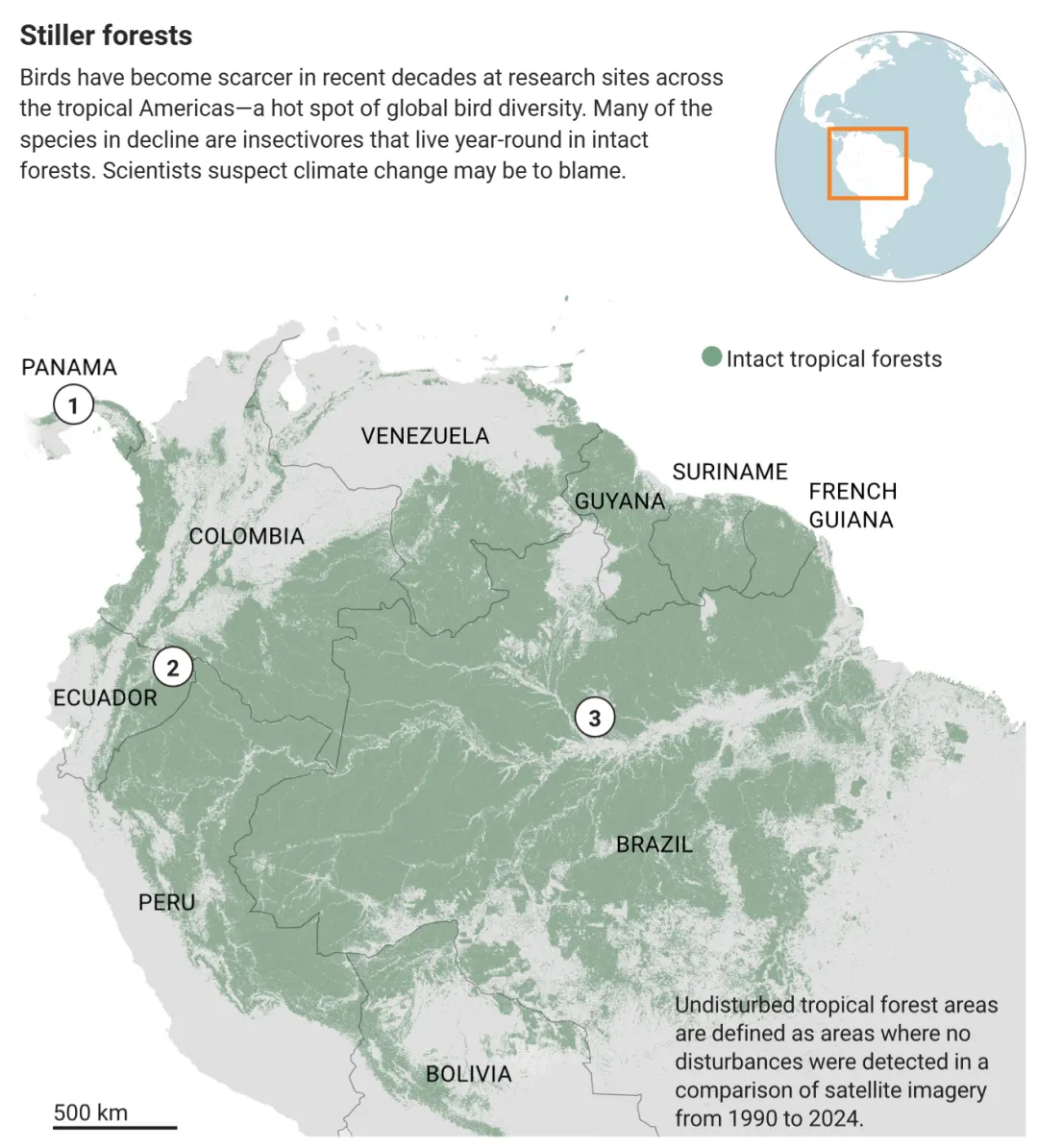
The lilting song of the musician wren once commonly heralded sunrise in the central Amazon jungle. Today, however, its flutelike melody has become a rare wonder. Across the tropical forests of the Americas—from Brazil to Panama—birds are vanishing from expanses of jungle entirely untouched by chainsaws or bulldozers. This enigmatic decline has set off alarm bells among scientists. Much like Rachel Carson’s Silent Spring warned of pesticide-induced ecological collapse, researchers fear these disappearing birds signal that climate change is now reaching deep into intact jungles and upending entire ecosystems.
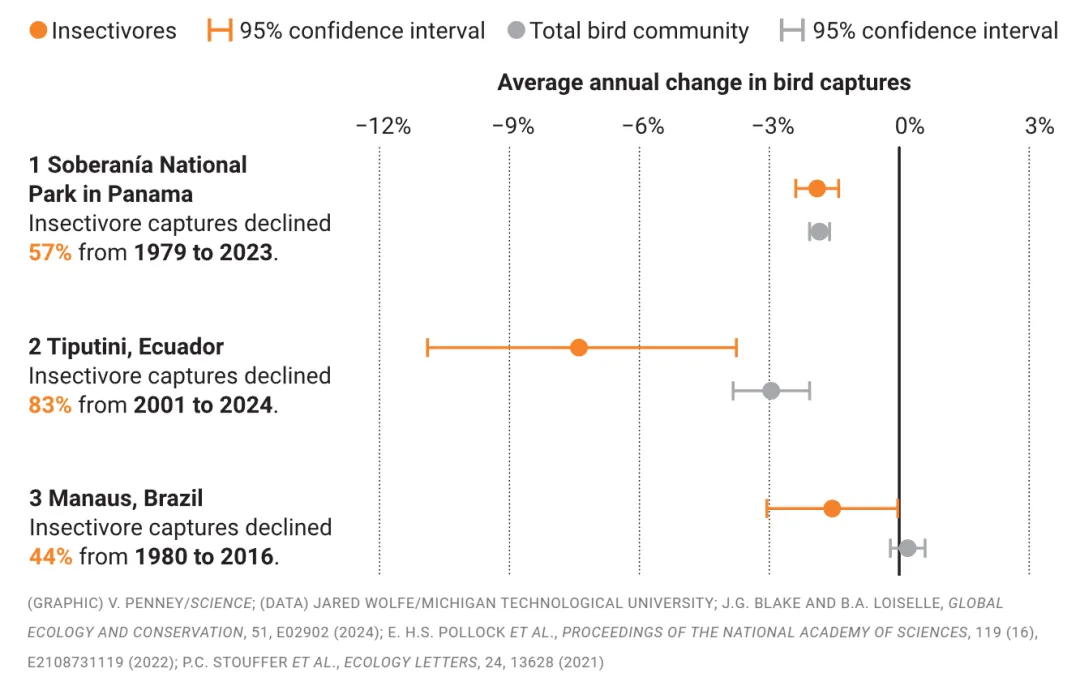
Decades of long-term monitoring have confirmed these alarming impressions. In Ecuador’s Yasuní Biosphere Reserve, systematic surveys revealed a 50% decline in bird populations between 2001 and 2014. The species that fared worst were insectivores—birds that prowl the forest floor for prey. Similar trends emerged at Brazil’s Biological Dynamics of Forest Fragments Project, where birds weighed significantly less than they did in the 1980s, indicating severe nutritional deficits. In Panama, 70% of resident species have become less abundant, with losses hitting omnivores and fruit eaters across the board.
Scientists suspect climate change is the primary culprit. Lowland tropical rainforests were once considered relatively sheltered from climate shifts due to their dense, cooling canopies. However, this historical environmental stability led flora and fauna to evolve into highly specialized niches, making them exceptionally vulnerable to change. Today, harsher dry seasons, rising temperatures, and erratic rainfall are disrupting these delicate balances. A major consequence is the indisputable collapse of tropical insect populations, which deprives the birds of their primary food source.
To illuminate the exact mechanisms behind these declines, ecologist Jared Wolfe and his colleagues embarked on an ambitious, seemingly quixotic experiment: they are artificially watering a rainforest. At a Brazilian research site, the team installed a massive network of pipes and sprinklers across intact forest plots. Each afternoon during the dry season, the system sprays tens of thousands of liters of water to simulate the wetter, more favorable climate of the 1980s.
The initial results have been tantalizing. Birds captured in the irrigated forest plots showed distinct signs of being better fed, exhibiting higher fat levels in their blood and lower stress-related acids. They were also more likely to display physical signs of active breeding. Furthermore, tiny sensors attached to the birds' backs revealed that hotter, drier conditions force them to restrict their activities. If birds must spend most of their day seeking shade rather than foraging, they inevitably fail to secure the calories necessary for survival and reproduction.
More troublingly, even if the exact mechanisms of the decline are fully understood, practical solutions remain elusive. The forests in question are already legally protected, and unlike some animals, many lowland tropical species have no cooler mountainous regions to escape to. The potential losses stretch far beyond a quieter, less colorful jungle. Birds are critical keystones that pollinate plants, spread seeds, and control pests. If they continue to fade away, their disappearance threatens to ripple through the rainforest, unraveling the entire ecological web.
31. The author mentions Rachel Carson’s Silent Spring in Paragraph 1 to ________.
[A] emphasize the devastating consequences of pesticide abuse in the Amazon
[B] draw a parallel to highlight the gravity of the current ecological crisis
[C] prove that modern agricultural practices are destroying tropical habitats
[D] argue that historical environmental predictions were largely exaggerated
32. According to Paragraph 3, the vulnerability of tropical birds largely stems from ________.
[A] their over-reliance on a single, rapidly disappearing insect species
[B] the sudden loss of dense canopies that once shielded them from heat
[C] their highly specialized evolution driven by long-term climatic stability
[D] the aggressive invasion of foreign predators into their natural habitats
33. Jared Wolfe’s watering experiment was designed primarily to ________.
[A] rescue the critically endangered musician wren from imminent extinction
[B] investigate how a simulated historical climate affects the birds' well-being
[C] prove that artificial irrigation is a sustainable solution for global warming
[D] train resident insectivores to adapt to extreme droughts and heatwaves
34. What can be inferred from the text about the lowland tropical rainforests?
[A] They offer virtually no geographical refuge for species fleeing rising temperatures.
[B] They have recently recovered from the severe droughts of the 1980s.
[C] They are legally protected, which successfully shields them from climate change.
[D] They rely heavily on migratory birds to pollinate plants and spread seeds.
35. Which of the following would be the best title for the text?
[A] The Evolution of Specialized Niches in the Amazon
[B] An Ambitious Experiment to Irrigate the Rainforest
[C] How Climate Change is Starving the Tropical Insects
[D] The Silent Crisis: Why Intact Jungle Birds are Vanishing
附注:根据历年考研英语真题阅读题源外刊等,摘选最新文章,模拟仿真出题。
参考答案见以下。
Quick look: BCBAD
31. 【答案】B
【解析】题型:修辞目的/例证题
定位: 第一段第五句 "Much like Rachel Carson’s Silent Spring warned of pesticide-induced ecological collapse, researchers fear these disappearing birds signal that climate change is now reaching deep into intact jungles..."
分析: 作者提到《寂静的春天》警告杀虫剂引发的生态崩溃,是为了作类比(Much like...),借此说明当前气候变化深入原始丛林所引发的鸟类消失,同样是生态系统崩溃的严重信号。选项 B "作类比以突出当前生态危机的严重性" 精准概括了这一写作意图。
干扰项:[A] 亚马逊的危机是气候变化引起的,而非杀虫剂滥用。 [C] 农业实践破坏栖息地与本文第一段的设定(untouched by chainsaws 没被破坏的丛林)相悖。 [D] 认为历史预测被夸大,与原意完全相反。
32. 【答案】C
【解析】题型:事实细节题
定位: 第三段第三句 "However, this historical environmental stability led flora and fauna to evolve into highly specialized niches, making them exceptionally vulnerable to change."
分析: 原文明确指出,历史上长期的环境稳定性导致动植物进化成了“高度专业化/特化的生态位(highly specialized niches)”,这使得它们对变化异常脆弱。选项 C "由长期气候稳定驱动的高度特化进化" 完美同义替换了原文。
干扰项:[A] 文中提到昆虫数量崩溃,但没说是“单一”物种。 [B] 树冠依然存在,是气候变化(高温/干旱)打破了平衡,而不是树冠突然消失。 [D] 外来捕食者入侵在文中只字未提(属于无中生有)。
33. 【答案】B
【解析】题型:事实细节题
定位: 第四段 "...the system sprays tens of thousands of liters of water to simulate the wetter, more favorable climate of the 1980s." 以及第五段观察鸟类的营养和繁殖状况。
分析: Wolfe 的洒水实验通过模拟20世纪80年代更湿润的气候(simulate the wetter... climate),来探究这种气候对鸟类营养和繁殖(well-being)的影响,从而找出它们数量下降的机制。选项 B 准确表述了这一实验目的。
干扰项:[A] 音乐家鹪鹩只是一个引子,实验的目的是寻找普遍机制,而非拯救单一物种。 [C] 实验只是为了“探究机制”,文章并没有说人工灌溉是解决全球变暖的“可持续解决方案”。 [D] “训练昆虫食性鸟类适应干旱”纯属无中生有。
34. 【答案】A
【解析】题型:推理判断题
定位: 最后一段第二句 "...many lowland tropical species have no cooler mountainous regions to escape to." (许多低地热带物种没有更凉爽的山区可以逃离)。
分析: 从文中可以推断出,生活在低地热带雨林中的物种在面对气温上升时,几乎没有地理上的避难所(no geographical refuge)可以转移。选项 A 完美对应了这一绝望的处境。
干扰项:[B] 第四段指出 1980s 是湿润的气候,现在的干旱是由于气候变化。 [C] 前半句是对的(它们受法律保护),但后半句错得离谱,法律保护并不能让它们免受气候变化的影响。 [D] 偷换概念。文章第一段明确指出,衰退的不是候鸟(These aren’t migratory species... many spend their entire lives in a single patch of trees)。
35. 【答案】D
【解析】题型:主旨大意题
定位: 全文主线逻辑。
分析: 文章开篇引出“完好的原始丛林(intact jungle)中鸟类在悄然消失”的现象,随后用数据证实这一危机,接着探讨气候变化的成因与科学家的洒水实验,最后指出这一危机的严重后果。选项 D “无声的危机:为什么完好丛林中的鸟类正在消失” 既呼应了第一段的 Silent Spring,又完美概括了全文的中心议题。
干扰项:[A]、[B]、[C] 只是文章中某个特定段落的局部细节(特化生态位、洒水实验、昆虫锐减),无法涵盖全文主旨。
【词汇注释】
herald: verb. (SIGNAL) to be a sign that something is going to happen 预示;宣告(文中指音乐家鹪鹩的歌声曾经宣告着日出的到来)
enigmatic: adjective. (MYSTERIOUS) mysterious and difficult to understand 神秘的;令人费解的(文中指这种在未被破坏的森林中发生的鸟类衰减令人费解)
insectivore: noun. (ANIMAL) an animal that eats insects 食虫动物(文中指以昆虫为食的鸟类受到的打击最为严重)
niche: noun. (ECOLOGY) the role that an organism plays in a particular ecosystem 生态位(文中指热带物种进化出了高度特化的生态位)
quixotic: adjective. (UNREALISTIC) having or showing ideas that are different and unusual but not practical or likely to succeed 异想天开的;不切实际的(文中指科学家试图给整个热带雨林洒水的实验看似异想天开)
tantalizing: adjective. (TEMPTING) making you want something that you cannot have or do 诱人的;撩拨人的(文中指实验的第一年提供了一些令人兴奋但尚不完全确定的初步结果)
keystone: noun. (IMPORTANT PART) the most important part of a plan, idea, etc. on which everything else depends 基石;关键要素(文中指鸟类是维持生态系统运转的关键物种)
【参考译文】
音乐家鹪鹩轻快的歌声曾是亚马逊丛林中部日出的常见预兆。然而今天,它那如长笛般的旋律已成为一种罕见的奇迹。在整个美洲的热带森林中——从巴西到巴拿马——鸟类正从完全没有被电锯或推土机触及过的广阔丛林中消失。这种令人费解的衰退在科学家中敲响了警钟。就像雷切尔·卡森的《寂静的春天》警告杀虫剂会导致生态崩溃一样,研究人员担心这些消失的鸟类是一个信号,表明气候变化正深入原始丛林,并颠覆整个生态系统。
几十年的长期监测证实了这些令人担忧的印象。在厄瓜多尔的亚苏尼生物圈保护区,系统调查显示,在 2001 年至 2014 年间,鸟类数量下降了 50%。情况最糟的物种是食虫鸟类——那些在森林地表潜行觅食的鸟类。在巴西的森林碎片生物学动态项目中也出现了类似的趋势,那里的鸟类体重明显低于 20 世纪 80 年代,表明存在严重的营养不足。在巴拿马,70% 的常驻物种数量有所减少,这种损失全面波及了杂食性鸟类和食果鸟类。
科学家怀疑气候变化是罪魁祸首。低地热带雨林曾被认为相对不受气候变化的影响,因为它们有着茂密、能降温的树冠。然而,这种历史上的环境稳定性导致动植物进化出了高度特化的生态位,使它们对变化异常脆弱。如今,更严酷的旱季、气温上升和不规律的降雨正在破坏这些微妙的平衡。一个主要的后果是热带昆虫数量无可争议的崩溃,这剥夺了鸟类的主要食物来源。
为了阐明这些衰退背后的确切机制,生态学家贾里德·沃尔夫及其同事开始了一项雄心勃勃、看似异想天开的实验:他们正在人工灌溉一片热带雨林。在一个巴西的研究基地,该团队在完好的森林地块上安装了庞大的管道和喷头网络。在旱季的每天下午,该系统会喷洒数万升水,以模拟 20 世纪 80 年代更为湿润、更为有利的气候。
初步结果非常令人鼓舞。在灌溉林区捕获的鸟类表现出吃得更好的明显迹象,其血液中的脂肪水平更高,而与压力相关的酸水平更低。它们也更有可能表现出活跃繁殖的身体迹象。此外,绑在鸟背上的微型传感器显示,更热、更干燥的环境迫使它们限制活动。如果鸟类一天中的大部分时间必须寻找阴凉处而不是觅食,它们必然无法获取生存和繁殖所需的热量。
更令人不安的是,即使完全了解了衰退的确切机制,实际的解决方案仍然难以捉摸。相关的森林已经受到了法律保护,而且与某些动物不同,许多低地热带物种没有更凉爽的山区可以逃离。潜在的损失远不止于一个更安静、色彩更少的丛林。鸟类是至关重要的基石,它们负责为植物授粉、传播种子和控制害虫。如果它们继续消亡,它们的消失将威胁到整个热带雨林,使整个生态网分崩离析。
附注:
本篇 Flesch–Kincaid 可读性指标(估算英文文章纯语言阅读难度,数值越大代表难度越大,十分制)评分为7.4。参考:2026年英语(一)真题四篇评分分别为 6.5、7.0、7.9、7.6,英语(二)为5.2、6.2、6.8、5.8 。在话题熟悉度,逻辑复杂度、段落结构线索丰富度方面综合指标(数值越大代表难度越大,十分制)评分为7.5。参考:2026年英语(一)真题四篇评分分别为5.8、6.5、8.2、8.0,英语(二)为4.5、6.0、6.5、5.2 。原文阅读链接为:https://www.science.org/content/article/birds-are-vanishing-tropical-forests-another-silent-spring-coming
( 点击广告为主包加速吧)