We've been discussing the importance of customer feedback in product development. Gathering feedback can help companies understand customer needs and improve their products. However, some argue that relying too heavily on customer feedback can stifle innovation and lead to mediocre products. What is your opinion on this?
Customer feedback is essential for product development. It helps companies understand customer needs and preference ensuring that products are tailored to the market. Feedback can guide improvements and enhance customer satisfaction.
I believe that relying too heavily on customer feedback can stifle innovation.
Companies should balance feedback with creative vision to avoid producing medicore products. Innovation often requires taking risks and pursuing new ideas that customers may not initially recognize.
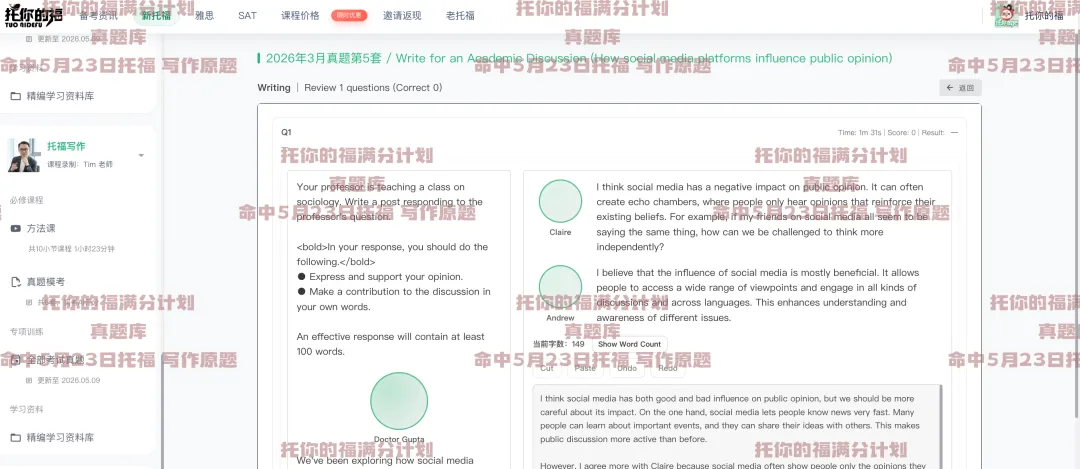
We often discuss the influence of social media on modern society. Social media platforms can connect people globally and promote the exchange of ideas. However, they can also lead to misinformation and negatively impact mental health. Do you think social media has a more positive or negative impact on society? Why?
I believe social media has a positive impact on society. It keeps people connected with friends and family, share experiences, and access information quickly. Social media can also be a powerful tool for raising awareness about important issues.
In my opinion, social media has a negative impact on society. It can spread misinformation quickly and contribute tomental health problems like anxiety and depression. People often compare themselves to others on social media, which can lead to feelings of inadequacy.
Today's educational institutions need to prepare students for a world impacted by climate change and other environmental problems. Education that focuses on science and technology can help students develop innovative solutions to environmental problems. On the other hand, education that emphasizes social sciences and ethics can foster students' deeper understanding of environmental problems and their effects. In your view, which of these two approaches best prepares students to face climate change and other environmental issues?
Focusing on social sciences like history and human geography helps us to see how our actions affect global communities. By learning about different cultures and the environment, we understand the need for collective action. This knowledge encourages us to work together to improve the environment on a global scale.
Technical skills are essential in combating climate change. They provide tangible solutions to environmental issues. Education should prioritize teaching these skills, as they directly address and solve problems like renewable energy development and waste reduction. A practical approach like this can ensure a better future for all.
Balancing work and social life is challenging. On one hand, working full-time is important for financial stability and career growth. On the other, maintaining a healthy social life is crucial for emotional well-being and stress relief. How can people best manage a demanding job while still enjoying meaningful relationships and activities outside work? I'm curious to learn your thoughts. Is it possible to maintain a healthy social life while working full-time?
Yes, but you have to set limits on work and prioritize your health and well-being.Focusing exclusively on work causes stress and burnout, which is bad for your career in the long run. Enjoying social activities is vital for your health. By setting the right boundaries, you can balance work with a healthy social life.
In my opinion, using technology to plan social activities can significantly enhance our social life. Tools like digital calendars and reminder apps help optimize free time, ensuring we don't miss out on valuable social interactions. This strategic planning can make maintaining a social life feasible, even with a full-time job.
We've been discussing development priorities for social advancement. Policymakers and leaders have to decide which area takes precedence in future social development. Some people hold that environmental protection should be prioritized, for protecting natural resources and ecosystems is fundamental to long-term sustainable development. Others believe social welfare such as medical care, education and economic opportunities should come first to improve people’s current life quality. In your view, should environmental protection or social welfare be the top priority for future development? Why?
I think environmental protection deserves priority. A sound ecological environment is the essential foundation of all social development. Proper conservation of nature can ensure stable and lasting development for future generations.
I maintain that social welfare should be placed first. Improving people’s well-being is the most practical goal. Optimizing education, healthcare and employment conditions can directly satisfy people’s real demands and raise overall happiness.
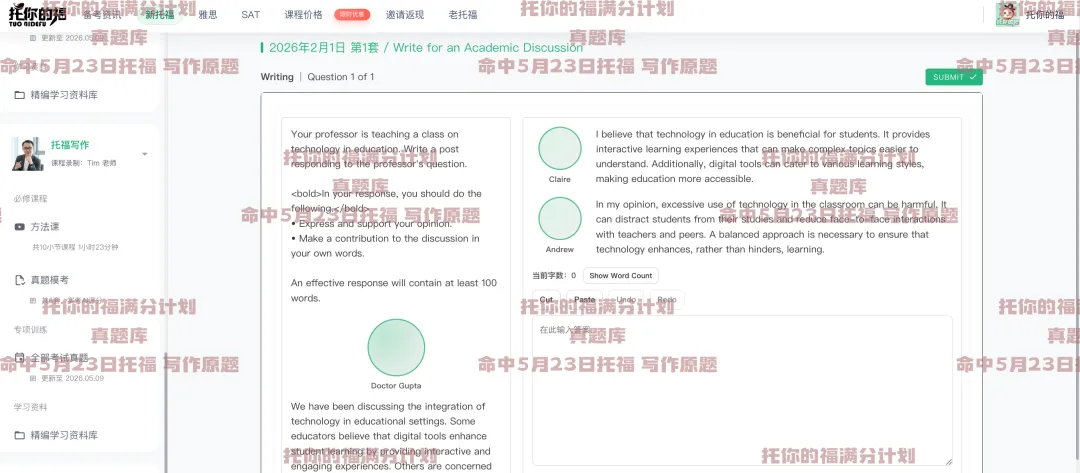
We have been discussing the integration of technology in educational settings. Some educators believe that digital tools enhance student learning by providing interactive and engaging experiences. Others are concerned that too much technology in the classroom can be distracting and may negatively impact learning outcomes. Do you think the use of technology in education is beneficial or harmful to students? Why?
I believe that technology in education is beneficial for students. It provides interactive learning experiences that can make complex topics easier to understand. Additionally, digital tools can cater to various learning styles, making education more accessible.
In my opinion, excessive use of technology in the classroom can be harmful. it can distract students from their studies and reduce face-to-face interactions with teachers and peers. A balanced approach is necessary to ensure that technology enhances, rather than hinders, learning.
We've been discussing the popularization of online news sources in modern society. Nowadays people can easily obtain information with various different viewpoints from numerous online news platforms. Some people think this trend enriches public knowledge and helps people become more open-minded. Others argue that it accelerates the spread of false information and further deepens social division. Do you think the wide access to diverse online news brings more positive or negative influences to society? Why?
I think abundant online news sources produce more positive effects. They allow people to listen to different voices freely, expand personal vision and foster inclusive thinking, which is helpful for people to view social events in an all-round way.
I hold the opposite opinion that it causes more negative results. Mass unregulated online news contains plenty of inaccurate content to mislead the public. Meanwhile, conflicting extreme views will make people hold firm prejudices and aggravate social polarization.