7.11雅思纸笔考试阅读真题:Reef fish study
- 2026-09-21 11:51:35

Reef fish study
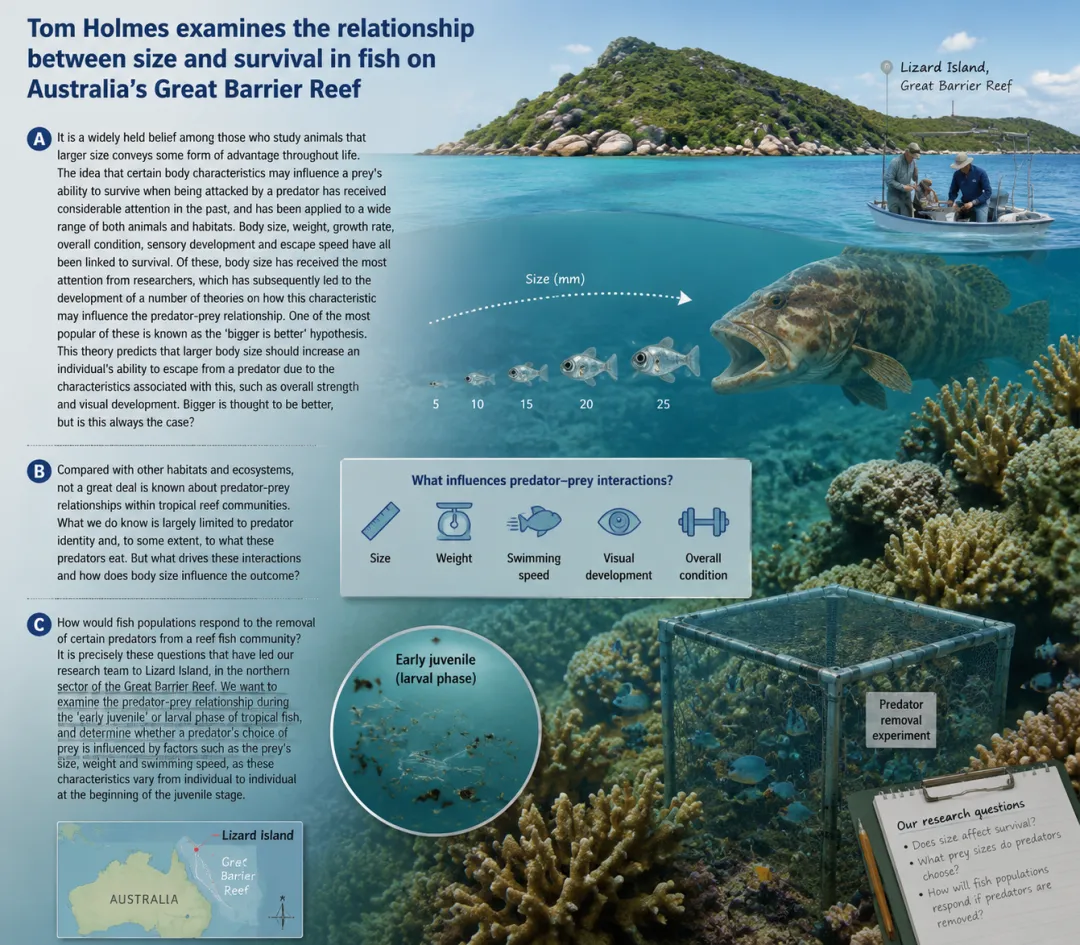
Tom Holmes examines the relationship between size and survival in fish on Australia's Great Barrier Reef
A It is a widely held belief among those who study animals that larger size conveys some form of advantage throughout life. The idea that certain body characteristics may influence a prey's ability to survive when being attacked by a predator has received considerable attention in the past, and has been applied to a wide range of both animals and habitats. Body size, weight, growth rate,overall condition, sensory development and escape speed have all been linked to survival. Of these, body size has received the most attention from researchers, which has subsequently led to the development of a number of theories on how this characteristic may influence the predator-prey relationship. One of the most popular of these is known as the bigger is better' hypothesis.This theory predicts that larger body size should increase an individual's ability to escape from a predator due to the characteristics associated with this, such as overall strength and visual development. Bigger is thought to be better, but is this always the case?
B Compared with other habitats and ecosystems, not a great deal is known about predator-prey relationships within tropical reef communities. What we do know is largely limited to predator identity and, to some extent, to what these predators eat. But what drives these interactions and how does body size influence the outcome?
C How would fish populations respond to the removal of certain predators from a reef fish community? It is precisely these questions that have led our research team to Lizard Island, in the northern sector of the Great Barrier Reef. We want to examine the predator-prey relationship during the 'early juvenile' or larval phase of tropical fish, and determine whether a predator's choice of prey is influenced by factors such as the prey's size, weight and swimming speed, as these characteristics vary from individual to individual at the beginning of the juvenile stage.
D Most coral reef fish have a life cycle consisting of an open ocean larval phase followed by a juvenile to adult phase near the reef. The transition between the two stages is marked by rapid and dramatic changes in the body of the fish, and a sudden move from the open ocean to coral reef habitats. This point is commonly known as 'settlement. Not surprisingly, it is also characterised by increased levels of mortality in the first 48 hours following settlement, as individuals are forced to adapt to life not only on the reef but also with a previously unknown set of predators.
Questions 14-18
Reading Passage has eight paragraphs, A-H.
Which paragraph contains the following information?
Write the correct letter, A-H, in boxes 14-18 on your answer sheet.
NB You may use any letter more than once.
14 a description of recent innovations in TV broadcasting ...............
15 a mention of the main goods and services advertised to children ...............
16 a reference to a current limitation on television advertising aimed at children ...............
17 two techniques used to encourage children to watch TV commercials ...............
18 a type of advertisement that may make children believe the opposite of what is true ...............
私信up主免费领取完整原文,答案,解析,机考刷题账号!