3267.64、2022英语一整套试卷:塑料制品、Z时代的学位、科学与艺术、解雇高管
- 2026-09-28 02:52:32
Section I Use of English
Directions:Read the following text. Choose the best word(s) for each numbered blank and mark A, B, C or D on the ANSWER SHEET. (10 points)
The idea that plants have some degree of consciousness first took root in the early 2000s; the term "plant neurobiology" was 1 around the notion that some aspects of plant behavior could be 2 to intelligence in animals. 3 plants lack brains, the firing of electrical signals in their stems and leaves nonetheless triggered responses that 4 consciousness, researchers previously reported.
1.[ A ] coined [ B ] discovered [ C ] collected [ D ]issued
2.[ A ] attributed [ B ] directed [ C ] compared [ D ] confined
3.[ A ] Unless [ B ] When [ C ] Once [ D ] Though
4.[ A ] coped with [ B ] consisted of [ C ] hinted at [ D ] extended to
But such an idea is untrue, according to a new opinion article. Plant biology is complex and fascinating, but it 5 so greatly from that of animals that so-called 6 of plants' intelligence is inconclusive, the authors wrote.
5.[ A ] suffers [ B ] benefits [ C ] develops [ D ] differs
6.[ A ] acceptance [ B ] evidence [ C ] cultivation [ D ] creation
Beginning in 2006, some scientists have 7 that plants possess neuron-like cells that interact with hormones and neurotransmitters, 8 "a plant nervous system, 9 to that in animals," said lead study author Lincoln Taiz. "They 10 claimed that plants have 'brain-like command centers' at their root tips."
7.[ A ] doubted [ B ] denied [ C ] argued [ D ] requested
8.[ A ] adapting [ B ] forming [ C ] repairing [ D ] testing
9.[ A ] analogous [ B ] essential [ C ] suitable [ D ] sensitive
10.[ A ] just [ B ] ever [ C ] still [ D ] even
This 11 makes sense if you simplify the workings of a complex brain, 12 it to an array of electrical pulses; cells in plants also communicate through electrical signals. 13 , the signaling in a plant is only 14 similar to the firing in a complex animal brain, which is more than "a mass of cells that communicate by electricity," Taiz said.
11.[ A ] restriction [ B ] experiment [ C ] perspective [ D ] demand
12.[ A ] attaching [ B ] reducing [ C ] returning [ D ] exposing
13.[ A ] However [ B ] Moreover [ C ] Therefore [ D ] Otherwise
14.[ A ] temporarily [ B ] literally [ C ] superficially [ D ] imaginarily
"For consciousness to evolve, a brain with a threshold 15 of complexity and capacity is required," he 16 . "Since plants don't have nervous systems, the 17 that they have consciousness are effectively zero."
15.[ A ] list [ B ] level [ C ] label [ D ] load
16.[ A ] recalled [ B ] agreed [ C ] questioned [ D ] added
17.[ A ] chances [ B ] risks [ C ] excuses [ D ] assumptions
And what's so great about consciousness, anyway? Plants can't run away from 18 , so investing energy in a body system which 19 a threat and can feel pain would be a very 20 evolutionary strategy, according to the article.
18.[ A ] danger [ B ] failure [ C ] warning [ D ] control
19.[ A ] represents [ B ] includes [ C ] reveals [ D ] recognizes
20.[ A ] humble [ B ] poor [ C ] practical [ D ] easy
Section IIReading Comprehension
Part A
Directions:Read the following four texts. Answer the questions after each text by choosing A, B, C or D. Mark your answers on the ANSWER SHEET. (40 points)
Text 1
1、People often complain that plastics are too durable. Water bottles, shopping bags, and other trash litter the planet, from Mount Everest to the Mariana Trench, because plastics are everywhere and don't break down easily. But some plastic materials change over time. They crack and frizzle. They "weep" out additives. They melt into sludge. All of which creates huge headaches for institutions, such as museums, trying to preserve culturally important objects. The variety of plastic objects at risk is dizzying: early radios, avant-garde sculptures, celluloid animation stills from Disney films, the first artificial heart.
2、Certain artifacts are especially vulnerable because some pioneers in plastic art didn't always know how to mix ingredients properly, says Thea van Oosten, a polymer chemist who, until retiring a few years ago, worked for decades at the Cultural Heritage Agency of the Netherlands (RCE). "It's like baking a cake: If you don't have exact amounts, it goes wrong," she says. "The object you make is already a time bomb."
3、And sometimes, it's not the artist's fault. In the 1960s, the Italian artist Piero Gilardi began to create hundreds of bright, colorful foam pieces. Those pieces included small beds of roses and other items as well as a few dozen "nature carpets"—large rectangles decorated with foam pumpkins, cabbages, and watermelons. He wanted viewers to walk around on the carpets—which meant they had to be durable.
4、Unfortunately, the polyurethane foam he used is inherently unstable. It's especially vulnerable to light damage, and by the mid-1990s, Gilardi's pumpkins, roses, and other figures were splitting and crumbling. Museums locked some of them away in the dark.
5、So van Oosten and colleagues worked to preserve Gilardi's sculptures. They infused some with stabilizing and consolidating chemicals. Van Oosten calls those chemicals "sunscreens" because their goal was to prevent further light damage and rebuild worn polymer fibers. She is proud that several sculptures have even gone on display again, albeit sometimes beneath protective cases.
6、Despite success stories like van Oosten's, preservation of plastics will likely get harder. Old objects continue to deteriorate. Worse, biodegradable plastics, designed to disintegrate, are increasingly common.
7、And more is at stake here than individual objects. Joana Lia Ferreira, an assistant professor of conservation and restoration at the NOVA School of Science and Technology, notes that archaeologists first defined the great material ages of human history—Stone Age, Iron Age, and so on—after examining artifacts in museums. We now live in an age of plastic, she says, "and what we decide to collect today, what we decide to preserve…will have a strong impact on how in the future we'll be seen."
21.According to Paragraph 1, museums are faced with difficulties in___
[ A ] maintaining their plastic items.
[ B ] obtaining durable plastic artifacts.
[ C ] handling outdated plastic exhibits.
[ D ] classifying their plastic collections.
22.Van Oosten believes that certain plastic objects are___
[ A ] immune to decay.
[ B ] improperly shaped.
[ C ] inherently flawed.
[ D ] complex in structure.
23.Museums stopped exhibiting some of Gilardi's artworks to___
[ A ] keep them from hurting visitors.
[ B ] duplicate them for future display.
[ C ] have their ingredients analyzed.
[ D ] prevent them from further damage.
24.The author thinks that preservation of plastics is___
[ A ] costly.
[ B ] unworthy.
[ C ] unpopular.
[ D ] challenging.
25.In Ferreira's opinion, preservation of plastic artifacts___
[ A ] will inspire future scientific research.
[ B ] has profound historical significance.
[ C ] will help us separate the material ages.
[ D ] has an impact on today's cultural life.
Text 2
1、As the latest crop of students pen their undergraduate application form and weigh up their options, it may be worth considering just how the point, purpose and value of a degree has changed and what Generation Z need to consider as they start the third stage of their educational journey.
2、Millennials were told that if you did well in school, got a decent degree, you would be set up for life. But that promise has been found wanting. As degrees became universal, they became devalued. Education was no longer a secure route of social mobility. Today, 28 per cent of graduates in the UK are in non-graduate roles, a percentage which is double the average among the OECD countries.
3、This is not to say that there is no point in getting a degree, but rather stress that a degree is not for everyone, that the switch from classroom to lecture hall is not an inevitable one and that other options are available.
4、Thankfully, there are signs that this is already happening, with Generation Z seeking to learn from their millennial predecessors, even if parents and teachers tend to be still set in the degree mindset. Employers have long seen the advantages of hiring school leavers who often prove themselves to be more committed and loyal employees than graduates. Many too are seeing the advantages of scrapping a degree requirement for certain roles.
5、For those for whom a degree is the desired route, consider that this may well be the first of many. In this age of generalists, it pays to have specific knowledge or skills. Postgraduates now earn 40 per cent more than graduates. When more and more of us have a degree, it makes sense to have two.
6、It is unlikely that Generation Z will be done with education at 18 or 21; they will need to be constantly upskilling throughout their career to stay employable. It has been estimated that this generation, due to the pressures of technology, the wish for personal fulfilment and desire for diversity, will work for 17 different employers over the course of their working life and have five different careers. Education, and not just knowledge gained on campus, will be a core part of Generation Z's career trajectory.
7、Older generations often talk about their degree in the present and personal tense: 'I am a geographer' or 'I am a classicist'. Their sons or daughters would never say such a thing; it's as if they already know that their degree won't define them in the same way.
26.The author suggests that Generation Z should___
[ A ] be careful in choosing a college.
[ B ] be diligent at each educational stage.
[ C ] reassess the necessity of college education.
[ D ] postpone their undergraduate application.
27.The percentage of UK graduates in non-graduate roles reflects___
[ A ] Millennial's opinion about work.
[ B ] the shrinking value of a degree.
[ C ] public discontent with education.
[ D ] the desired route of social mobility.
28.The author considers it a good sign that___
[ A ] Generation Z are seeking to earn a decent degree.
[ B ] school leavers are willing to be skilled workers.
[ C ] employers are taking a realistic attitude to degree.
[ D ] parents are changing their minds about education.
29.It is advised in Paragraph 5 that those with one degree should___
[ A ] make an early decision on their career.
[ B ] attend on-the-job training programs.
[ C ] team up with high-paid postgraduates.
[ D ] further their studies in a specific field.
30.What can be concluded about Generation Z from the last two paragraphs?
[ A ] Lifelong learning will define them.
[ B ] They will make qualified educators.
[ C ] Degrees will no longer appeal to them.
[ D ] They will have a limited choice of jobs.
Text 3
1、Enlightening, challenging, stimulating, fun. These were some of the words that Nature readers used to describe their experience of art-science collaborations in a series of articles on partnerships between artists and researchers. Nearly 40% of the roughly 350 people who responded to an accompanying poll said they had collaborated with artists; and almost all said they would consider doing so in future.
2、Such an encouraging result is not surprising. Scientists are increasingly seeking out visual artists to help them communicate their work to new audiences. "Artists help scientists reach a broader audience and make emotional connections that enhance learning," one respondent said.
3、One example of how artists and scientists have together rocked the scenes came last month when the Sydney Symphony Orchestra performed a reworked version of Antonio Vivaldi's The Four Seasons. They reimagined the 300-year-old score by injecting the latest climate prediction data for each season—provided by Monash University's Climate Change Communication Research Hub. The performance was a creative call to action ahead of November's United Nations Climate Change Conference in Glasgow, UK.
4、But a genuine partnership must be a two-way street. Fewer artists than scientists responded to the Nature poll; however, several respondents noted that artists do not simply assist scientists with their communication requirements. Nor should their work be considered only as an object of study. The alliances are most valuable when scientists and artists have a shared stake in a project, are able to jointly design it and can critique each other's work. Such an approach can both prompt new research as well as result in powerful art.
5、More than half a century ago, the Massachusetts Institute of Technology opened its Center for Advanced Visual Studies (CAVS) to explore the role of technology in culture. The founders deliberately focused their projects around light—hence the "visual studies" in the name. Light was something that both artists and scientists had an interest in, and therefore could form the basis of collaboration. As science and technology progressed, and divided into more sub-disciplines, the centre was simultaneously looking to a time when leading researchers could also be artists, writers and poets, and vice versa.
6、Nature's poll findings suggest that this trend is as strong as ever, but, to make a collaboration work, both sides need to invest time, and embrace surprise and challenge. The reach of art-science tie-ups needs to go beyond the necessary purpose of research communication, and participants must not fall into the trap of stereotyping each other. Artists and scientists alike are immersed in discovery and invention, and challenge and critique are core to both, too.
31.According to Paragraph 1, art-science collaborations have___
[ A ] caught the attention of critics.
[ B ] received favorable responses.
[ C ] promoted academic publishing.
[ D ] sparked heated public disputes.
32.The reworked version of The Four Seasons is mentioned to show that___
[ A ] art can offer audiences easy access to science.
[ B ] science can help with the expression of emotions.
[ C ] public participation in science has a promising future.
[ D ] art is effective in facilitating scientific innovations.
33.Some artists seem to worry about in the art-science partnership___
[ A ] their role may be underestimated.
[ B ] their reputation may be impaired.
[ C ] their creativity may be inhibited.
[ D ] their work may be misguided.
34.What does the author say about CAYS?
[ A ] It was headed alternately by artists and scientists.
[ B ] It exemplified valuable art-science alliances.
[ C ] Its projects aimed at advancing visual studies.
[ D ] Its founders sought to raise the status of artists.
35.In the last paragraph, the author holds that art-science collaborations ___
[ A ] are likely to go beyond public expectations.
[ B ] will intensify interdisciplinary competition.
[ C ] should do more than communicating science.
[ D ] are becoming more popular than before.
Text 4
1、The personal grievance provisions of New Zealand's Employment Relations Act 2000 (ERA) prevent an employer from firing an employee without good cause. Instead, dismissals must be justified.Employers must both show cause and act in a procedurally fair way.
2、Personal grievance procedures were designed to guard the jobs of ordinary workers from "unjustified dismissals". The premise was that the common law of contract lacked sufficient safeguards for workers against arbitrary conduct by management. Long gone are the days when a boss could simply give an employee contractual notice.
3、But these provisions create difficulties for businesses when applied to highly paid managers and executives. As countless boards and business owners will attest, constraining firms from firing poorly performing, high-earning managers is a handbrake on boosting productivity and overall performance. The difference between C-grade and A-grade managers may very well be the difference between business success or failure. Between preserving the jobs of ordinary workers or losing them. Yet mediocrity is no longer enough to justify a dismissal.
4、Consequently—and paradoxically—laws introduced to protect the jobs of ordinary workers may be placing those jobs at risk.
5、If not placing jobs at risk, to the extent employment protection laws constrain business owners from dismissing under-performing managers, those laws act as a constraint on firm productivity and therefore on workers' wages. Indeed, in "An International Perspective on New Zealand's Productivity Paradox" (2014), the Productivity Commission singled out the low quality of managerial capabilities as a cause of the country's poor productivity growth record.
6、Nor are highly paid managers themselves immune from the harm caused by the ERA'S unjustified dismissal procedures. Because employment protection laws make it costlier to fire an employee, employers are more cautious about hiring new staff. This makes it harder for the marginal manager to gain employment. And firms pay staff less because firms carry the burden of the employment arrangement going wrong.
7、Society also suffers from excessive employment protections. Stringent job dismissal regulations adversely affect productivity growth and hamper both prosperity and overall well-being.
8、Across the Tasman Sea, Australia deals with the unjustified dismissal paradox by excluding employees earning above a specified "high-income threshold" from the protection of its unfair dismissal laws. In New Zealand, a 2016 private members' Bill tried to permit firms and high-income employees to contract out of the unjustified dismissal regime. However, the mechanisms proposed were unwieldy and the Bill was voted down following the change in government later that year.
36.The personal grievance provisions of the ERA are intended to___
[ A ] punish dubious corporate practices.
[ B ] improve traditional hiring procedures.
[ C ] exempt employers from certain duties.
[ D ] protect the rights of ordinary workers.
37.It can be learned from Paragraph 3 that the provisions may___
[ A ] hinder business development.
[ B ] undermine managers' authority.
[ C ] affect the public image of the firms.
[ D ] worsen labor-management relations.
38.Which of the following measures would the Productivity Commission support?
[ A ] Imposing reasonable wage restraints.
[ B ] Enforcing employment protection laws.
[ C ] Limiting the powers of business owners.
[ D ] Dismissing poorly performing managers.
39.What might be an effect of ERA's unjustified dismissalprocedures?
[ A ] Highly paid managers lose their jobs.
[ B ] Employees suffer from salary cuts.
[ C ] Society sees a rise in overall well-being.
[ D ] Employers need to hire new staff.
40.It can be inferred that the "high-income threshold" in Australia___
[ A ] has secured managers' earnings.
[ B ] has produced undesired results.
[ C ] is beneficial to business owners.
[ D ] is difficult to put into practice
Part B
Directions:In the following text, there are five people’s opinions about Emma Manis’s article “ The Case Against Zoos”. For Questions 41-45, choose the best statement from the list A-G to summarize each numbered person’s opinion. There are two extra choices which do not fit in any of the blanks. Mark your answers on the ANSWER SHEET. (10 points)
Teri Byrd: (41)
I was a zoo and wildlife park employee for years. Both the wildlife park and zoo claimed to be operating for the benefit of the animals and for conservation purposes. This claim was false. Neither one of them actually participated in any contributions to animal research or conservation. They are profitable institutions whose bottom line is much more important than the condition of the animals.
Animals despise being captives in zoos. No matter how you "enhance" enclosures, they do not allow for freedom, a natural diet or adequate exercise. Animals end up stressed and unhealthy or dead. It's past time for transparency with these institutions, and it's past time to eliminate zoos from our culture.
[ F ] 重视赚钱、应该关闭Zoos should have been closed down as they prioritize money making over animals' wellbeing.
Karen R. Sime: (42)
As a zoology professor, I agree with Emma Marris that zoo displays can be sad and cruel. But she underestimates the educational value of zoos.
The zoology program at my university attracts students for whom zoo visits were the crucial formative experience that led them to major in biological sciences. These are mostly students who had no opportunity as children to travel to wilderness areas, wildlife refuges or national parks. Although good TV shows can help stir children's interest in conservation, they cannot replace the excitement of a zoo visit as an intense, immersive and interactive experience. Surely there must be some middle ground that balances zoos' treatment of animals with their educational potential.
Greg Newberry: (43)
Emma Marris's article is an insult and a disservice to the thousands of passionate people who work tirelessly to improve the lives of animals and protect our planet. She uses outdated research and decades-old examples to undermine the noble mission of organizations committed to connecting children to a world beyond their own.
Zoos are at the forefront of conservation and constantly evolving to improve how they care for animals and protect each species in its natural habitat. Are there tragedies? Of course. But they are the exception, not the norm that Ms. Marris implies. A distressed animal in a zoo will get as good or better treatment than most of us at our local hospital.
Dean Gallea: (44)
As a fellow environmentalist, animal-protection advocate and longtime vegetarian, I could properly be in the same camp as Emma Marris on the issue of zoos. But I believe that well-run zoos, and the heroic animals that suffer their captivity, do serve a higher purpose. Were it not for opportunities to observe these beautiful, wild creatures close to home, many more people would be driven by their fascination to travel to wild areas to seek out, disturb and even hunt them down.
Zoos are, in that sense, similar to natural history and archeology museums, serving to satisfy our need for contact with these living creatures while leaving the vast majority undisturbed in their natural environments.
John Fraser: (45)
Emma Marris selectively describes and misrepresents the findings of our research. Our studies focused on the impact of zoo experiences on how people think about themselves and nature, and the data points extracted from our studies do not, in any way, discount what is learned in a zoo visit.
Zoos are tools for thinking. Our research provides strong support for the value of zoos in connecting people with animals and with nature. Zoos provide a critical voice for conservation and environmental protection. They afford an opportunity for people from all backgrounds to encounter a range of animals, from drone bees to springbok or salmon, to better understand the natural world we live in.
Part C
Directions:Read the following text carefully and then translate the underlined segments into Chinese. Write your answers on the ANSWER SHEET. ( 10 points)
Between 1807 and 1814 the Iberian Peninsula (comprising Spain and Portugal) was the scene of a titanic and merciless struggle. It took place on many different planes: between Napoleon's French army and the angry inhabitants; between the British, ever keen to exacerbate the emperor's difficulties, and the marshals sent from Paris to try to keep them in check; between new forces of science and meritocracy and old ones of conservatism and birth. (46)It was also, and this is unknown even to many people well read about the period, a battle between those who made codes and those who broke them.
1、同样,这种情形少有人知;2、甚至对于许多在这一时期曾经认真阅读的人;3、一场战争在;4、制密者和解密者之间。
同样,这种情形少有人知,甚至对于许多在这一时期曾经认真阅读国电文的人而言,也不知晓这是发生于制密者和解密者之间的一场博弈。
I first discovered the Napoleonic cryptographic battle a few years ago when I was reading Sir Charles Oman's epic History of the Peninsular War. In volume V he had attached an appendix, The Scovell Ciphers. (47)It listed many documents in code that had been captured from the French army of Spain, and whose secrets had been revealed by the work of one George Scovell, an officer in British headquarters.
1、它用密码罗列了很多文件;2、从法军驻西班牙部队所捕获;3、并且被解密;4、通过一位名叫乔治·苏克维尔(George Scovell)的英军司令部军官。
通过一位名叫乔治·苏克维尔(George Scovell)的英军司令部军官的工作,大量法军驻西班牙部队的密电文件被捕获、破解,从而令英军掌握先机。
Oman rated Scovell's significance highly, but at the same time, the general nature of his History meant that (48)he could not analyze carefullywhat this obscure officer may or may not have contributedto that great struggle between nations or indeed tell us anything much about the man himself. I was keen to read more, but was surprised to find that Oman's appendix, published in 1914, was the only considered thing that had been written about this secret war.
1、他不能仔细地分析;2、这位不起眼的军官是否贡献了/3、以致两国之间的大战;4、或者实际上连他自己也说不清楚到底有多少?
这位不起眼的军官所做的工作,是否是两国战况的关键所在,亦或是没有丝毫帮助?确实难以定论,具体起到怎样的作用,恐怕连他本人都说不清楚。
I became convinced that this story was every bit as exciting and significant as that of Enigma and the breaking of German codes in the Second World War. The question was, could it be told?
Studying Scovell's papers at the Public Record Office, London, I found that he had left an extensive journal and copious notes about his work in the peninsula. What was more, many original French dispatches had been preserved in this collection, which I realized was priceless. (49)There may have been many spies and intelligence officers during the Napoleonic Wars, but it is usually extremely difficult to find the material they actually provided or worked on.
1、那里确实有很多间谍或智力超群的专业人士;2、在拿破仑战役期间;3、但也确实特别困难;4、去发现确实由他们提供和加工过的材料。
在拿破仑战役期间,确实有很多间谍或智力超群的专业人士参与其中,但因为几乎没有发现确凿的证据资料,因此也很难证实他们在战争中所起的作用。
As I researched Scovell's story I found far more of interest besides his intelligence work. His status in Lord Wellington's headquarters and the recognition given to him for his work were all bound up with the class politics of the army at the time. His tale of self-improvement and hard work would make a fascinating biography in its own right, but represents something more than that. (50)Just as the code breaking has its wider relevance in the struggle for Spain, so his attempts to make his way up the promotion ladder speak volumes about British society.
1、正如密码破解具有广泛的关联性;2、在争取西班牙的斗争中;3、因此,他的攀升之路的企图;4、也是对英国社会的真实反映。
正如在争取西班牙的斗争中,被破解的密码具有广泛的关联性类似;他在军队中的晋升途中的各种作为,恰好也是当时英国社会现实的写照。

Section IIIWriting
Part A
51.Directions: Write an email to a professor at a British university, inviting him/her to organize a team for the international innovation contest to be held at your university. You should write about 100 words on the ANSWER SHEET. Do not use your own name. Use “Li Ming” instead. (10 points)
Dear Professor Bruce,
On behalf of the International Innovation Contest Committee, I am writing this email to invite you to organize a group of competitors for the purpose of participating in the upcoming International Innovation Contest to be held in our university.
This contest is due to be held in the Innovation Center Hall from 2:00 p.m. to 5:00 p.m. on May 1st. The arrangements are as follows. First, we will hold an opening ceremony. Then, the competitors from different countries will display their works related to the updated and sophisticated science and technology. Last, we will confer awards and certificates on outstanding candidates. We believe you and your team's participation will surely bring up new ideas and enlightening perspectives.
Once again, we sincerely hope you and your team can take part in this contest. I am looking forward to your favorable reply.
Yours sincerely, Li Ming
即将举行的国际创新大赛upcoming International Innovation Contest、
更新且更完善的方案updated and sophisticated、
富有启发性的视角enlightening perspectives
Part B
52.Directions:Write an essay of 160-200 words based on the picture below. In your essay, you should1) describe the picture briefly,2) explain its intended meaning, and3) give your comments.You should write neatly on the ANSWER SHEET. ( 20 points)
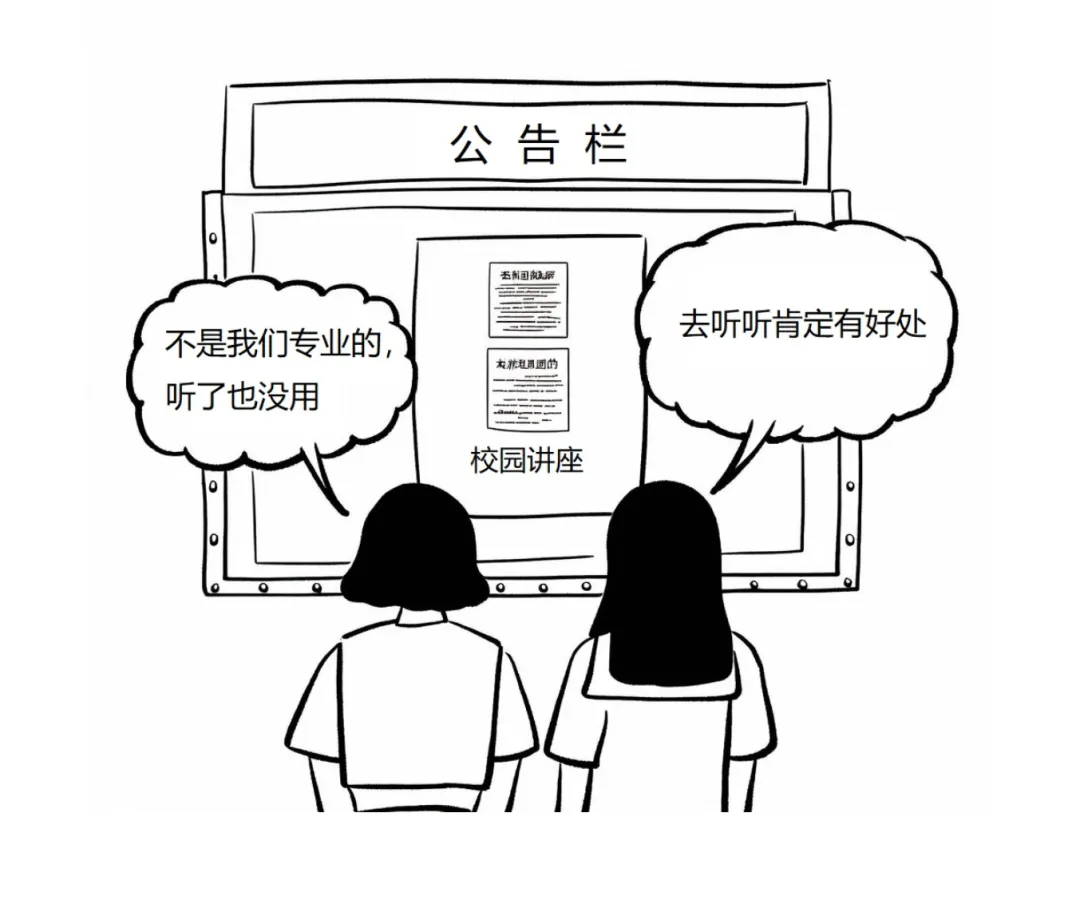
As is featured in the picture, in front of a billboard full of information about various campus lectures and speeches, the girl on the left with long hair complains to her companion, "They're not related to our major. They will not do any good to our studies." On the contrary, the girl on the right replies, "There must be some benefits of these lectures."
Simple as the picture is, it does reflect a phenomenon which is not uncommon in contemporary universities: college students are expected to learn as much knowledge as possible in various fields instead of being limited to their own major. With the remarkable development of economy, science and technology, college students with multiple skills and extensive knowledge can better adapt to the fast-paced society and be more competitive in the workplace. As the old saying goes, knowledge is no burden. On the one hand, it is the ability to acquire knowledge in various fields and explore all the possibilities that enables college students to achieve their academic and career success. Take the famous scientist Yuan Longping for example. His great achievements can be attributed more or less to his thirst for knowledge in all walks of life. On the other hand, college students who spend campus life centering on their majors without knowing anything outside of the field will ultimately fail to fulfill their own goals.
Initially, it is high time that a schoolwide campaign was launched to encourage students to explore all kinds of possibilities and gain all kinds of knowledge. What's more, college students are expected to cultivate the awareness of staying hungry and staying foolish.

