202608-202701各地联考模拟题整理-阅读理解C篇
- 2026-09-25 15:17:57
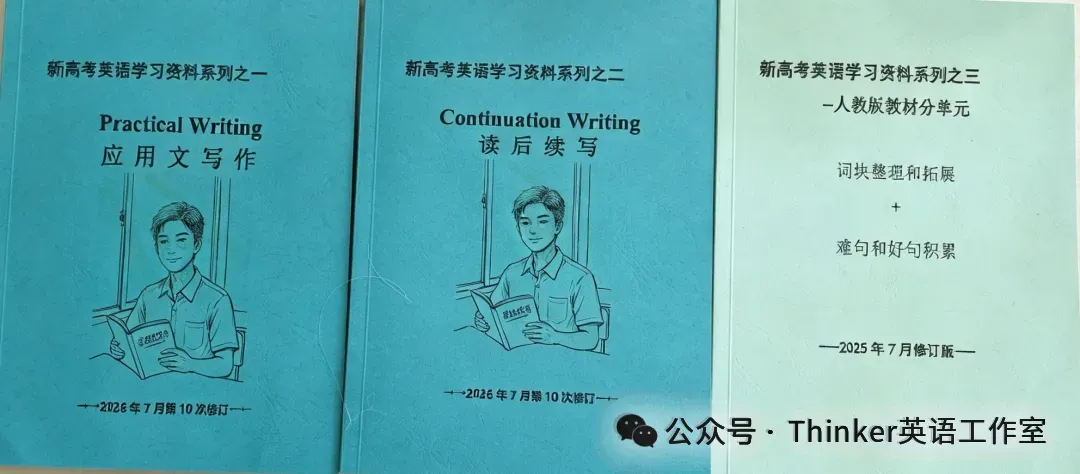
开学了,推荐高中英语学习必备书:最新2026版应用文写作和读后续写:
2026年7月第10版《新高考英语应用文写作+读后续写+人教版单元词块整理三驾马车》来啦!
202608-202701各地联考模拟题阅读理解C
目录:
1.202608湖北圆创联盟联考
2.202608湖北省部分高中返校考
3.202608湖南长郡中学开学考
4.20260821浙江Z20联考
5.202608山东同心同德学校联盟开学考
6.20260827强基高三返校考
7.202608安徽十联考第一次教学质量测评
8.202608广东省第一次模拟考
9.202608湖北省云学联盟阶段训练
10.20260827七彩精诚金兰联考
11.202608巴蜀月考卷(一)
12.202608福建名校联盟开学考
13.202608浙江省A9协作体暑假返校学情诊断
14.202608湖南雅礼中学开学考
15.20260902名校协作体高三
16.202609 湖南省部分名校阶段检测
17.20260909嘉兴基测
18.202609山东济南市摸底考
19.202609山东名校考试联盟
20.202609南开中学月考(一)
21.202609南通市部分学校质量监测
22.202609青岛市期初调研
23.20260916镇江市期初考试
24.20260916苏州四市五区期初考试
25.20260917湖北武汉九调
26.202609广东省六校联盟
试题:
1.202608湖北圆创联盟联考
Summer comes, and mosquitoes constantly buzz and bite, leaving red marks and ruining our sleep.
To fight them, DEET (避蚊胺) is assumed to be the gold standard for preventing mosquito bites. Most researchers agree that a key part of its effectiveness is unpleasantness — the bugs just hate to be around it. However, some mosquitoes seem capable of overcoming their revulsion, leading to the theory that the insects might be getting used to the chemical.
Claudio Lazzari at the University of Tours set out to investigate, by running a version of the experiments made famous by Ivan Pavlov in the late 1800s where dogs were conditioned to associate sounds with food. In those experiments, Pavlov routinely rang a bell and then immediately fed the dogs. Eventually, when he made the sounds but didn’t provide food, he found the animals still salivated (流口水), as they would before a meal.
In his experiments, Dr Lazzari presented hungry mosquitoes with warm sheep’s blood while being exposed to a gentle breeze of ordinary air or of air blown past a piece of paper soaked in DEET. After many similar repeated experiments, the researchers then bravely presented their own hands to the insects. One hand was covered in DEET while the other was left untreated. To their frustration they watched as 60% of the mosquitoes that had been presented with blood while being exposed to DEET bit the hand coated in DEET. In contrast, all mosquitoes trained with ordinary air avoided it entirely.
Dr Lazzari’s conditioning in the laboratory was important for the mosquitoes in developing their fondness for DEET. But the chances are good that a similar scene is taking place in the real world, where the effects of DEET typically weaken over time, especially when people are sweating or not applying enough of the stuff in the first place.
In such circumstances, hungry mosquitoes are most likely to be able to tolerate the faint smell of DEET, bite a lightly protected person, begin connecting the smell with food and become more dangerous to those they encounter later in their lives.
28.What does the underlined word “revulsion” in paragraph 2 mean?
A. Dislike.B. Fondness.C. Desire.D. Curiosity.
29.Why was Pavlov’s experiment mentioned?
A. To prove DEET’s effect.B. To explain conditioning.
C. To honor early biologists.D. To analyze animal behavior.
30.What can we learn about the research from paragraph 4?
A. Sheep’s blood drove mosquitoes away. B. All mosquitoes weren’t thirsty for blood.
C. Ordinary air fueled mosquitoes’ appetite. D. Most mosquitoes were conditioned to DEET.
31.Why does DEET sometimes fail to keep mosquitoes away?
A. Sweat clears DEET completely. B. Mosquitoes associate it with food.
C. Its smell grows stronger over time. D. Human blood weakens the chemical.
2.202608湖北省部分高中返校考
When a Los Angeles hospital authorized handwriting courses for its doctors, it highlighted a modern contradiction: in an era of digital perfection, the simple act of writing by hand remains critically important. The chief of staff explained to Science Daily, "Many of our physicians don't write clearly." The consequences can be severe, as seen in an unfortunate case where a chemist's misreading of a doctor's prescription (处方) led to a patient's death.
Even though many medical records are now stored on computers, physicians still spend a lot of their time writing notes on charts or writing prescriptions by hand. Clarity in handwriting isn't merely an aid to communication. In some significant way, writing by hand primes the brain for learning to read. Psychologists Mueller and Oppenheimer found that "Laptop note takers' tendency to write down lectures verbatim (逐字地) rather than processing information and reframing it in their own words has a negative effect on learning". In their experiments, students typing notes processed information shallowly, while those writing by hand were forced to summarize, leading to better understanding. The slower pace of pen and paper acts as a cognitive filter, activating the brain for deeper comprehension.
Yet, the skill is fading rapidly. Researchers worry that abandoning the pen for the keyboard will lead to any number of unforeseen negative consequences. Anne Mangen, who studies how technology transforms literacy, notes that typing, being more "abstract and unconnected," could have profound implications; this decline is similar to a form of cultural pollution, a loss of a fundamental human capacity.
A common misconception is that we have simply traded an inefficient tool for a superior one. However, like the loss of face‑to‑face interaction, this trade for efficiency comes at a hidden cost. We are sacrificing irrecoverable ways of learning and knowing. Ultimately, a child who masters the keyboard but cannot sign their name is not a symbol of progress.
Handwriting is not a relic; it is a vital thread in the fabric of our cognition, and its wearing demands our immediate attention.
28.Why did the hospital introduce handwriting courses?
A. To follow the latest handwriting trend.B. To prevent potential medical accidents.
C. To improve doctors' handwriting skills.D. To promote the use of handwritten records.
29.What can we learn from Mueller and Oppenheimer's research?
A. Typing facilitates meaningful understanding.
B. Note‑taking blocks verbatim comprehension.
C. Keyboarding ensures higher learning efficiency.
D. Handwriting benefits deeper cognitive engagement.
30.What is the cost of abandoning handwriting?
A. The pollution of a traditional culture.B. The decline in communication efficiency.
C. The over‑reliance on modern technologies.D. The fading of an essential cognitive ability.
31.What does the author suggest we do?
A. Preserve handwriting as a tradition.B. Encourage keyboard use in education.
C. Value the crucial role of handwriting.D. Introduce handwriting courses widely.
3.202608湖南长郡中学开学考
A new Antarctic lab carved into an icy cave that functions like a bank vault for glacier landscapes that might soon disappear has opened at Concordia Station, run by French and Italian researchers. Named the Ice Memory Sanctuary, it will hold ice cores drilled from melting glaciers around the world, joined by more cores from other places. To recover the record of past climates contained within a glacier or ice sheet, scientists drill holes through layers of ice to the bedrock, dislodging cylinders that range from 300 to 500 feet long. Then, they are shipped to Antarctica.
Glaciers function like climate archives, trapping the gases, aerosols, and pollutants from ancient atmospheres between layers of ice. Because glacier melt can’t be stopped without dramatic action taken to stop climate change, the Ice Memory Sanctuary is a last resort for scientists hoping to preserve this knowledge.
“Fifty or 100 years from now, scientists will have analytical capabilities we cannot even imagine today,” says Thomas Stocker, IMF chair and professor emeritus of climate and environmental physics at the University of Bern, Switzerland.
Stocker thinks scientists could one day learn unprecedented insights into how air moves around the planet and how water moves among the oceans, atmosphere, and land. On a hotter planet, these cycles can dramatically change. Precise measurements of the chemical signals in ice could help scientists understand how Earth’s climate systems work and could test their climate models, he explains.
28. What do we know about the Ice Memory Sanctuary?
A. It is a station based in European Alps.
B. It is a bank vault in the shape of a cave.
C. It is a cave cold enough to preserve samples.
D. It is a lab founded by Anne-Catherine Ohlmann.
29. What does the underlined word “dislodging” in paragraph 3 mean?
A. Preserving. B. Polishing. C. Stuffing. D. Removing.
30. Why is the Ice Memory Sanctuary crucial for scientists?
A. Because it provides irreplaceable climate clues.
B. Because it warns humans to protect the Earth.
C. Because it purifies the chemicals and pollutants.
D. Because it slows down the melting speed of glaciers.
31. Which of the following does Thomas Stocker most probably agree with?
A. Scientists’ capabilities are severely underestimated.
B. Air and water movement is the hardest to understand.
C. Future climate research will center around chemicals.
D. A long-term perspective is quite necessary in science.
4.20260821浙江Z20联考
Pop culture holds that if you’re trapped in a well, Lassie will lead the rescue—but if you’re stuck with Garfield, you’d better have some lasagna(千层面)in your pocket. And a recent study suggests such stereotypes(刻板印象)aren’t far off.
The study grew out of a broader question about prosocial behavior—why some species help others and some don’t, says comparative ethologist Melitta Csepregi. To get at that, she and her colleagues compared 19 children (16–24 months old) with 38 untrained pet dogs and 22 cats—three species that live closely with humans but differ sharply in their evolutionary histories.
In the experiment, a familiar caregiver—the child’s parent or the pet’s owner—interacted with a sponge(海绵)before turning away. Then an experimenter hid it in full view of the study subject. Across three trials—when the sponge was unreachable and covered, then visible but out of reach, then fully reachable—the caregiver searched, repeating, “I can’t find it. What should I do?” but never directly addressing the subject.
The study, published inAnimal Behaviour, found that all three groups paid similar levels of attention. But children and dogs were more likely to show helping-related behaviors—approaching, indicating or retrieving the object. By the third trial, more than half the dogs and nearly half the kids indicated the object’s location, and some even brought it to the caregiver. Cats never approached it and only rarely indicated its location.
So was it that the cats didn’t understand the cue, or did they just lack the motivation? To find out, the researchers added a final trial, replacing the sponge with food or a favorite toy. Cats then approached and indicated the object as often as dogs and children did.
“This brilliant study puts hard data to showing that cats aren’t mean but operate on a different evolutionary system,” says ethologist Elisabetta Palagi, who was not part of the study. Dogs and children, she notes, are evolutionarily hardwired to treat another’s problem as their own. Cats, however, remain autonomous, understanding the situation without feeling forced to intervene unless there’s a direct benefit for themselves. “They truly are the efficient specialists of the animal kingdom.”
28. How does the author introduce the research topic in paragraph 1?
A. By presenting a scientific theory.B. By citing pop culture images.
C. By questioning certain stereotypes.D. By describing a rescue experience.
29. What can we learn about the experiment?
A. The caregiver turned to the subject for help.
B. The first three trials were randomly conducted.
C. The last trial explored the cause of cats’ inaction.
D. The subjects have identical evolutionary histories.
30. What does the underlined word “retrieving” in paragraph 4 mean?
A. Fetching.B. Locating.C. Overlooking.D. Identifying.
31. What does Palagi mean by referring to cats as “efficient specialists”?
A. They are less attached to humans. B. They are evolutionarily superior.
C. They help only when it pays to do so.D. They are more efficient at problem-solving.
5.202608山东同心同德学校联盟开学考
After lunch, many students feel their eyes grow heavy and their minds slow down. Some fight the sleepiness with strong coffee; others simply give in and take a nap. Which choice is wiser? Scientists who study sleep have some surprising answers.
First, feeling sleepy in the early afternoon is not a sign of laziness. Our bodies run on an internal (内部的) clock, which naturally lowers our energy level between 1:00 and 3:00 p.m. This happens to almost everyone, whether they slept well the night before or not.
Research shows that a proper nap can improve memory, attention and even mood. In one study, students who napped for 20 minutes after learning new words remembered much more than those who stayed awake. However, the length of the nap matters a great deal. A nap of 10 to 20 minutes helps the brain rest without entering deep sleep. But if you sleep for more than 30 minutes, you may enter deep sleep, and waking up from it can leave you feeling even more tired—a state researchers call “sleep inertia (睡眠惯性)”.
Timing is also important. Napping too late in the afternoon may make it harder to fall asleep at night, which can create a vicious (恶性的) circle: poor sleep at night leads to a stronger need to nap the next day, which then ruins the next night’s sleep. Experts suggest keeping naps short and finishing them before 3:00 p.m.
So the next time you feel sleepy after lunch, don’t feel guilty. Set an alarm for 20 minutes, find a quiet place, and let your brain recharge. Your afternoon classes—and your memory—will thank you.
28. What causes people to feel sleepy in the early afternoon according to paragraph 2?
A. Eating too much lunch.B. The body’s internal clock.
C. Lack of sleep the night before.D. Drinking too much coffee.
29. What is “sleep inertia” mentioned in paragraph 3?
A. The tiredness after waking from a long nap.
B. The difficulty in falling asleep at night.
C. The habit of napping every day.
D. The desire to sleep during class.
30. What do experts suggest about napping?
A. Napping as long as possible.B. Napping after 3:00 p.m.
C. Keeping naps short and early.D. Avoiding naps completely.
31. What is the best title for the text?
A. Why Students Need More SleepB. The Power of a Short Afternoon Nap
C. How to Stay Awake in ClassD. Coffee or Sleep: A Difficult Choice
6.20260827强基高三返校考
An interesting cultural phenomenon occurs every summer when Europeans and Americans visit each other’s continents. Europeans complain that shops and restaurants in America are so coldly air‑conditioned as to require a jacket. Americans holidaying in Europe grow impatient on finding that European old‑world buildings cause them to sweat.
The divide is rooted in both climate and culture. Long before American companies began using cooling chemicals for air‑conditioning, southern Europe was built to handle heat. In traditional houses, white paint and shaded courtyards keep things cool. Windows are thrown open and rooms aired in the mornings. Shutters keep out the midday sun. Northern Europe, meanwhile, is mostly spared the problem by its cold weather thanks to geographical advantages.
These days, as global warming is putting Europe to test, some Europeans who celebrate green lifestyles still feel pangs of carbon guilt about equipping their houses with air‑conditioning. Actually, they needn’t. The rapid expansion of renewable energy in Europe means that lowering the temperature will not do much to melt the glaciers. In Spain, solar capacity has grown nearly ten times in the past decade, so it causes fewer carbon emissions to generate power. Portugal and France do just as well, thanks to dozens of nuclear reactors.
Apart from climate morality, many Europeans also worry about the costs, but there is good news on that front as well. Their homes are smaller than American ones, which helps them save two thirds as much electricity on average. Moreover, the solar energy boom means that power is not just greener but cheaper than before. And some governments even offer funding to make old houses energy‑efficient.
As the world warms, Europe is heating up faster than any other region. Those who prefer to tough out the summer are free to do so. However, as Dr. Elena Rossi, a climate researcher, points out, “Cooling should no longer be a luxury but a basic necessity. Therefore, the ultimate goal should be to make cheap, clean air‑conditioning for everyone.”
28.How does the author introduce the topic?
A. By criticizing energy waste.B. By describing a tourist trend.
C. By presenting a cultural conflict.D. By analyzing different personalities.
29.What contributes to the cooling of houses in Southern Europe?
A. Adjusted lighting system.B. Modern cooling technology.
C. Unique geographical advantages.D. Traditional architectural wisdom.
30.Which of the following is an example of “climate morality”?
A. Using renewable energy to lower electricity bills.
B. Refusing air‑conditioning to cut carbon emissions.
C. Upgrading old houses to gain government funding.
D. Expanding power capacity to promote cozy lifestyles.
31.What does Dr. Elena Rossi’s words mean?
A. Traditional cooling methods are outdated.
B. Affordable air‑conditioning should be accessible.
C. The public should avoid using air‑conditioners.
D. People can choose to live with the summer heat.
7.202608安徽十联考第一次教学质量测评
City planners measure urban greenery from above‑park acreage, canopy(树荫) coverage, how far any given block sits from the nearest open ground. It's how most cities assess whether a neighborhood supports outdoor life.
Jian Sun of Fuzhou University and colleagues following 20, 000 GPS‑logged runs across a subtropical Chinese city are now suggesting the overhead picture is incomplete. Where people chose to run had more to do with something that park maps don't measure—and urban heat was doing more to empty public spaces than most city planners had accounted for.
Rather than guess which features drove the pattern, the team fed roughly three dozen variables‑temperature, vegetation(植被), road density, air quality and more‑into nine competing prediction models. The sharpest explained most of where runs gathered.
The clearest signal was urban heat stress. They tracked it with land surface temperature‑how hot the ground reads from satellites‑and where those numbers climbed,recorded runs thinned out.
Surface temperature is only a rough stand‑in. It tracks how hot pavement and rooftops get, not what a runner's body feels, which also turns on shade, wind, and humidity(湿度). The real lesson is the worth of cooler ground.
If heat pushes people indoors, greenery seems to pull them back out. Not the abstract kind you spot from a satellite. Street greenery at eye level turned out to be the strongest green factor‑the leaves a runner sees while moving through a block.
Distance did a lot of the talking. The closer a starting point sat to water‑a river, a lake, a waterfront path‑the more runs began nearby, and the same held for sports facilities.
Water kept showing up. The researchers grouped rivers, lakes, parks, and vegetation together as blue‑green spaces, the natural and semi‑natural areas that cool the air and give people somewhere appealing to move.
The practical takeaways line up with the findings. In the city's hottest pockets, planners can lean on shaded jogging corridors, street trees, and waterfront paths to keep outdoor space usable when urban heat strikes.
28. What greatly reduces activities in open urban areas?
A. Canopy coverage.B. Urban heat.
C. Park size. D. Sports facilities.
29. What does the underlined phrase “thinned out” in paragraph 4 mean?
A. Were more intense. B. Got randomly planned.
C. Were much longer.D. Became less frequent.
30. What is a major finding of the research regarding eye‑level street greenery?
A. It slows down joggers' rhythm. B. It is more difficult to measure.
C. It can boost outdoor activities. D. It barely affects runners' body feels.
31. What would the author probably suggest city planners do?
A. Keep greenery in sight. B. Jog in built‑up neighborhoods.
C. Stick to shorter routes. D. Avoid using the natural spaces.
8.202608广东省第一次模拟考
The Age of Information is mushrooming, perhaps even bulging. If you tried to download all the data available today, you’d need more than 180 million years to do so. But you are wrong to assume that all this information would stimulate a boost of innovation to match the output of data. Indeed, the last time we found ourselves in a period of significant innovation, was more than 120 years ago, in the Age of Insight.
Innovations, both big and small, often occur as a moment of insight, which typically involves quiet signals deep in the brain, just under the surface of awareness. Anything that helps us notice quiet signals, such as taking breaks between meetings, simplifying learning approaches or avoiding digital distractions, can increase the number of insights. However, it’s becoming more challenging to find those signals with the ballooning use of technology, stuffing every moment with an endless supply of content.
Besides, we also want to increase the quality of them — to be able to sort through big new ideas and find the ones that have real value. Launched in 2015, the Eureka Scale (尤里卡量表) allows us to assess the strength of our insight experiences on a five-point scale, which is marked by intense emotions, motivation, memory advantage, aftershocks, and following ideas. The Scale combines these five variables into a single value and allows us to define the importance of a new idea. The level-5 insight, involving the richest emotion, motivation, and lasting impact, holds the greatest significance. Contributive to measuring and improving individual and organizational performance, the Scale can be used to measure the impact of different kinds of work environments and learning approaches on participants’ growth.
For organizations to benefit from another age of insight, it’s not enough to access more data or increase the number of insights we generate. It’s indeed essential to make space for the biggest ideas to emerge from all the information. Using the shared language of the Eureka Scale will enable better decision-making toward practical and competitive outcomes. And if we’re to enter a new age of insight, we must design our environments to allow for the best insight possible to surface.
8.What does the underlined word “bulging” in Paragraph 1 probably mean?
A.Stabilizing.B.Exploding.C.Shifting.D.Collapsing.
9.According to the passage, how can the amount of insights be increased?
A.By making due pauses in your work schedule.
B.By consuming boundless social media content.
C.By avoiding distracting quiet signals in your brain.
D.By adopting additional training and coaching approaches.
10.What can be inferred from the passage?
A.The Eureka Scale controls the influence of our insights.
B.Possessing minimal emotional responses is a level-5 insight.
C.Both the quantity and quality of insights are essential to innovation.
D.A breakthrough has been made in innovation due to a wealth of information.
11.What is the author’s attitude towards the current environment for innovations?
A.Uncertain.B.Optimistic.C.Tolerant.D.Dissatisfied.
9.202608湖北省云学联盟阶段训练
Engineers at the University of California have developed an experimental smart ring that continuously analyzes sweat from the finger to monitor several molecules (分子) associated with nutrition, exercise, and alcohol consumption.
The technology marks a shift from the physical measurements collected by most consumer wearables. Existing smart rings typically rely on signals such as heart rate, movement, and skin temperature, while the new device is designed to capture changing chemical information from inside the body. It is described as the first fully integrated smart ring intended for routine biochemical monitoring.
The ring contains the entire sensing system rather than relying on a separate patch or external reader. One sectionhouses the sweat collection system, fluid channel, and sensors, while another includes the battery and circuit board. Results are transmitted wirelessly to a smartphone app, allowing biomarker changes to be viewed over time.
The device’s most important feature is that wearers don’t need to exercise or deliberately get sweaty. Fingers continually release small amounts of sweat, even when a person is resting. A soft material inside the ring creates a pressure difference that gently pulls sweat through the skin and into a narrow fluid channel. Afterwards, a set of electrochemical sensors capture that fluid and measure molecules in the collected sweat. The electronic signals are later transformed into estimated concentrations using calibration (校准) factors developed for each wearer. This personalized calibration is important because sweat composition and the relationship between sweat and blood measurements can vary from one person to another.
The ability to follow several molecules together may reveal patterns that a single reading would miss. Continuous monitoring could show how those levels change after meals, during fasting, throughout exercise, or in response to medication. A ring capturingdynamic chemical information in real time would be extremely useful for making informed decisions regarding health, diet, and lifestyle.
28.How is the new smart ring different from existing ones?
A.It detects heart rates.B. It records body temperature.
C. It works without phones.D. It analyzes chemicals in sweat.
29.What does the underlined word “houses” in paragraph 3 mean?
A. Connects.B. Generates.C. Transports.D. Contains.
30.Which factor makes the device reliable during the sweat-testing process?
A.Sweat collection.B. Individualized calibration.
C. Blood measurements.D. Electronic signal transformation.
31.What does the last paragraph tell us about the ring?
A.Its practical valueB. Its potential limitations.
C. Its production cost.D. Its physical appearance.
10.20260827七彩精诚金兰联考
It used to be easy to tell when a face was generated with AI. Whether it was an unnatural expression, impossibly smooth skin, or a noticeable third ear, early AI‑generated fake human faces were simple to spot and easy to dismiss. That's just not true anymore.
Now, AI image generators can produce portraits so convincing that even careful observers struggle to distinguish fact from fiction. That's why apps such as Zoom and Tinder allow their users to submit biometric identification to help prove a real person exists behind a profile picture. But a new study suggests you can train your brain to get better at spotting fakes.
Past attempts to teach people to spot AI faces have focused on visual errors like strange ears. But those clues can disappear with a software update or by a different prompt (提示词). "The AI is getting too good," said Amy Dawel, the lead author of the study. "And fraudsters (骗子) may avoid using pictures with obvious mistakes anyway. The result is an endless technological arms race humans are likely to lose."
Instead, the researchers taught the participants how to recognize broader patterns in how AI systems generate images. "Our training directs people's attention to global qualities differing between AI and human faces," Dawel said. Current AI image generators are trained on datasets composed of millions of images. When prompted to generate a face, they don't copy, but compose one based on the mathematical patterns shared across the faces. Individually, none of these characteristics are strange. But together, the whole is plainer than the sum of its parts which can often be sensed.
Compared with real faces, AI‑generated faces tend to be more symmetrical (对称的), more balanced, and more attractive — while also being less expressive, less distinctive and significantly less memorable. The participants were trained to look for these six markers instead of obvious errors. "Even with short training sessions, the chance of spotting AI faces almost doubled," says Tanya George, a trainer from Australian National University."People need training to navigate increasingly complex online environments."
28.Why do some apps require biometric identification?
A. To replace AI image generators.B. To confirm online users' identity.
C. To limit the use of AI portrait tools.D. To improve the quality of online photos.
29.What does Amy Dawel think of the earlier ways to spot AI faces?
A. They rely much on varied prompts.B. They help fraudsters avoid detection.
C. They have fallen behind AI progress.D. They beat humans in tech competitions.
30.What were the participants told to focus on?
A. Overall facial features.B. Massive image datasets.
C. Tiny facial characteristics.D. Shared mathematical patterns.
31.What does Tanya George think of the training in the research?
A. Effective.B. Complicated.C. Temporary.D.Thorough.
11.202608巴蜀月考卷(一)
What can novelists learn from non‑fiction?The greatest imagination is often fed with the depth of material that research offers. Sure,you can imagine anything,but readers will not necessarily believe anything. Truth doesn't have to be true,but it does have to be credible (We've all read something unrealistic that the author insists"really happened!")
I've written a few historical novels,including a series based in early Victorian London.That kind of fiction requires a lot of research just at the level of what people wear,eat and how they live their lives. Then you need location details,buildings,streets,smells,sounds etc. It looks laborious but it's almost as much fun as the actual writing. I spent months reading books and newspapers produced in the 1840s. The novel's plot would be mine,but everything it rested on was pure historical research.
Anthony Burgess was once waiting to meet his publisher in London and decided to leaf through a pile of the newest bestselling thrillers on the reception's coffee table. He noted that each book was based on a specific subject area‑avalanches (雪崩),oil drilling work‑and understood that readers don't just want a story. They also want to learn something about an unknown subject. They want fiction and non‑fiction combined.
I've also written history.I already knew about the history of the Greek town I'd decided to focus on,but I wanted to make it appealing to the general reader using the techniques I'd used in fiction.
The result was mostly an experiment in structure.I decided to tell the history in a non‑chronological (时间顺序的) way,focusing instead on themes that would allow me to group different and individual stories in ways that would hold together like chapters in fiction.The whole history would be told eventually,but it would come together gradually like a plot rather than"in order"as it happened.As such,it appeared to be almost like a novel,though everything in it is history.
28.What quality should a novel carry according to paragraph 1?
A. Readability.B. Reliability.C.Authenticity.D. Originality.
29.What did the research into Victorian London serve to ensure?
A. Visual presentation.B. Identity exploration.
C.Theme relevance.D. Historical accuracy.
30.What do readers expect from a book according to Anthony Burgess?
A.Novel content.B. Varied settings.
C.Thrilling elements.D. Immersive experience.
31.How did the author tell the history of the Greek town?
A.By following the timeline.B. By respecting historical events.
C. By combining facts and fantasy.D. By adopting a fictional organization.
12.202608福建名校联盟开学考
Squid (鱿鱼) are widely regarded as one of the most intelligent groups of animals living in the ocean. Across roughly 375 species, squid can hunt cooperatively, recognize individual humans and learn from experience. However, according to an ongoing scientific study, ocean acidification (酸化), an often overlooked effect of human‑caused climate change, could change this within decades.
Researchers raised newly hatched squid in separate tanks — one reflecting present‑day ocean
CO2(pH 8.2) and the other representing CO2 levels in the year 2100 based on a climate change prediction model (pH 7.8). After 90 days, the squid were removed and their heads were kept for analysis. Dr. Allen discovered that the brains of squid from the high‑acid tank were 49% smaller in volume than the brains of squid raised under current CO2 conditions.
The most striking damage occurs in the squid's optic lobes and optic tracts — brain regions responsible for handling visual information — which shrink (收缩) by over 50%. This brain damage directly leads to changes in behaviour. An earlier study found that squid exposed to high CO2hunt less often, and Dr. Allen links this to weaker vision. He believes the shrinking brain makes it harder for brain cells to pass signals correctly, which in turn affects their judgment and makes them more hesitant while hunting.
The oceans take in nearly 30% of human‑released CO2 , which has raised seawater acidity by about 30%, says the U. S. National Oceanic and Atmospheric Administration (NOAA). NOAA predicts ocean acidity could rise another 100%‑150% by the end of this century if we keep releasing
CO2 at the current rate. If wild squid suffer the same brain damage, the impact could spread through the entire ocean food chain.
Squid are not the only sea creatures at risk, but their sharp ability to learn makes their loss especially troubling. As our oceans grow more acidic, we may not only be changing what lives in the sea — but also how smart those creatures can be.
28.What did Dr. Allen's research find about squid?
A. Acidic water caused their brains to shrink.B. Present‑day oceans sped up their growth.
C.High CO2 boosted their learning abilities.D. Climate change shortened their life span.
29.What causes squid to hunt less often?
A. A lack of available food sources.B. A drop in overall physical strength.
C. A decline in visual processing ability.D. A change in their living temperatures.
30.Why does the author mention the data from NOAA in paragraph 4?
A. To predict what will happen to different sea creatures.
B. To warn of the severity of ongoing ocean acidification.
C. To prove human activities have caused global warming.
D. To compare the CO2 absorption rates of different periods.
31.What is a suitable title for the text?
A. Squid: A Smart Indicator of Ocean Acidification
B. Climate Change: A Big Killer of Intelligent Squid
C. The Food Chain Crisis: A Result of Human Actions
D. Acidification: A Hidden Threat to Marine Intelligence
13.202608浙江省A9协作体暑假返校学情诊断
Dreams seem to occur at random, from everyday situations to unpredictable experiences. Now, a new study shows that our personal features as well as reallife events actually shape what we dream about, creating patterns in our subconsciousness (潜意识).
The study, published in Communications Psychology, analyzed thousands of dream and waking experience reports collected over four years. The researchers used natural language processing tools to quantify the structure of dreams. They found that personal features like how often someone daydreams, their attitudes about dreams, and their sleep quality all influence dream content.
Researchers noticed that dreams don't simply replay scenes from our daily lives. Instead, dreams seem to mix familiar places like workplaces, hospitals, and schools into new scenes that blend memories with imagination. The reported dreams tended to focus more on visual details, feature more characters, and make less logical sense. They were also less selffocused and less driven by conscious thinking.
These dream transformations weren't the same for everyone. Participants who spent more time daydreaming during the day tended to have dreams that jumped rapidly from one scene to another. Those who placed more importance on dreams described them as more vivid and immersive. Sleep quality also played a role.
The team used three large language models, LLMA 3, ChatGPT4, and ChatGPT4 Turbo, to rate dream reports on 16 different features, such as mood, strangeness and freedom of movement. "By combining largescale data with computational methods, we were able to uncover patterns in dream contents that were previously difficult to find," Elce said. "This opens new possibilities for studying consciousness, memory, and mental health in a better way."
28.How did the researchers conduct the study?
A. Data analysis. B. Sleep observation. C. Personal surveys. D. Life event tracking.
29.Which of the following best describes the nature of the dream?
A. Creative. B. Conscious. C. Realistic. D. Repetitive.
30.What is the main advantage of the language models?
A. Increasing the number of dream features. B. Enhancing the accuracy of human brains.
C. Simplifying more personal dream reports. D. Identifying the structures of various dreams.
31.Which of the following can be a suitable title for the text?
A. To Control Dreams, Control Your Day. B. Better Sleep Creates Better Dreaming.
C. AI Now Fully Understands Our dreams. D. Dreams Are the Mind's Hidden Patterns.
14.202608湖南雅礼中学开学考
Cars produced today are essentially smartphones with wheels. For drivers, this means many new features: automatic braking(刹车), turn-by-turn directions, and entertainment systems. But carmakers are getting much more. They' re constantly collecting data from our vehicles, like how much we weigh, how fast we drive, how many children we have and even financial information. But who owns and, ultimately, controls that data? And what are carmakers doing with it?
The issue of ownership is not clearly known. Drivers usually sign away their rights to data. It's not unlike buying a smartphone. The difference is that most customers have no idea that vehicles collect data. We know our smartphones collect data and we've come to accept that we trade personal information for convenience. With cars, we have no such expectation.
What carmakers are doing with the collected data isn't clear. We know they use it to improve car performance and safety, and that they have the ability to sell it to third parties they might choose. The data on your driving habits could be valuable to insurance companies. You may or may not choose to share it with these services. But while you can turn off location data on your cellphone, there is no opt-out feature for your car.
Carmakers use data to warn us when something needs repair or when our cars need to be taken in for service. For almost a century, car owners have been able to take their vehicles to whichever shop they trust for maintenance and repair. That may be changing. When carmakers control the data, they can choose which service centers receive our information. They' re more likely to share our data only with their branded dealerships(经销商) than with independent repair shops which could have an advantage in price and convenience.
It is clear that because of its value— as high as 750 billion dollars by 2030— carmakers are unlikely to release control of the data collected from our vehicles. Policymakers, however, have the chance to give drivers control—— not just so that they can keep their data private but also so that they can share it with the people who want to access it. This will let car owners maintain what they've had for a century: the right to decide who fixes their cars.
28. How is paragraph 2 developed?
A. By expressing ideas.B. By giving examples.
C. By exploring reasons.D. By making comparisons.
29. What does the underlined part “opt-out feature” in paragraph 3 refer to?
A. A useful tool.B. A special part.
C. A function to stop something.D. A way to start something.
30. What might happen if carmakers control users' data?
A. More repair shops will appear.
B. Carmakers will offer more repair shops.
C. Users will spend more on car maintenance.
D. Independent repair shops will earn higher profits.
31. What is the author's attitude towards the future of vehicle data control?
A. Policies may help drivers gain control of their data.
B. Car owners will release control over their vehicle data.
C. Drivers should realize the value of their personal data.
D. Carmakers may share vehicle data with drivers in no way.
15.20260902名校协作体高三
A popular musician posts a music video or an athlete shares a workout, and suddenly they seem like part of our lives. People like and share these posts, and over time, admiration can start to feel like friendship — people like to think they know celebrities. Psychology Today defines this phenomenon as a parasocial relationship (准社会关系) — a onesided connection that exists only in the fan's mind. First identified in 1956 to describe television viewers feeling closely connected to onscreen figures, this behavior has existed for ages.
Today, social platforms deepen this illusion by offering constant, seemingly real updates on the lives of public figures. However, what audiences actually see is a carefully selected version of reality, edited for perfection rather than truth. Despite this created closeness, young people frequently view celebrities as standards for success. This influence often unconsciously shapes everything from their selfimage to their longterm career goals.
These relationships are not always harmful. For some, especially those who feel left out in society, seeing public figures with similar backgrounds can offer a sense of belonging. These connections can inspire confidence and make people feel less alone. In that sense, they can serve a real and meaningful purpose, offering comfort.
The danger arises when the line between admiration and imagination disappears. The relationship becomes unhealthy when fans act as if they truly know a celebrity. They might take planned posts as personal messages and develop unrealistic expectations. Furthermore, these feelings now extend to artificial intelligence (AI). Chatbots acting like real friends can produce deep emotional responses, making it harder to tell real human connection from AI.
Admiration itself is fine. Music, sports and entertainment have long connected communities, but that influence needs clear boundaries. Without them, simply watching a video is easily mistaken for close friendship, and carefully chosen content is mistaken for true connection. Parasocial relationships should remain what they are: distant and onesided. In a digital age where everything is designed to feel personal, we must remember that it is not.
28.Why did the author mention the musician and the athlete in the first paragraph?
A. To reveal the market value of stars' posts.B. To criticize celebrities' toomuchsharing.
C. To show an imagined familiarity with stars. D. To illustrate progressive fanstar connection.
29.How do digital bonds built on celebrity posts affect the youth?
A. They shape youths' personal values. B. They make the youth perfectionists.
C. They ease beauty standards for youths. D. They develop the youth's social skills.
30.Which of the following is an example of the "danger" in paragraph 4?
A. Flooding friends' chats with celebrity updates.
B. Using AI chatbots to solve academic challenges.
C. Taking idols' livestream as private video calls.
D. Tracking a star's posts to monitor their traces.
31.What may be the best title for the text?
A. Music and Sports: The Uniting Strength
B. Posts and Responses: The Healing Circle
C. Blessing or Disaster: The Booming Internet
D. Stardom or Friendship: The Mistaken Closeness
16.202609 湖南省部分名校阶段检测
You ask your wife to pick a local restaurant and pick up some take-out one evening. Then, while logging in to a Zoom meeting, you also ask your mom to buy some wine on her way home. While they follow through on your requests, you are left astonished and annoyed: How is it that they could pick a restaurant that was involved in a health scandal (丑闻) last month? And why would they choose a type of wine you hate?
The husband above has been caught by a psychological effect known as the curse (诅咒) of knowledge. It’s a simple but destructive effect: once we know something, it’s very difficult to imagine not knowing it, or to take the perspective of someone who doesn’t.
The effect was first put forward by Elizabeth Newton, a Ph.D. candidate at Stanford, in 1990. Newton arranged an experiment in which one person, a tapper (敲击者), was asked to tap out the melody (旋律) of a popular song, while another person, the listener, was asked to identify it. The tappers assumed that their listeners would correctly identify about 50% of their melodies; they were amazed to learn that the listeners only got about one out of 40 songs correct. To the tappers, their melodies sounded perfectly clear and obvious, but the listeners heard no music and no instrumentation in their heads, who only heard noise of a finger tapping on a table.
As I noted in a post about the Dunning-Kruger effect last year, people who aren’t well-informed are quite likely to feel confident in their opinions, because they don’t know enough to question their own unearned confidence. Similarly, we often make an unrecognized assumption: someone can read our minds or form opinions based on information we haven’t shared. This assumption often leads us to feel we’ve clearly expressed our wants and needs even when we haven’t.
28. Why is the husband shocked and angry?
A. His requests were refused.B. He preferred sweet wines.
C. His wife purchased unnecessary items.D. He disagreed with his family’s options.
29. What is a feature of the curse of knowledge?
A. It overstates people’s innovation.B. It causes people to ignore advice.
C. It blinds people to others’ ignorance.D. It stops people from sharing opinions.
30. What can be inferred from Elizabeth Newton’s experiment?
A. Tappers succeeded in controlling the speed.
B. Tappers failed to consider listeners’ actuality.
C. Listeners with hearing loss had bad perception.
D. Listeners fond of pop music hated instruments.
31. How can we remove the curse of knowledge?
A. By detailing our thoughts.B. By figuring out our needs.
C. By listening to diverse ideas.D. By showing the action steps.
17.20260909嘉兴基测
Two friends are seated in a busy restaurant. They acknowledge it has been “too long” since they last caught up. Then a tense silence follows. One friend asks, “So, how are you?” Such a simple question weighs heavily on the other. She forces a smile and replies, “I’m fine. How are you?”
The strange part is that she doesn't say it intentionally. “Fine” seems to arrive on its own before she even questions if it’s true. For many of us, being “fine” is a reflex, like pulling our hands back from something hot before we feel the pain. This behavioral pattern sticks because it works, at least on a surface level. It keeps the childhood dinner table calm, or a boss from further asking personal questions. “Fine” creates a boundary without us having to voice the need for space.
There is a trade‑off, of course. “I’m fine” isn’t so much a lie. Rather, it’s a stand‑in for something more authentic (真实的) and complicated. Often we lack the time, safety or language to name what is under “fine.” The reflex to be “fine” becomes so automatic that rarely does anyone get a real answer, including ourselves.
This “I'm fine” reflex is seldom built in a single event. Instead it’s incubated in moments when “fine” keeps things working: with easily stressed parents, or in a household where no one truly cares to listen when asking “how are you”. None of the exchanges has to be dramatic to leave a mark; enough repetition tells the nervous system that honesty here is unsafe or unwanted.
Fortunately, once identified, the reflex can be changed‑‑just a brief pause (暂停) before saying “fine”. In that pause, you don’t even have to voice the truth to break the habit, start simply by noticing the gap between the automatic answer and the real one. Then start with one low‑pressure person, like a friend, to practise honest replies before opening up to others.
28.Why does the author mention the two friends in paragraph 1?
A. To share communication skills.B. To give a reason for small talk.
C. To introduce a response pattern.D. To illustrate the safe social distance.
29.What can we infer about the “I’m fine” reflex?
A. It allows people some personal space.B. It is a white lie meant to hide bad moods
C. It does more harm than good in daily life.D. It efficiently expresses complicated emotions.
30.What does the underlined word “incubated” in paragraph 4 mean?
A. Hidden.B.Replaced.C. Developed.D.Discovered.
31.What is suggested in the last paragraph?
A. Questioning the honesty of others.B. Sharing pressure with trusted friends.
C. Avoiding simple answers in conversations.D. Examining automatic replies before speaking.
18.202609山东济南市摸底考
Feeling thirsty? Drawing clean water directly from the air is possible, as even extremely dry regions contain some moisture (水汽). Over the past few years, researchers have created sponge-like (海绵状的) materials that make “atmospheric water harvesting” (AWH) possible by absorbing moisture. However, recovering the trapped water usually involves heat and a long wait. Most current systems rely on sunlight to warm these materials. This slow step can take many hours or even stretch into days.
To break this bottleneck, MIT engineers Ikra Shuvo and Svetlana Boriskina identified a much faster method. Instead of heating the water-absorbing materials to release water, they use high-frequency ultrasonic (超声波的) vibrations to shake the moisture loose. These sound waves are precisely tuned to break the weak bonds holding water molecules (分子) in place. This targeted disturbance creates enough force to release the water, shaking it out in small drops.
The new approach elegantly bypasses the materials’ unyielding nature. “Any material that is very good at absorbing water doesn’t want to part with it,” explains Boriskina. “So you normally need to put a lot of energy into pulling water out.” With ultrasound, this process is completely transformed. Lab tests show this method is about 45 times more efficient than traditional heating, freeing the trapped water in mere minutes.
This breakthrough overturns the assumption that AWH systems must absorb moisture overnight and depend on passive sunlight during the day. Powered by a small solar cell, which supplies electricity and also acts as a sensor to detect when the material is wet, the system activates automatically whenever enough water has gathered, allowing the setup to cycle day and night.
The project’s ultimate purpose goes far beyond laboratory efficiency. Boriskina notes it could provide a reliable source of drinking water for remote communities lacking freshwater. As global water crises worsen, this innovation offers a ray of hope, which might be a life-saving solution in the thinnest of air.
28. What does “this bottleneck” mentioned in Paragraph 2 refer to?
A. The lack of water in dry regions.B. The huge cost of current devices.
C. The slow process of releasing water.D. The poor performance of the materials.
29. How do the ultrasound waves release water from the materials?
A. By heating the watery materials.B. By overcoming the trapping force.
C. By breaking water into small drops.D. By changing the materials’ property.
30. What activates the new device automatically?
A. An electronic sensor.B. A water cycling setup.
C. Insufficient water absorption.D. Continuous sunlight exposure.
31. What does Boriskina highlight regarding the project in the last paragraph?
A. Its further research.B. Its practical potential.
C. Its current limitations.D. Its technical improvements.
19.202609山东名校考试联盟
Have you ever left a social event convinced, without any evidence, that everyone hated you? Or felt anxious when a friend’s text ended with a period instead of an exclamation point? According to psychotherapist Meg Josephson, these feelings are surprisingly common, and they point to a stress response known as “fawning”.
Psychologists have long recognized three classic stress responses: fight, flight, and freeze. However, some experts believe there is a fourth: fawning. The term was coined by psychologist Pete Walker to describe a protective reaction that often develops in childhood, particularly in response to trauma (创伤). Fawning is essentially an extreme form of people pleasing — a strategy of being overly agreeable, helpful, and self-sacrificing in order to keep oneself safe from a perceived threat.
Meg Josephson herself grew up in a chaotic household where she constantly tried to calm and accommodate her unpredictable father. For people who habitually fawn, the urge to monitor others’ emotions goes into overdrive. They may rush to apologize even when they’ve done nothing wrong, or desperately try to “fix” other people’s feelings.
Neurologically, fawning activates the nervous system’s “rest and digest” response rather than the sympathetic “fight or flight” chain reaction. This creates a paradox: the body stays calm, but the brain remains alert, scanning for cues of disapproval or rejection. For individuals with a history of relational trauma, this alertness becomes automatic, transforming social interactions into survival scenarios where worth is dependent on others’ approval. While fawning can be necessary in genuinely dangerous situations — for physical safety or even job security — it often spills into everyday life where no real threat exists.
Ms. Josephson has been a practicing therapist for five years and has 337,000 followers on Instagram. With her new book, she hopes to help people who think that “I can’t feel OK unless the other person is OK,” she said. She suggested checking fawning behavior by starting small. For people who habitually fawn, it can feel fearful to set boundaries and say no. So begin with low-stakes situations.
28.What can be learned about fawning?
A. It is a response to misunderstanding others.
B. It has long been recognized as a cause of stress.
C. It is a method to please people and avoid threats.
D. It emphasizes the importance of one’s inner thoughts.
29.Why is the example of Josephson given in paragraph 3?
A. To indicate how fawning develops.B. To show fawning is a natural talent.
C. To explain why fawning is hard to stop.D. To suggest fawning only happens at work.
30.Why does fawning occur according to paragraph 4?
A. The brain instructs the body to respond. B. The “rest and digest” mode is activated.
C. A sympathetic chain reaction is generated. D. Survival in social situations is ensured.
31.What will the text talk about next?
A. How to start small. B. What the new book covers.
C. How to stop fawning behavior. D. Why it’s necessary to self-check.
20.202609南开中学月考(一)
Every morning, Kathy Reagan Young finishes her shower, dries off, puts on eye protectors, and receives purple ultraviolet (UV) light treatment from a specialized light box. This simple daily routine has completely transformed her life.
In 2008, Young was diagnosed with multiple sclerosis (多发性硬化), a severe autoimmune disorder (自身免疫性疾病). The disease makes the immune system mistakenly attack the protective covering of nerve fibers, causing muscle weakness, visual problems, severe fatigue and cognitive difficulties. It may even lead to motor control loss or paralysis. For years, frequent exhaustion forced Young to rest in bed many times a day. Fortunately, after months of UV light treatment, her fatigue faded greatly. Her disease activity score fell to the best level and stayed stable for over a year. She finally regained energy and no longer canceled social plans due to tiredness.
UV light therapy is not new and has been used for decades to treat psoriasis, an immune-related skin disease. Studies have proven that UV light can modulate overactive immune systems and reduce inflammation (炎症) across the whole body. When UV rays reach the skin, they change specific chemical substances that send regulatory signals to internal organs. This makes UV therapy promising for treating other autoimmune diseases, for example, Type 1 diabetes.
Research also shows that people in low-sunlight regions are more likely to suffer from such illnesses, proving the link between UV exposure and immune health. Some experiments found UV light may weaken skin immunity and cause cancers, but further studies confirmed that the same immune-suppressing effect can also calm abnormal immune responses that trigger autoimmune disorders.
Scientists are now exploring the exact biological mechanisms of UV therapy to solve a century-old medical puzzle. As one of the first Americans testing UV phototherapy for multiple sclerosis, Young has offered practical advice to improve the device. Though large-scale clinical trials are still needed, UV light therapy shows great potential. For countless autoimmune disease patients worldwide, it has become a reassuring new hope.
28.What happened to Young after the treatment in paragraph 2?
A. Her tiredness was relieved obviously. B. She recovered from multiple sclerosis.
C. Her disease score kept rising for a year. D. She regained energy but refused to socialize.
29.What does the underlined word “modulate” in paragraph 3 most probably mean?
A. Monitor. B. Intensify. C. Ruin. D. Regulate.
30.What can we infer about UV light from the text?
A. It has a double-sided effect on the immune system.
B. It roots out inflammatory responses in human bodies.
C. It only works on skin diseases rather than inner illnesses.
D. It has already been widely applied to treat Type 1 diabetes.
31.What does the passage mainly talk about?
A. The secrets behind sunlight effects.
B. A fighter against multiple sclerosis.
C. The causes of abnormal immune responses.
D. A promising treatment for autoimmune diseases.
21.202609南通市部分学校质量监测
Recently, OpenAI launched free AI image generation on ChatGPT. The Internet is now flooded with AI pictures imitating the styles of Miyazaki Hayao and other famous artists. Yet AIgenerated artworks feel strangely empty to audiences. It is not simply that AI lacks originality, after all, so too does most human art.
The work produced by machines is, in an important sense, a body without soul. There is no self within the machine, and so there can be no connection or community with the other at the level of being.
Art is a unique human pursuit for everyone. It is more than a beautiful combination of colors, forms, sounds and words. As Hegel puts it, art is a sensitive expression of an idea. It is a spiritual and cultural activity. Its beauty lies in how it affects us — whether it makes us think, feel another's pain, brings hope, or uplifts spirits. When humans create art, they pour indescribable inner feelings and personal life experiences into their works. As a process, art includes all activities and efforts which express human mentality, perceived through our senses.
This special human touch allows viewers to project their own emotions onto artworks and spiritually communicate with creators beyond the limits of language. The permanent value of art comes from the unique inner traces, feelings and life perspectives of individual creators. Art creation is essentially emotional transference. Creators convey inner true feelings, while audiences are able to understand them and find reflections of their own hidden fears and desires in works. Art bridges the inner gaps between audiences and creators with a shared language.
Machinegenerated art loses its most vital power —the ability to connect people. This loss is especially harmful in an increasingly lonely world. The disappearance of such artistic connection damages personal relationships and undermines social and political stability. Our society relies on these emotional bonds. We recognize fundamental shared humanity despite our differences.
28.Why do AIgenerated artworks feel empty to audience?
A. They are short of originality. B. They fail to convey messages.
C. They lack a genuine connection. D. They imitate other artists' styles。
29.What does the true beauty of art lie in?
A. The power to touch the human souls.B. The combination of colors and words.
C. The reflection of artists' experiences. D. The description of human activities。
30.How does art bridge the inner gaps between human beings?
A. It creates special visual effects. B. Viewers personally talk with artists.
C. It relieves viewers' hidden fears. D. Viewers have empathy with artists.
31.What is the author's attitude towards the wave of AIgenerated art?
A. Supportive. B. Objective. C. Concerned. D. Uncertain.
22.202609青岛市期初调研
In recent years, eco‑conscious gardening has gained popularity. With so much emphasis on native plants, it is easy to see non‑natives as simply a bad choice. However, gardeners say it's not that simple.
Laura Janney, CEO of The Inspired Garden Masterclass, argues that we miss the big picture by thinking in terms of native vs. non‑native and assigning opposing moral labels. Instead, we should define "bad plants" as those that are invasive (入侵的) or damaging to local ecosystems, and "good plants" as those that support pollinators (传粉者), are sustainable, and aren't invasive. The good plants, she adds, "work well in the garden whether they're native or not."
That said, it's still helpful to understand why non‑native plants can be problematic when not planted thoughtfully. "There's always a risk that a non‑native plant can become invasive outside its native range, meaning it could cause negative impacts by out‑competing native species for necessities of survival — especially in the absence of its co‑evolved organisms feeding on it that otherwise keep its population in check — introducing pests or diseases, or providing low food and habitat value for native wildlife," says Amy Karpati, Ph. D. , senior science advisor at Teatown Lake Reservation.
Since native plants are being grown in their native climate, once established, they can grow with little extra care. As a result, they are widely promoted as the virtuous choice, which can create pressure to turn a garden into a fully native landscape and guilt when that goal isn't met. However, experts say a 100% native garden is simply not realistic for most people. A 2018 study of Carolina chickadees (山雀) shows that in areas with less than 70% native plant biomass, the birds could not produce enough young to sustain their populations, but thrived at 70% or higher. This has led to the recommendation that homeowners aim for roughly 70% native plants‑a goal that supports wildlife while remaining realistic.
"A healthy ecosystem is more important than the pursuit of native purity," says Shane Pliska, the president and CEO of Planterra. "There is no turning back from the human impact, so we should be more focused on greening our environments with more plants and wooded habitats rather than a historical restoration to what was. Ecosystems evolve."
28.What does Janney think determines whether a plant is "good" or"bad" ?
A. Whether it is native to the area.
B. Whether it can survive with little care.
C. Whether it benefits the local ecosystem.
D. Whether it is popular among local gardeners.
29.How can non‑native plants cause problems according to paragraph 3?
A. By attracting co‑evolved organisms.
B. By driving away native insect species.
C. By destroying habitats for native wildlife.
D. By taking resources away from native species.
30.What is paragraph 4 mainly about?
A. Risks of uncontrolled plant growth.B. The superiority of native‑only gardens.
C. A proper target for native plant cover.D. Influences of plants on bird reproduction.
31.What does Pliska imply in the last paragraph?
A. Human impact is far‑reaching.B.A plant's role outweighs its origin.
C. Native plants have lost their value.D. Past landscapes should be restored.
23.20260916镇江市期初考试
When measuring the impacts of climate change, we typically focus on visible signs: rising temperatures, hurricane winds, or flood extents. However, the silent yet significant effects of climate change on the human brain are only now starting to be understood.
Extreme heat has been tied to worsening symptoms (症状) and increased hospitalizations across a range of nervous system and mental conditions. The same pollutants that scar the lungs may cross into brain tissue, speeding the machinery of aging or increasing the risk of diseases like dementia (痴呆症). Children are particularly vulnerable (易受伤害的) because their brains are still developing. Even being exposed to a traumatic (创伤性的) climate event before birth can change the structure of developing brains, resulting in a higher risk of behavioral disorders later in life.
Unfortunately, these damaging effects remain largely invisible. The suffering is real, but the causes are often unknown. A teenager unable to concentrate during a heat wave in an apartment without air conditioning; a grandfather whose dementia worsens during a power failure: These are not just projections; they are happening all around us.
This brings us to the concept of “neuroclimate vulnerability” ― the risk of the human brain to the side effects of climate change. This risk is shaped by age, existing medical conditions, and socioeconomic factors that determine whether a person can cool down or breathe clean air. For those facing multiple risk factors, the danger multiplies greatly.
The greatest challenge in addressing this issue is time. While some consequences emerge quickly as changes in mood or sleep, others, such as Parkinson’s disease (帕金森病),may begin decades before symptoms appear. This makes it extraordinarily difficult to connect today's environmental exposures with tomorrow's disease. Worse still, the communities most exposed to this risk are often absent from the clinical studies on which future policies will be built.
This invisibility is not unavoidable. Once the harm is named, it can be measured, and if measured, it can be reduced. To achieve this, scientists from various fields have formed the International Neuro Climate Working Group (INCWG). Their goal is to develop practical tools, such as the Brain Vulnerability and Resilience (复原力) Index, to identify those at greatest risk and guide investments. Climate change is already reshaping our brains. The question is whether we will act now to build resilience and change the future for future generations.
28.How does the author develop paragraph 2?
A. By presenting findings. B. By giving definitions.
C. By making comparisons. D. By quoting comments.
29.What does the underlined word “projections” in paragraph 3 probably mean?
A. Records. B. Facts. C. Predictions. D. Sufferings.
30.What is the main idea of paragraph 5?
A. The factors behind future policies. B. The reasons for quick mood changes.
C. The features of slow-developing diseases. D. The difficulties of environmental-risk research.
31.What does the INCWG aim to do?
A. Study mood changes. B. Promote climate awareness.
C. Collect related brain data. D. Create risk-evaluating tools.
24.20260916苏州四市五区期初考试
Most people rely on digital reminders daily. Smartphones, smartwatches and calendar alerts help us remember appointments and deadlines, cutting the mental work of tracking future plans. Psychologists call this strategy cognitive(认知的)offloading―shifting part of the brain’s workload to outside aids. Previous research has shown that reminders boost short-term performance, but much less is known about whether they influence our ability to remember independently.
In order to investigate whether reminders simply provide temporary assistance or whether they also change the learning processes that normally strengthen prospective memory―the ability to remember to carry out intended actions later, the research team, led by Craig Fellers from the University of California, Santa Cruz, conducted two online experiments.
In the first experiment, participants completed an ongoing word task while remembering two prospective memory tasks. In one condition, participants remembered both tasks using their own memory. In the offloading condition, one of the memory tasks was supported by a highly noticeable reminder displayed in bold text, while the other had to be remembered internally. After the first stage, all participants redid the task with no reminders. A second experiment was carried out to confirm the results.
As expected, reminders greatly improved performance while available. Participants almost never forgot the task supported by the reminder. However, the researchers found no evidence that removing one memory burden allowed participants to perform better on the other memory task they still had to remember by themselves. In fact, in the second experiment, when the reminders were made even more explicit, performance on the non-offloaded memory task actually worsened.
While reminders can be a powerful tool for ensuring immediate task completion, they are not cognitively neutral. They can gradually weaken the essential practice that helps us form lasting memory skills we rely on ourselves to use.
The researchers caution that the study was conducted online using university students, so the results may not fully reflect how people use reminder apps in everyday life. They also examined relatively short-term memory performance, leaving open the question of whether long-term reliance on digital reminders produces similar effects.
28. What remains a puzzle about reminders according to paragraph 1?
A. Their burden on smart devices.
B. Their role in cutting mental stress.
C. Their application in daily appointments.
D. Their influence on independent memory.
29. What does the underlined word “explicit” in paragraph 4 mean?
A. Reasonable.B. Comparable.C. Obvious.D. Restricted.
30. What message do the experiments mainly convey?
A. External aids guarantee reliable memory.
B. Memory burdens can almost be removed.
C. Reminders may harm inner-memory skills.
D. More reminders ensure better task outputs.
31. Why are the study’s limitations mentioned in the last paragraph?
A. To prove short-term tests' unreliability.
B. To show its incomplete research evidence.
C. To criticize online student-based research.
D. To stress its narrow real-world application.
25.20260917湖北武汉九调
Want to lose fat? There’s one method scientifically proven to work: eating a little less food than your body needs to fuel itself each day. Do that, and your body starts using its energy reserves—its stored fat—to make up the deficit.
It sounds straightforward. You dutifully keep track of the calories in every meal to make sure your daily intake stays less than your fixed limit, but the number on your weight scale never changes at all. It’s frustrating and disheartening. But there’s good news: you’re not to blame.
Recent scientific findings suggest it’s almost impossible to count calories with any degree of accuracy, which explains why trying to lose weight by calorie counting is so hard. It’s not bad maths that trips most of us up, though. Generally, unless you diligently log every ingredient before you eat, humans just aren’t very good at recalling exactly what was on their plate, let alone the handful of snacks they ate without thinking. Given all that, it’s no surprise that studies suggest the average person underestimates their daily consumption by around 30 per cent (roughly 600 - 750 calories), or about 10 digestive biscuits.
The very idea of working out calorie amounts is problematic. And that’s before we even consider the effect your individual biology can have. For instance, a 2023 study tested the outcomes of giving people a high-fibre diet, designed to feed their gut microbes (肠道菌群). With growing microbial communities in their guts, the scientists found that the participants in the study lost a little bit of weight—without eating less or feeling hungry—because they were absorbing fewer calories from their food.
“That means, depending on what you eat and how many microbes are thriving (旺盛繁殖) in your gut, some calories are used by you, while others feed the microbes.” says Professor Rosa Brown, a co-author of the study.
If all this is starting to make you think that calorie monitoring might be off the menu, you’d be right.
28.What does the underlined word “deficit” in paragraph 1 mean?
A. Database.B. Shortfall.C. Nutrition.D. Weight.
29.What makes it hard for dieters to count calories?
A. Inaccuracy of intake records.B. Lack of tracking approaches.
C. Absence of scientific evidence.D. Complexity of calculation procedures.
30.What can we learn from the 2023 study?
A. Calorie absorption may vary.B. Eating less means losing weight.
C. Fibre reduces people’s hunger.D. Food calories determine body weight.
31.Which of the following can be the best title for the text?
A. Forget the Strict DietB. Simplify Your Calorie Log
C. Skip the Dietary MathD. Adjust Your Diet Structure
26.202609广东省六校联盟
Today, with the help of AI tools, anyone can instantly generate impressive architectural images. Yet this raisesa serious question for architects: if technology lowers the technical barrier, what remains the true value of design?The answer, many experts believe, lies in deeper philosophical(哲学的)thinking.
Architecture is not only about structure. It also reflects how humans understand life. This understandingbegins with the individual-how a building can shape people’s emotions. It then extends to the community-whether aneighborhood design brings people together or drives them apart. Ultimately, it touches upon time itself-how tobalance the preservation of historical identity with the need for change.
AI can copy thousands of design styles, but it cannot make value judgments. It doesn’t know why somedesigns are good in a moral or human sense. For instance, a library in Colombia places its reading rooms, notoffices, in the brightest and highest spaces-a design choice symbolizing equality and care. As scholar NayefAl-Rodhan points out, “Good design should possess valuable qualities, including respect, inclusion, and safety, which cannot be left to AI to handle.”
In the future, the best architects may not be those who master AI tools, but those who comprehendphilosophical reflection. Saudi Arabia’s project “The Line” is a case in point. Designed to let residents live inharmony with nature, the city spans 170 kilometres in length yet is only 200 metres wide, with no cars, no streets, and a transit system that reaches any destination within five minutes. Whether The Line succeeds or fails, itreminds us that although technology can help us design the city, it cannot judge for us what kind of life is worthliving, and AI can’t fathom the deepest beliefs we have for our lives.
Freed from repetitive drafting work, architects in the age of AI must think more deeply about humanity,community, and sustainability. The great designs of the future will emerge where technology meets philosophy, notwhere one replaces the other.
28. What is the main function of paragraph 2 in the passage?
A. To introduce examples of architecture.
B. To compare architecture with philosophy.
C. To present architecture from a philosophical view.
D. To explain how AI will change future construction.
29. What can we learn from the example of the library in Colombia?
A. Great design is human-centered. B. AI can understand public buildings.
C. Symbolic meaning should be considered. D. Equality is the core value of modern design.
30. What does the underlined word “fathom” in paragraph 4 probably mean?
A. Decline. B. Understand. C. Recover. D. Measure.
31. According to the passage, what should architects do in the age of AI?
A. Shift from drawing to building. B. Employ AI as a powerful tool.
C. Prioritize philosophy over function. D. Bring soul and meaning to designs.
答案:
1.202608湖北圆创联盟联考ABDB
2.202608湖北省部分高中返校考BDDC
3.202608湖南长郡中学开学考CDAD
4.20260821浙江Z20联考BCAC
5.202608山东同心同德学校联盟开学考BACB
6.20260827强基高三返校考CDBB
7.202608安徽十联考第一次教学质量测评BDCA
8.202608广东省第一次模拟考BACD
9.202608湖北省云学联盟阶段训练DDBA
10.20260827七彩精诚金兰联考BCAA
11.202608巴蜀月考卷(一)BDAD
12.202608福建名校联盟开学考ACBD
13.202608浙江省A9协作体暑假返校学情诊断AADD
14.202608湖南雅礼中学开学考DCCA
15.20260902名校协作体高三CACD
16.202609 湖南省部分名校阶段检测DCBA
17.20260909嘉兴基测CACD
18.202609山东济南市摸底考CBAB
19.202609山东名校考试联盟CABC
20.202609南开中学月考(一)ADAD
21.202609南通市部分学校质量监测CADC
22.202609青岛市期初调研CDCB
23.20260916镇江市期初考试ACDD
24.20260916苏州四市五区期初考试DCCB
25.20260917湖北武汉九调BAAC
26.202609广东省六校联盟CABD

